Best sugar substitute for PCOS: what the evidence says, and what we pick for chai
 Written bySheen HitaishiChief Brand Officer and Co-Founder, The Sweet Change
 Reviewed byJatin AgnihotriCOO and Co-Founder, The Sweet Change
 Medically reviewed byManvi AgnihotriCEO and Co-Founder, The Sweet Change


There is no best sugar substitute for PCOS in the sense of one that treats it, and we found no trial of any sweetener in women with PCOS; a swap takes the added sugar out of your chai. Our pick is monk fruit made without sugar alcohols: it adds no sugar, and in a small trial in healthy men a monk fruit drink caused no glucose or insulin spike [1]. Gur, honey and dates are still sugar.
Discuss with your doctor or dietitian before changing your diet, especially if you take diabetes medicines.
On this page
- Why sugar gets so much attention when you have PCOS
- Has any sweetener been tested in women with PCOS?
- Monk fruit: our first choice for daily chai
- Stevia: zero calories, with an aftertaste
- Allulose: is it bad for PCOS?
- Artificial sweeteners: sucralose, aspartame and saccharin
- Sugar alcohols and the erythritol question
- Gur, honey, dates and maple syrup: natural, but still sugar
- Our verdict: the best sugar substitute for PCOS in chai
- Making the swap in chai and coffee
- Mithai, kheer and baking without the sugar dabba
- Reading a sweetener label in India
- Cheat sheet: PCOS and sweeteners in five lines
- Sources
- Cut the added sugar first: many women with PCOS have insulin resistance, and no single type of diet has been shown to work best [2] [3].
- No PCOS trial yet: we found no trial of any sweetener in women with PCOS, so choose one for what it adds to your cup.
- Still sugar: honey has a glycemic index of 61 and table sugar 65, so count gur, honey and dates as sugar [4].
- Erythritol: a 2023 study linked it to heart events, and the US FDA said that study did not establish cause [5] [6].
If you have PCOS and take medicine, or are planning a pregnancy, talk to your doctor or dietitian before changing what you eat or drink.
Why sugar gets so much attention when you have PCOS
The diagnosis often arrives with one line of advice: "PCOD hai, sugar band karo." The next morning the first chai tastes of nothing, and you start hunting for the best sugar substitute for PCOS that will not undo the effort.
You are far from alone. PCOS affects an estimated 10 to 13% of women of reproductive age worldwide, and up to 70% of those who have it do not know [7]. In India, a 2024 national study of women aged 18 to 40 found it in about 7% to 20%, depending on which diagnostic criteria were used [8].
Sugar gets singled out for a reason. Many women with PCOS have insulin resistance: the body's cells do not respond normally to insulin, so insulin levels in the blood rise [2]. PCOS also carries a higher risk of type 2 diabetes, regardless of age or BMI [3].
That makes added sugar worth cutting. The 2023 international PCOS guideline, though, found no evidence that any one type of diet beats another, and recommends healthy eating in line with general population advice [3].
A sugar substitute is anything used in place of table sugar to sweeten food. Some add calories and sugar of their own, and some add almost none. That is the one test this page applies to each sugar substitute for PCOS: what it puts into your cup.
We care about the question because it reaches our own customers' kitchens. In our survey of our own buyers, 10% said someone at home keeps an eye on hormones or PCOS.
For the condition itself, start with what PCOS and PCOD mean and then our PCOS and women's hormones guide.
In short: cut the spoons of added sugar first, then pick a substitute for what it adds to the cup.
Has any sweetener been tested in women with PCOS?
This is the part that rarely gets said. We searched the medical literature for any trial of a sweetener for PCOS in women who have the condition, and found none. The PCOS studies on stevia and on mogrosides from monk fruit that we found so far are in rats and cells.
The wider evidence on sweeteners and women's hormones is thin too. A 2026 review of high-intensity sweeteners and reproductive health found that most of its evidence came from animal studies and limited observational data in people, and called for better human studies [9].
The World Health Organization (WHO) took a wider view. Its 2023 guideline advises against using non-sugar sweeteners to control body weight or to lower the risk of disease [10]. The advice is conditional, covers stevia and artificial sweeteners alike, and applies to everyone except people who already have diabetes; sugar alcohols and low-calorie sugars such as allulose fall outside it [10].
No trial we found in women with PCOS shows that a sweetener is bad for PCOS, or that one helps it, so choose a sweetener for what it adds to the cup (sugar, calories, taste). For PCOS itself, ask your doctor about treatment.
In short: anyone who sells a sweetener as a hormone remedy is ahead of the evidence.
Monk fruit: our first choice for daily chai
Our short version on monk fruit for PCOS: it adds no sugar to the cup, and it is the sweetener we reach for in daily chai.

Monk fruit (Siraitia grosvenorii, also called luo han guo) gets its sweetness from mogrosides. An extract is 100 to 250 times sweeter than sugar, depending on how much mogroside it holds [6]. It is a non-nutritive sweetener and stays stable under heat, so it works in cooking as well as in a cup [11].
In the US, the FDA has answered seven monk fruit GRAS notices since 2010 with no questions [12]. It has not set an acceptable daily intake for monk fruit, and says one may not be needed [6].
The blood sugar question comes next. In a 2017 crossover trial in 30 healthy men, a monk fruit drink caused no spike in glucose or insulin, unlike the drink made with 65 g of sugar [1]. The later rise followed lunch, when the men ate more [1].
Those were healthy men, not women with PCOS, so read the result as what the drink itself did. Monk fruit also has fewer long-term human studies than older sweeteners.
One catch sits on the shelf rather than in the fruit. Erythritol is used as a bulk sweetener alongside high-intensity ones [5]. A pinch of extract cannot fill a spoon, so a "monk fruit" powder that measures spoon for spoon like sugar may be mostly something else, and the first ingredient tells you what.
There is more on monk fruit, from fruit to extract and on what regulators and studies say about monk fruit.
In short: for daily chai, monk fruit made without sugar alcohols gives you the sweetness and leaves the sugar out.
Stevia: zero calories, with an aftertaste
Stevia for PCOS comes up in nearly every search, and it has real strengths. High-purity steviol glycosides from the stevia plant are 200 to 400 times sweeter than sugar, and only those high-purity extracts have gone through the US GRAS notice route [6]. Stevia adds zero calories [11].
The honest downside is taste. Stevia can leave a bitter off-taste, and taste tests with cell studies traced it to two of the body's bitter-taste receptors [13].
The gut comes up next. In a 2-week trial in 120 healthy adults, stevia, like each of the other sweeteners tested, changed the bacteria in the gut and mouth [14]. A change is not the same as harm, and these were healthy adults.
In your kitchen, stevia is a fine choice if the aftertaste does not bother you. Try it in a single cup before you buy a big pack, and read how stevia is made and used if you want the detail.
Allulose: is it bad for PCOS?
We found no study of allulose in women with PCOS, so there is no PCOS-specific answer in either direction.
Allulose is a rare sugar found in small amounts in wheat and in dried fruits such as figs and raisins. US labels may count it at 0.4 kcal per gram and leave it out of the "sugars" lines, and the FDA had no questions about a GRAS notice for it [15].
Indian labelling rules list no separate factor for allulose and count carbohydrate at 4 kcal per gram, so a pack sold here may show it as carbohydrate, with calories counted like sugar's [16].
Because allulose is a sugar in its own right, it fills a spoon the way sugar does. That makes it more useful in a cake tin than in a cup of chai, where a few drops of something stronger do the job.
Artificial sweeteners: sucralose, aspartame and saccharin
Most of the worry about artificial sweeteners and PCOS traces back to the same mostly animal evidence we met in the section on PCOS trials. These are synthetic sweeteners, and strong ones.
Sucralose is about 600 times sweeter than sugar and holds up to heat. Aspartame is about 200 times sweeter and loses its sweetness when heated, and saccharin is 200 to 700 times sweeter [6].
The 2-week gut trial matters here. In it, saccharin and sucralose worsened blood sugar responses in some of the healthy adults who took them [14].
On Indian shelves, table-top aspartame must carry a warning that it is not recommended for people with phenylketonuria, for children with seizure disorders, or for pregnant or breastfeeding women [16].
Our view: they do the job in a cup of chai, but they are artificial. For daily use our pick stays a monk fruit sweetener made without sugar alcohols.
Sugar alcohols and the erythritol question
If a stevia or monk fruit powder measures like sugar, a sugar alcohol may be doing the filling. Sugar alcohols such as erythritol, xylitol, sorbitol and maltitol are 25 to 100% as sweet as sugar and do not cause a sudden rise in blood glucose [6].
Indian labels count polyols (sugar alcohols) at 2 kcal per gram and erythritol at 0, and table-top packs must say that polyols may have a laxative effect [16]. That laxative line is the gut catch.
Erythritol has a second question around it. The US FDA said the observational studies in a 2023 erythritol paper did not establish a causal link [6]. That paper linked higher blood erythritol with heart attack, stroke or death over three years, in people already under evaluation for heart disease [5].
A 2024 follow-up gave healthy volunteers, 10 in each group, a single 30 g drink of erythritol or glucose. Erythritol, but not glucose, made their platelets more reactive [17]. That is a link, not proof.
Our own buyers paid attention. In our survey of our own buyers, 49% said they chose us for no erythritol. For the wider picture, see how safe sweeteners are, type by type.
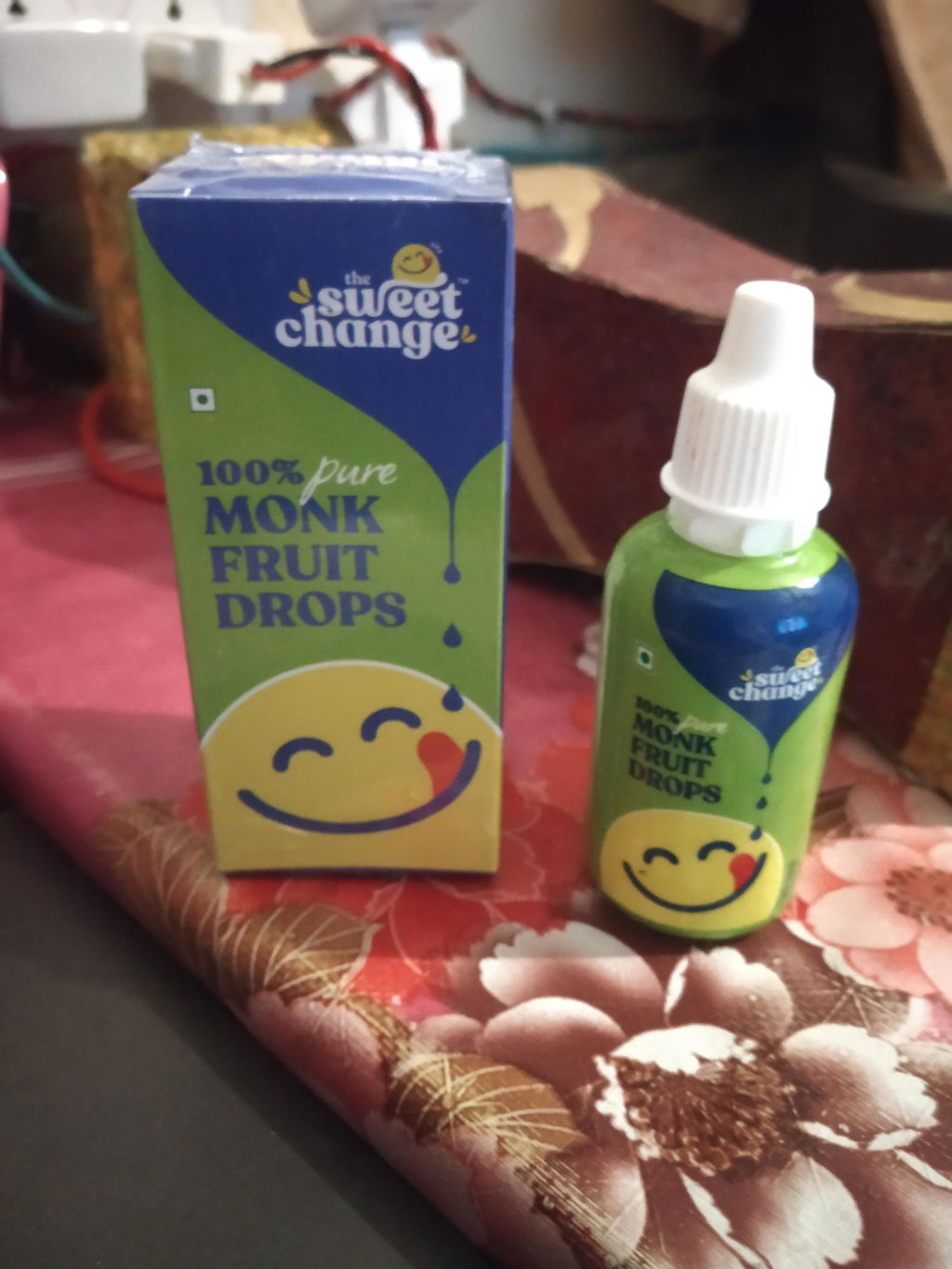
At The Sweet Change: our drops and powder contain no erythritol or other sugar alcohols. The powder is made with monk fruit, guar fibre and allulose, with no erythritol. We chose this in light of the 2023 and 2024 studies, which found links, not proof.
Gur, honey, dates and maple syrup: natural, but still sugar
These are the swaps that feel healthiest, and the ones a well-meaning relative is most likely to suggest. The numbers say they are still sugar.

Honey's glycemic index (GI) is 61, close to table sugar's 65, and raw dates come in at 42; a low GI is 55 or less [4]. Cane jaggery is about 84 g of sugars per 100 g [18].
The WHO counts the sugars in honey and syrups as free sugars, and advises keeping free sugars under 10% of daily energy, with 5% or less better still [19]. ICMR-NIN advises adults to keep sugar under 5% of their daily energy [20].
In our survey of our own buyers, 16% said they had been sweetening with jaggery or honey before they switched.
So swapping sugar for gur in your chai changes the taste and keeps the sugar. None of these is a sugar substitute in the real sense: count gur, honey, dates and maple syrup as sugar, and keep them for the occasional ladoo rather than every cup.
Our verdict: the best sugar substitute for PCOS in chai
If you want one answer for the best sweetener for PCOS and a daily cup, ours is a monk fruit sweetener made without sugar alcohols. This is our view, judged on what goes into your cup, not a claim about PCOS.
We picked it on five points from the sections above: it adds no sugar, it adds almost no calories, it carries no sugar alcohols, it tastes clean in chai, and it stays stable under heat for cooking.
After monk fruit, in order:
- Stevia: the other plant-based option people search for as a natural sweetener for PCOS; good if the aftertaste does not bother you.
- Allulose: better in baking than in chai, and counted as carbohydrate on Indian labels.
- Sucralose, aspartame and saccharin: they work, but they are artificial.
- Erythritol and other sugar alcohols: the laxative catch, plus the open erythritol question.
- Gur, honey and dates: sugar in another form.
How we compared: Confidence is how sure we are of the pick for daily chai and cooking; it is our view, not a grade of the research, and we found no sweetener trial in women with PCOS.
| Option | What it adds to your cup | Our view for daily chai | Confidence |
|---|---|---|---|
| Monk fruit, no sugar alcohols | No sugar, almost no calories | Our pick | High confidence |
| Stevia | No sugar, no calories | Good if the aftertaste suits you | Moderate confidence |
| Allulose | Counted as carbohydrate on Indian labels | Better for baking | Moderate confidence |
| Sucralose, aspartame, saccharin | No sugar | Artificial | Low confidence |
| Erythritol and other sugar alcohols | 0 to 2 kcal per gram on Indian labels | Gut catch, erythritol question | Low confidence |
| Gur, honey, dates | Sugar | Still sugar | No label |
Making the swap in chai and coffee
It is 4 pm and the office chai round has arrived, two spoons in every cup. That is where the swap earns its place. In our survey of our own buyers, 66% said their sweetener goes into coffee and 64% into chai.
The goal fits in one line: sugar kam karni hai, par chai ka taste nahi chhodna. These four habits get you there without missing the sugar dabba.
- Cut the spoons first: if you take two spoons, take one for a week, then make the swap.
- Add a little at a time: drops and stevia are many times sweeter than sugar, so add a drop or a pinch, stir and taste before adding more.
- Sweeten after the boil: add the sweetener once the chai is off the flame, so you can taste it as you go.
- Change one cup first: swap the cup you drink most often for a week before you touch the rest.
Coffee is the easier place to start, because there is no boiling and stirring in a pan. Give your taste a week and the new cup starts to taste normal.
Mithai, kheer and baking without the sugar dabba
Festive kheer and Sunday halwa are where most of us give up on a swap. Heat is the first test, and the sections above show which sweeteners pass it: leave aspartame out of the pan.

Bulk is the second test. Drops add sweetness without adding volume, so a ladoo or cake recipe built on a katori of sugar needs a powder, and the texture will still change a little. In our survey of our own buyers, 14% said they use their sweetener in Indian sweets.
The sweetener is only one part of the plate. The flour, ghee and portion still count, and our PCOD diet chart covers the rest of the day's food.
Start with kheer: milk and rice forgive a lot, which makes it the easiest dish to test a new sweetener in.
Reading a sweetener label in India
The front of a pack sells; the back tells you what is inside. Ingredients on Indian labels are listed in descending order by weight, so the first ingredient is the one there is most of [16].
A "monk fruit" or "stevia" powder that measures spoon for spoon like sugar is mostly a bulking ingredient, so check what that ingredient is. Look for the polyol laxative line and the aspartame warning from the sections above.
Front-of-pack words such as "zero GI" or "hormone-friendly" are marketing, not a reason to buy. Drops suit chai and coffee, and powders suit cooking and baking; ours come as drops and powder, with sachets coming.
Whatever you choose, the best sugar substitute for PCOS is the one that takes the spoon of sugar out of a cup you drink every day. For every type in more depth, read our full guide to sweeteners.
Cheat sheet: PCOS and sweeteners in five lines
- Cut first, then swap: fewer spoons of added sugar is the change that counts.
- No PCOS trial: we found no trial of any sweetener in women with PCOS, so judge each one by what it adds to the cup.
- Our pick: the best sugar substitute for PCOS in daily chai and cooking, in our view, is a monk fruit sweetener made without sugar alcohols.
- Read the back: the first ingredient is the main one; watch for erythritol and other sugar alcohols.
- Natural is not sugar-free: gur, honey, dates and maple syrup are still sugar.
Questions people ask
What is the best sugar substitute for PCOS?
No sweetener treats PCOS, and we found no trial of one in women with PCOS. For daily chai, our pick is a monk fruit sweetener made without sugar alcohols, because it adds no sugar, and stevia works well if its aftertaste does not bother you. Gur, honey and dates are still sugar, so they do not count as a swap.
Is sweetener bad for PCOS?
We found no trial showing that a sweetener is bad, or good, for women with PCOS. The WHO's 2023 guideline advises against sweeteners for weight control, as a conditional recommendation, which is a different question from using one in place of sugar in chai. Read the label, and talk to your doctor if you take medicine.
Is allulose bad for PCOS?
We found no study of allulose in women with PCOS. It is a rare sugar that the US FDA lets American labels count at a low calorie value and leave out of the sugars line, while Indian labels count it as carbohydrate. It fills a spoon the way sugar does, so it is most useful in baking.
Is stevia good for PCOS?
Stevia adds no sugar and no calories, so it can replace the sugar in your chai. We found no trial of stevia in women with PCOS; the PCOS studies we found were in rats or cells. Some people notice a bitter aftertaste, which taste research has traced to two bitter-taste receptors, so try a single cup first.
Is monk fruit good for PCOS?
Monk fruit adds no sugar to your cup, and a 2017 trial in 30 healthy men found that a monk fruit drink caused no glucose or insulin spike, unlike a sugar drink. It has not yet been studied in women with PCOS, and it has fewer long-term human studies than older sweeteners. Check the label for erythritol.
Are artificial sweeteners okay if you have PCOS?
The US FDA has approved sucralose, aspartame and saccharin as food additives, and we found no trial of them in women with PCOS. A 2022 trial in healthy adults saw saccharin and sucralose worsen blood sugar responses in some people. Worries about reproductive health rest mostly on animal studies, so far.
Guide: shopping for a sweetener with PCOS
Guide: sweeteners around menopause
 Monk Fruit Drops (100 servings)
Rs. 497.00
Monk Fruit Drops (300 servings)
Rs. 1,197.00
 Monk Fruit Powder No Erythritol (100 servings)
Rs. 675.00
Monk Fruit Powder No Erythritol (300 servings)
Rs. 1,493.00
Related articles


Written by
Sheen Hitaishi · Chief Brand Officer and Co-Founder
4 years in content writing · Sri Venkateswara College, University of Delhi
Sheen Hitaishi is Chief Brand Officer and Co-Founder of The Sweet Change, which she started with her sister, Manvi Agnihotri. She runs our social media, customer retention and customer care. Before The Sweet Change she spent four years as a content writer, most recently Senior Content Writer at Univest. She studied at Sri Venkateswara College, University of Delhi.
Disclosure: Co-founder of The Sweet Change

Reviewed by
Jatin Agnihotri · COO and Co-Founder
MBA, Indian School of Business · 12 years in technology and security
Jatin Agnihotri is COO and Co-Founder of The Sweet Change, where he runs operations, from manufacturers and vendors to shipping and logistics, and creates content for our Instagram. He spent 12 years in technology at Honda Cars India, Extramarks Education, where he was Vice President IT, and Jio Platforms. He holds an MBA from ISB.
Disclosure: Co-founder of The Sweet Change

Medically reviewed by
Manvi Agnihotri · CEO and Co-Founder
12 years in clinical nutrition, over 11,000 patients · M.Sc Food and Nutrition, silver medallist
Manvi Agnihotri is CEO and Co-Founder of The Sweet Change. She holds an M.Sc in Food and Nutrition, in which she was a silver medallist, and has led brand strategy and patient and doctor education at Breathe Well-being, a diabetes care programme. She reviews our health and nutrition pages before they go live.
Reviews: Nutrition and food science, Blood sugar and diabetes diet
Disclosure: Co-founder of The Sweet Change
Sources
- Tey SL, Salleh NB, Henry J, Forde CG. 2017. Effects of aspartame-, monk fruit-, stevia- and sucrose-sweetened beverages on postprandial glucose, insulin and energy intake. International Journal of Obesity 41(3):450-457. https://doi.org/10.1038/ijo.2016.225
- US Department of Health and Human Services, Office on Women's Health. Polycystic ovary syndrome (accessed 10 October 2026). https://womenshealth.gov/a-z-topics/polycystic-ovary-syndrome
- Teede HJ, Tay CT, Laven JJE, et al. 2023. Recommendations from the 2023 International Evidence-based Guideline for the Assessment and Management of Polycystic Ovary Syndrome. Journal of Clinical Endocrinology & Metabolism 108(10):2447-2469. doi:10.1210/clinem/dgad463. https://pmc.ncbi.nlm.nih.gov/articles/PMC10505534/
- Atkinson FS, Foster-Powell K, Brand-Miller JC. 2008. International tables of glycemic index and glycemic load values: 2008. Diabetes Care 31(12):2281-2283. https://doi.org/10.2337/dc08-1239
- Witkowski M, Nemet I, Alamri H, et al. 2023. The artificial sweetener erythritol and cardiovascular event risk. Nature Medicine 29(3):710-718. https://doi.org/10.1038/s41591-023-02223-9
- US Food and Drug Administration. 2025. Aspartame and Other Sweeteners in Food (content current as of 27 February 2025). FDA, Silver Spring. https://www.fda.gov/food/food-additives-petitions/aspartame-and-other-sweeteners-food
- World Health Organization. Polycystic ovary syndrome (fact sheet; accessed 29 October 2026). WHO, Geneva. https://www.who.int/news-room/fact-sheets/detail/polycystic-ovary-syndrome
- Ganie MA, Chowdhury S, Malhotra N, et al. 2024. Prevalence, phenotypes, and comorbidities of polycystic ovary syndrome among Indian women. JAMA Network Open 7(10):e2440583. https://doi.org/10.1001/jamanetworkopen.2024.40583
- Rezvani Kakhki B, Sahebi S, Sahebi S. 2026. Effect of high intensity sweeteners on the reproductive system: from the onset of puberty to menstrual health: a comprehensive review of human and animal evidence. International Journal of Women's Health 18:621813. https://doi.org/10.2147/ijwh.s621813
- World Health Organization. 2023. WHO advises not to use non-sugar sweeteners for weight control in newly released guideline (departmental update, 15 May 2023). WHO, Geneva. https://www.who.int/news/item/15-05-2023-who-advises-not-to-use-non-sugar-sweeteners-for-weight-control-in-newly-released-guideline
- MedlinePlus Medical Encyclopedia, US National Library of Medicine. 2025. Sweeteners - sugar substitutes (reviewed 3 July 2025). https://medlineplus.gov/ency/article/007492.htm
- US Food and Drug Administration. 2010 to 2018. GRAS Notice Inventory: Siraitia grosvenorii (monk fruit) notices GRN 301, 359, 522, 556, 627, 706 and 784. https://www.hfpappexternal.fda.gov/scripts/fdcc/index.cfm?set=GRASNotices&sort=GRN_No&order=DESC&startrow=1&type=basic&search=Siraitia
- Hellfritsch C, Brockhoff A, Stähler F, Meyerhof W, Hofmann T. 2012. Human psychometric and taste receptor responses to steviol glycosides. Journal of Agricultural and Food Chemistry 60(27):6782-6793. https://doi.org/10.1021/jf301297n
- Suez J, Cohen Y, Valdés-Mas R, et al. 2022. Personalized microbiome-driven effects of non-nutritive sweeteners on human glucose tolerance. Cell 185(18):3307-3328. https://doi.org/10.1016/j.cell.2022.07.016
- US Food and Drug Administration. 2020. The Declaration of Allulose and Calories from Allulose on Nutrition and Supplement Facts Labels: Guidance for Industry; with GRAS Notice No. 693, D-psicose (closed 28 August 2017, https://www.hfpappexternal.fda.gov/scripts/fdcc/index.cfm?set=GRASNotices&id=693). https://www.fda.gov/media/123342/download
- Food Safety and Standards Authority of India. 2020. Food Safety and Standards (Labelling and Display) Regulations, 2020, regulations 5(2)(b) and 5(3)(e)(i) (compendium version IV, 23 September 2022). FSSAI, New Delhi. https://www.fssai.gov.in/upload/uploadfiles/files/Compendium_Labelling_Display_23_09_2022.pdf
- Witkowski M, Wilcox J, Province V, et al. 2024. Ingestion of the non-nutritive sweetener erythritol, but not glucose, enhances platelet reactivity and thrombosis potential in healthy volunteers. Arteriosclerosis, Thrombosis, and Vascular Biology 44(9):2136-2141. https://doi.org/10.1161/ATVBAHA.124.321019
- Longvah T, Ananthan R, Bhaskarachary K, Venkaiah K. 2017. Indian Food Composition Tables 2017 (food I001, jaggery, cane). ICMR-National Institute of Nutrition, Hyderabad. https://www.nin.res.in/ebooks/IFCT2017.pdf
- World Health Organization. 2026. Healthy diet (fact sheet). WHO, Geneva. https://www.who.int/news-room/fact-sheets/detail/healthy-diet
- ICMR-National Institute of Nutrition. 2024. Dietary Guidelines for Indians (English booklet). ICMR-NIN, Hyderabad. https://www.nin.res.in/downloads/DGI_Booklet_English_CMYK.pdf
The Sweet Change makes the products mentioned on this page. How we write and review