Sweetener for menopause: which to pick, and what it will not do
 Written byKapil GroverrChief Business Officer and Co-Founder, The Sweet Change
 Reviewed byJatin AgnihotriCOO and Co-Founder, The Sweet Change
 Medically reviewed byManvi AgnihotriCEO and Co-Founder, The Sweet Change


No sweetener eases hot flushes, poor sleep or mood changes. What a sweetener for menopause can do is take the place of the sugar in your chai and mithai, at an age when weight and heart risk start to shift. Cut the spoons first, and for the sweetness you keep, our pick is monk fruit made without sugar alcohols.
Discuss with your doctor or dietitian before changing your diet, especially if you take diabetes medicines.
On this page
- Sweetener for menopause: what it can and cannot do
- What changes in midlife, and why sugar matters more now
- Does sugar make hot flashes worse?
- How much sugar is too much after 40?
- Sugar substitute for menopause: the types, one by one
- Gur, honey and dates: natural, but still sugar
- Which sweetener should you pick? Our verdict
- Making the switch in chai, kheer and laddoo
- Reading the label after 45
- Sources
- A swap, nothing more: hot flushes, night sweats, poor sleep and mood changes come with menopause [1]; no sweetener eases them, and its one job is to stand in for sugar.
- Earlier in India: the mean age at menopause here is about 46, and weight and heart risk start to change around then [2][3].
- One study, a link: women whose diets were high in fat and sugar reported more hot flushes, an association, not proof [4].
- The chai sum: three cups with two teaspoons each use up about a day's sugar allowance under Indian advice [5][2][6].
- Our pick: for daily chai, a monk fruit sweetener made without sugar alcohols.
If you have diabetes, heart disease or take medicines, talk to your doctor or a dietitian before changing your diet. For hot flushes, sleep or mood, ask your doctor about treatment.
Sweetener for menopause: what it can and cannot do
Somewhere in your mid-forties, a doctor or a cousin says it: "ab sugar kam karo." You nod. Then the 4 pm chai arrives, and it still has to taste like chai.
Before picking anything, it helps to know what is changing. Most women reach menopause between 45 and 55, and it is counted once 12 months have passed without a period [1]. The transition around it can last several years, with hot flushes, night sweats, poor sleep and mood changes along the way [1].
In India it tends to come sooner. Population data put the national mean age at menopause at about 46, four to five years earlier than in Caucasian women (mean about 51) [2].
So, the honest line. No sweetener cools a hot flush or settles your sleep. Its only job is to stand in for the sugar you would otherwise stir in, and that job is still worth doing well.
Our guide to every type of sweetener covers the whole shelf. This page asks a narrower question: which sweetener for menopause fits an Indian kitchen, and why.
Guide: the menopause years explained, stage by stage.
What changes in midlife, and why sugar matters more now
You may notice it first in the waistband. The same kurta sits differently, and the yearly check-up comes back with a number your doctor wants to watch.
During the transition, women tend to gain weight, about 0.7 kg a year, and fat moves towards the belly; age is still the bigger driver [2]. Indian guidance asks women to start paying attention at 35, with checks from 40, because menopause comes early here [2].
Heart risk climbs after menopause, and studies that followed women through the transition record less favourable changes in cholesterol and body make-up [3]. The edge women have over men against heart disease fades as oestrogen falls, and bone density drops at the same time [1].
A sweetener will not change any of that. What it can change is how much extra sugar lands on top of a body that is already shifting, and the two spoons that did not matter at 30 are worth counting now.
That is where sweeteners for menopause earn a place: they keep the chai you love while the sugar dabba stays shut. For the wider picture of hormones across a woman's life, read our guide to PCOS, menopause and women's hormones.
Guide: sweeteners for PCOS, the sister page to this one.
Does sugar make hot flashes worse?
It is 3 am, the fan is on full and you are awake again. The next day you read posts blaming sugar, coffee and even sweeteners.
The evidence is thinner than those posts suggest. In one Australian study that followed about 6,000 women for nine years, those whose diets were high in fat and sugar reported more hot flushes and night sweats, while women who ate more fruit or a Mediterranean-style diet reported fewer [4].
That is an association from one diet questionnaire taken at the start, not proof that sugar causes hot flushes. The high-sugar pattern was also high in fat, so sugar cannot be singled out [4].
You may also read that artificial sweeteners set off hot flushes. When we searched the research, we found no trial that tested any sweetener on hot flushes, so that idea rests on personal experience rather than studies.
Your own experience still counts. A simple food and symptom diary for a few weeks, noting what you ate and when a flush came, will tell you more about your body than any post can.
In short: the whole plate matters more than one spoon, and no sweetener for menopause changes that.
Guide: sugar cravings in midlife and what to do about them.
How much sugar is too much after 40?
Your chai does not feel like dessert. That is where the sugar hides.
ICMR-NIN advises adults to keep sugar under 5% of the day's energy [5]. The global benchmark for free sugars is under 10% of daily energy, with under 5% better still [7].
One teaspoon of sugar, honey or jaggery weighs about 4 g, and Indian sweets such as laddoo and gulab jamun often carry 8 to 12 teaspoons [2].

Our own arithmetic: take an 1,800 kcal day as an example. Five per cent of that is 90 kcal, and at 4 kcal per gram of carbohydrate that comes to about 22 g of sugar, or 5 to 6 teaspoons [6].
So three cups of chai with two teaspoons each, 24 g in all, already use the whole day's allowance before a single piece of mithai.
Chai is also where our own buyers make the change. In our survey of our own buyers, 64% said they use our sweetener in chai [8].
The first sugar replacement for menopause worth making is not in the mithai box. It is in the cup you drink three times a day.
Sugar substitute for menopause: the types, one by one
A sugar substitute for menopause has one test to pass: it has to keep your chai sweet without putting the sugar back. Each type below gets that test, starting with our pick.
A non-sugar sweetener is an ingredient that tastes sweet but adds little or no sugar and few or no calories to a food or drink.
One position first. The WHO advises against relying on non-sugar sweeteners to control body weight or to lower the risk of noncommunicable diseases. The advice is conditional, applies to everyone except people who already have diabetes, covers synthetic and naturally occurring sweeteners such as stevia, and leaves out low-calorie sugars and sugar alcohols [9].
So a sweetener is a swap for sugar you already eat, not a weight plan. Sweeteners for weight loss goes through what that advice means if weight is your main worry.
Monk fruit: our first choice for daily chai
Monk fruit (Siraitia grosvenorii, luo han guo) gives a non-nutritive sweetener, and it is heat-stable, so it works in boiling chai and in cooking [10]. Its extract is 100 to 250 times sweeter than sugar, depending on how much mogroside it holds [11].

In the US, the FDA has not questioned the GRAS notices for monk fruit extract, and it has set no acceptable daily intake, noting that one may not be needed [11][12].
In a trial of 30 healthy men, the monk fruit drink caused no spike in blood sugar (glucose) or insulin, unlike the sugar drink, which spiked both within the first hour [13].
Its honest limit is a shorter record. There are fewer long-term human studies than for older sweeteners, and we found no study of monk fruit, or of any other sweetener here, in women going through menopause.
What to check is the ingredient list: look for erythritol or other sugar alcohols before you buy. Our page on is monk fruit safe goes through the research in detail.
Stevia: a close second, if the taste suits you
As a zero calorie sweetener for menopause, stevia does the basic job well: it provides zero calories [10], and its purified extracts are 200 to 400 times sweeter than sugar [11].
The catch is taste. Some people notice a bitter aftertaste, and lab work traced it to two human bitter-taste receptors [14].
Try it in a single cup before you buy a big pack. Our stevia explainer covers the leaf, the extract and the different forms on the shelf.
Allulose: better in baking than in chai
Allulose is a rare sugar, a monosaccharide found in small amounts in wheat and some dried fruits such as raisins and figs, and US labels count it at 0.4 kcal per gram [15].
India's label rules list no separate energy factor for allulose; their factor for carbohydrate is 4 kcal per gram [6]. So the calorie saving printed on an imported pack may not carry over to an Indian label.
Because it is a sugar itself, it brings the bulk a cake needs, which drops cannot. Here is what allulose is, in more depth.
Artificial sweeteners and menopause
Artificial sweeteners and menopause come up together mostly through online stories, so it helps to know what each one is and how it behaves in your kitchen.
Sucralose and aspartame are synthetic sweeteners. Sucralose is about 600 times sweeter than sugar and holds up to heat, while aspartame is about 200 times sweeter and loses its sweetness when heated [11].
Indian table-top packs with aspartame must say it is not recommended for people with phenylketonuria, children with seizure disorders, or pregnant or lactating women [6].
They work in a pinch, but they are artificial, and for a cup you drink every day we would rather start from a fruit. More on are artificial sweeteners safe.
Sugar alcohols: low calorie, with a gut catch
Sugar alcohols (polyols), erythritol among them, add bulk with fewer calories. Indian labels count most polyols at 2 kcal per gram and erythritol at 0, and table-top sweetener packs with polyols must warn that they may have a laxative effect [6].
Higher blood erythritol has been linked with more heart attacks, strokes and deaths over three years in people already under heart evaluation [16]. That is a link, not proof, and the US FDA said those observational studies did not establish a causal link [11].
That 2023 paper still sent many people back to reading labels, and with a sweetener that goes into your cup every day, it is fair to want to know what is in it.
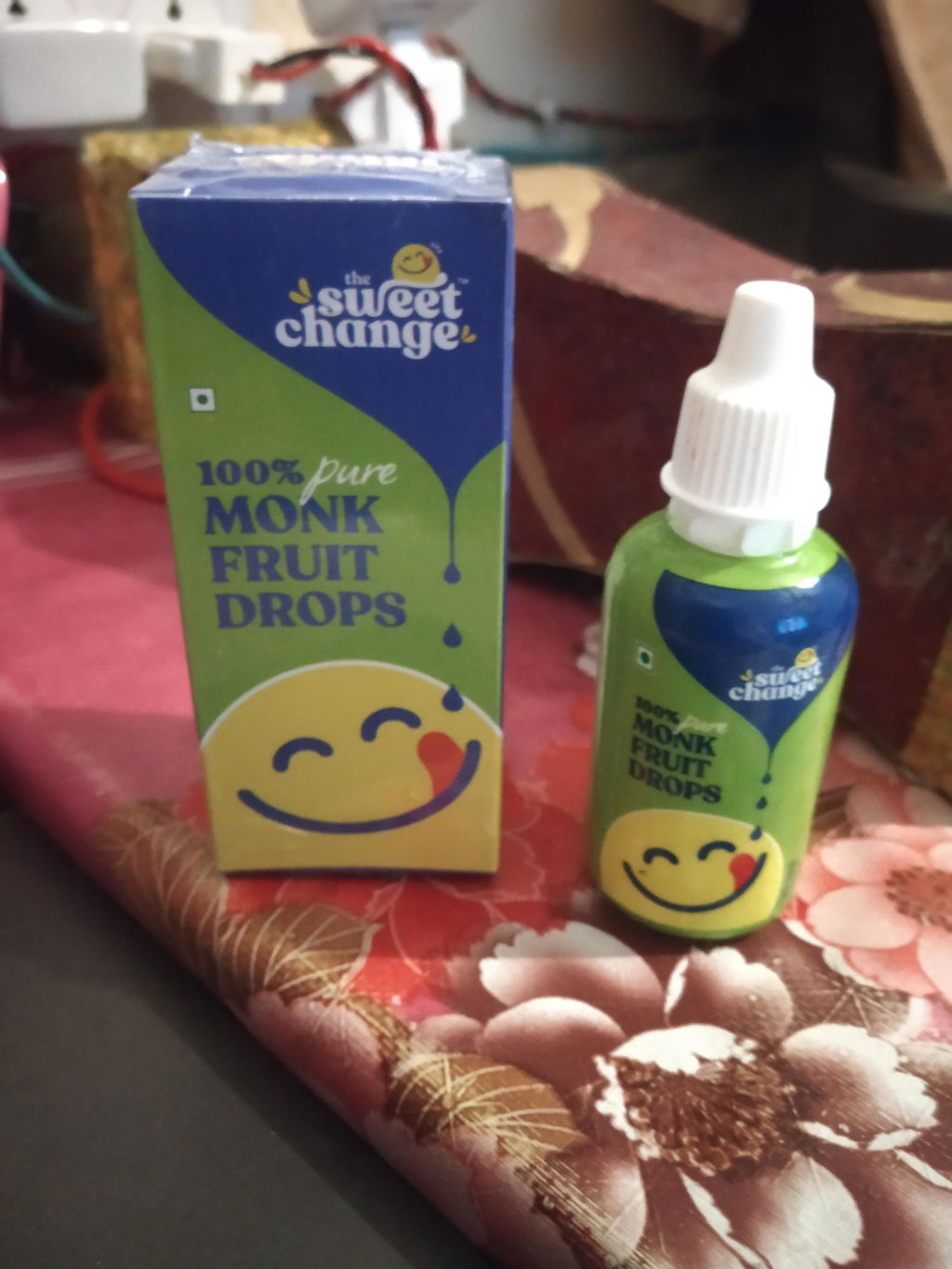
At The Sweet Change: our powder is made with monk fruit, guar fibre and allulose, with no erythritol, and our drops contain no erythritol or other sugar alcohols. We sell them as drops and powder, with sachets coming.
Gur, honey and dates: natural, but still sugar
If you have been told that a natural sweetener for menopause means gur or honey, the hard part is that they are sugar with a better story.
Free sugars cover the sugar a cook adds plus the sugars in honey and syrups [7], and jaggery counts too [2].
Cane jaggery carries about 354 kcal and 84 g of sugars per 100 g [17]. Honey's glycaemic index (GI) is 61 and table sugar's is 65, both in the medium band, while glucose sits at 103 [18].

Whole dates are a fruit, so free-sugar definitions leave them out [2], and raw dates have a lower GI of 42 [18]. Pressed into a laddoo, though, they still bring their sugar with them.
So "natural" on a jar of honey is not the same as less sugar. Our page on jaggery vs sugar sets the two side by side.
Guide: what to eat in the years around menopause.
Which sweetener should you pick? Our verdict
The best sweetener for menopause, in our view, is a monk fruit sweetener made without sugar alcohols, for daily chai, coffee and kheer.
We judged each option on five things that matter in an Indian kitchen:
- Adds no sugar: the spoon of sugar leaves the cup.
- Few or no calories: the swap does not bring the calories back.
- No sugar alcohols: no polyol gut catch and no erythritol question.
- Clean taste in chai: no bitter finish in milky tea.
- Heat-stable: it survives boiling chai and cooking.
In our view, monk fruit made without sugar alcohols meets all five. Stevia comes next if the aftertaste does not bother you, and allulose suits baking, knowing Indian labels give it no lower calorie factor.
Artificial sweeteners work, but they are artificial. Gur and honey are sugar.
How we compared: we scored each sweetener for menopause out of 10 against the five criteria above, as our overall view for daily chai. Confidence is how sure we are of the pick for daily chai and cooking; it is our view, not a grade of the research.
| Option | Sugar and calories it adds | Our view for daily chai | Our score, confidence |
|---|---|---|---|
| Monk fruit, no sugar alcohols | No sugar, almost no calories [10] | Our pick | 9/10, High confidence |
| Stevia | No sugar, zero calories [10] | Good if the aftertaste suits you | 7/10, Moderate confidence |
| Allulose | 0.4 kcal/g on US labels; no lower factor on Indian labels [15][6] | Better for baking | 6/10, Moderate confidence |
| Sucralose, aspartame | Sucralose none or very few; aspartame has some calories, but far less is used than sugar [10][11] | Artificial | 4/10, Low confidence |
| Erythritol and other sugar alcohols | 0 to 2 kcal/g on Indian labels [6] | Gut catch | 4/10, Low confidence |
| Gur and honey | Sugar: gur has about 354 kcal per 100 g [17] | Still sugar | 2/10 |
Making the switch in chai, kheer and laddoo
A sugar alternative for menopause only helps if it ends up in the cup every day, so make the change easy on yourself.

- Halve first: for one week, take your usual chai with half the sugar. It makes the swap that follows a smaller step.
- Then swap, a little at a time: concentrated sweeteners such as monk fruit drops are far sweeter than sugar, so start with less than you think and add to taste.
- Kheer: stir the sweetener in after the milk has reduced, then taste before adding more.
- Laddoo and halwa: these need bulk as well as sweetness, so use a measured swap rather than guessing.
- Mithai at functions: take one piece and skip the second; a sweetener cannot help with sweets someone else made.
Guide: our sugar-to-sweetener converter, for laddoo and halwa amounts.
Give the new cup two weeks before you judge the taste.
Reading the label after 45
Whichever sweetener for menopause you choose, the back of the pack tells you more than the front. Ingredients are listed in descending order by weight or volume, so the first one named is what you are mostly buying [6].
When we checked monk fruit powders sold online in India on 13 October 2026, more than half contained erythritol [19]. In our survey of our own buyers, 49% said they chose us for no erythritol [8].
So turn the pack over. Look for monk fruit near the top of the list, and check for sugar alcohols, whose names usually end in "-itol", such as erythritol.
A short ingredient list is easier to check in the shop aisle.
Cheat sheet
Sweetener for menopause, in five lines:
- No symptom relief: no sweetener eases hot flushes, sleep or mood; its one job is to replace sugar.
- Count the chai: three cups with two teaspoons each use about a day's sugar allowance under Indian advice.
- Gur and honey are sugar: both count as free sugars, whatever the jar says.
- Read the label: the first ingredient is the one there is most of; check for erythritol.
- Our pick: monk fruit made without sugar alcohols, for daily chai, coffee and kheer.
Questions people ask
Is stevia good for menopause?
Stevia adds no sugar, and the US National Library of Medicine describes it as giving zero calories, so it can replace the sugar in chai, though it does not ease hot flushes, sleep or mood. Lab studies traced the bitter aftertaste some people notice to two bitter-taste receptors. For daily chai, our pick is monk fruit made without sugar alcohols.
Do artificial sweeteners trigger hot flushes?
We found no trial that tested artificial sweeteners, or any other sweetener, on hot flushes, so the idea comes from personal reports. If you suspect a trigger, keep a food and symptom diary for a few weeks and look for a pattern. If hot flushes disturb your days or nights, talk to your doctor about them.
Does sugar make hot flashes worse?
It is not proven. A long Australian study of midlife women found that those whose diets were high in fat and sugar reported more hot flushes and night sweats, but it shows a link, not a cause, and the diet was high in fat too. Keeping free sugar low is advised by the WHO and ICMR-NIN anyway.
Is monk fruit safe during menopause?
In the US, the FDA has not questioned the GRAS notices for monk fruit extract and has set no acceptable daily intake. We found no study of monk fruit in women going through menopause, and we found the same gap for every other sweetener. What to check is the label: choose one made without erythritol or other sugar alcohols.
Is jaggery better than sugar when you are going through menopause?
No: the WHO counts honey and syrups as free sugars, and the Indian Menopause Society counts jaggery too. India's food composition tables from ICMR-NIN show that most of cane jaggery's weight is sugar. Swapping one for the other changes the flavour of your chai far more than the amount of sugar in it.
Can a sugar substitute help me keep my weight steady after 45?
Only as a swap for sugar you already eat. The WHO advises against relying on non-sugar sweeteners to control body weight, and the Indian Menopause Society notes that midlife weight gain comes with both age and falling oestrogen, with age the bigger factor. A dietitian can help you plan meals; a sweetener keeps your chai sweet with less sugar.
 Monk Fruit Drops (100 servings)
Rs. 497.00
Monk Fruit Drops (300 servings)
Rs. 1,197.00
 Monk Fruit Powder No Erythritol (100 servings)
Rs. 675.00
Monk Fruit Powder No Erythritol (300 servings)
Rs. 1,493.00
Related articles


Written by
Kapil Groverr · Chief Business Officer and Co-Founder
IIM Lucknow alumnus · 18 years in marketing
Kapil Groverr is Co-Founder and Chief Business Officer of The Sweet Change, where he leads growth and marketing. He has 18 years in marketing, most recently as Vice President Marketing at Breathe Well-being and before that Head of Digital Marketing at King Koil. An IIM Lucknow alumnus, he writes our sweetener guides and comparisons.
Writes about: Sweetener guides and comparisons
Disclosure: Co-founder of The Sweet Change

Reviewed by
Jatin Agnihotri · COO and Co-Founder
MBA, Indian School of Business · 12 years in technology and security
Jatin Agnihotri is COO and Co-Founder of The Sweet Change, where he runs operations, from manufacturers and vendors to shipping and logistics, and creates content for our Instagram. He spent 12 years in technology at Honda Cars India, Extramarks Education, where he was Vice President IT, and Jio Platforms. He holds an MBA from ISB.
Disclosure: Co-founder of The Sweet Change

Medically reviewed by
Manvi Agnihotri · CEO and Co-Founder
12 years in clinical nutrition, over 11,000 patients · M.Sc Food and Nutrition, silver medallist
Manvi Agnihotri is CEO and Co-Founder of The Sweet Change. She holds an M.Sc in Food and Nutrition, in which she was a silver medallist, and has led brand strategy and patient and doctor education at Breathe Well-being, a diabetes care programme. She reviews our health and nutrition pages before they go live.
Reviews: Nutrition and food science, Blood sugar and diabetes diet
Disclosure: Co-founder of The Sweet Change
Sources
- World Health Organization. 2024. Menopause, fact sheet, 16 October 2024. WHO, Geneva. https://www.who.int/news-room/fact-sheets/detail/menopause
- Meeta M, Anuradha M, Ashraf AB, Aggarwal K, Digumarti L, Singh T. 2026. Clinical Practice Guidelines for Menopause: An Executive Summary and Recommendations: Indian Menopause Society 2026. Journal of Mid-life Health 17(Suppl 1):S12-S116. https://doi.org/10.4103/jmh.jmh_302_25
- El Khoudary SR, Aggarwal B, Beckie TM, et al. 2020. Menopause Transition and Cardiovascular Disease Risk: Implications for Timing of Early Prevention: A Scientific Statement From the American Heart Association. Circulation 142(25):e506-e532. https://doi.org/10.1161/CIR.0000000000000912
- Herber-Gast GC, Mishra GD. 2013. Fruit, Mediterranean-style, and high-fat and -sugar diets are associated with the risk of night sweats and hot flushes in midlife: results from a prospective cohort study. American Journal of Clinical Nutrition 97(5):1092-1099. https://doi.org/10.3945/ajcn.112.049965
- ICMR-National Institute of Nutrition. 2024. Dietary Guidelines for Indians (English booklet). ICMR-NIN, Hyderabad. https://www.nin.res.in/downloads/DGI_Booklet_English_CMYK.pdf
- Food Safety and Standards Authority of India. 2020. Food Safety and Standards (Labelling and Display) Regulations, 2020 (compendium Version IV, 23 September 2022), regulations 5(2)(b) and 5(3)(e)(i) and the table-top sweetener declarations. FSSAI, New Delhi. https://www.fssai.gov.in/upload/uploadfiles/files/Compendium_Labelling_Display_23_09_2022.pdf
- World Health Organization. 2026. Healthy diet, fact sheet. WHO, Geneva. https://www.who.int/news-room/fact-sheets/detail/healthy-diet
- The Sweet Change. 2026. Survey of our own buyers (whole-number percentages of buyers who answered). The Sweet Change, as quoted on our sweeteners guide. https://www.thesweetchange.com/blogs/sweeteners/sweeteners-detailed-guide
- World Health Organization. 2023. WHO advises not to use non-sugar sweeteners for weight control in newly released guideline. Departmental update, 15 May 2023. WHO, Geneva. https://www.who.int/news/item/15-05-2023-who-advises-not-to-use-non-sugar-sweeteners-for-weight-control-in-newly-released-guideline
- MedlinePlus Medical Encyclopedia, US National Library of Medicine. 2025. Sweeteners - sugar substitutes (reviewed 3 July 2025). https://medlineplus.gov/ency/article/007492.htm
- US Food and Drug Administration. 2025. Aspartame and Other Sweeteners in Food (content current as of 27 February 2025). FDA, Silver Spring. https://www.fda.gov/food/food-additives-petitions/aspartame-and-other-sweeteners-food
- US Food and Drug Administration. 2010 to 2018. GRAS Notice Inventory: Siraitia grosvenorii (monk fruit) notices GRN 301, 359, 522, 556, 627, 706 and 784. FDA, Silver Spring. https://www.hfpappexternal.fda.gov/scripts/fdcc/index.cfm?set=GRASNotices&sort=GRN_No&order=DESC&startrow=1&type=basic&search=Siraitia
- Tey SL, Salleh NB, Henry J, Forde CG. 2017. Effects of aspartame-, monk fruit-, stevia- and sucrose-sweetened beverages on postprandial glucose, insulin and energy intake. International Journal of Obesity 41(3):450-457. https://doi.org/10.1038/ijo.2016.225
- Hellfritsch C, Brockhoff A, Stähler F, Meyerhof W, Hofmann T. 2012. Human psychometric and taste receptor responses to steviol glycosides. Journal of Agricultural and Food Chemistry 60(27):6782-6793. https://doi.org/10.1021/jf301297n
- US Food and Drug Administration. 2020. The Declaration of Allulose and Calories from Allulose on Nutrition and Supplement Facts Labels: Guidance for Industry. FDA, Silver Spring. https://www.fda.gov/media/123342/download
- Witkowski M, Nemet I, Alamri H, et al. 2023. The artificial sweetener erythritol and cardiovascular event risk. Nature Medicine 29(3):710-718. https://doi.org/10.1038/s41591-023-02223-9
- Longvah T, Ananthan R, Bhaskarachary K, Venkaiah K. 2017. Indian Food Composition Tables 2017 (food I001, jaggery, cane). ICMR-National Institute of Nutrition, Hyderabad. https://www.nin.res.in/ebooks/IFCT2017.pdf
- Atkinson FS, Foster-Powell K, Brand-Miller JC. 2008. International Tables of Glycemic Index and Glycemic Load Values: 2008. Diabetes Care 31(12):2281-2283. https://doi.org/10.2337/dc08-1239
- The Sweet Change. 2026. Market label scan of monk fruit sweeteners sold online in India: 55 marketplace listings (40 powders, 10 drops, 5 sachets) plus 4 powders found only on brand websites (44 powders in all), checked 13 October 2026 (internal record; brand names not published).
The Sweet Change makes the products mentioned on this page. How we write and review