Artificial sweetener for diabetics: sucralose, aspartame, saccharin and our pick
 Written byKapil GroverrChief Business Officer and Co-Founder, The Sweet Change
 Reviewed byJatin AgnihotriCOO and Co-Founder, The Sweet Change
 Medically reviewed byManvi AgnihotriCEO and Co-Founder, The Sweet Change


An artificial sweetener for diabetics, such as sucralose, aspartame or saccharin, adds no sugar, on its own does not raise blood sugar the way a spoon of sugar does, and India's diabetes guidelines allow it in moderation. The catch: long-term evidence in people with diabetes is inconclusive, and one trial found sucralose and saccharin changed glucose tolerance in some healthy adults. Our pick for daily chai is a monk fruit sweetener made without sugar alcohols.
Key takeaways
- Few or no calories: sucralose, aspartame and saccharin add few or no calories and generally do not raise blood sugar [1].
- India's line: ICMR lists them as approved for use, to be used in moderation and best avoided in pregnancy [2].
- The WHO exception: the WHO's 2023 advice against sweeteners for weight control does not apply to people who already have diabetes [3].
- The honest middle: a 2020 review of 9 trials in 979 people with diabetes found the evidence on HbA1c and weight inconclusive and of very low certainty [4].
- Our pick: a monk fruit sweetener made without sugar alcohols; a monk fruit drink caused no glucose or insulin spike in a 2017 trial, and monk fruit keeps its sweetness in cooking [5] [6].
Discuss with your doctor or dietitian before changing your diet, especially if you take diabetes medicines.
On this page
- What an artificial sweetener does to blood sugar
- What India's guidelines say about artificial sweeteners
- Sucralose: the 13-week trial and the gut question
- Aspartame: the 18-week trial, PKU and the cancer headline
- Saccharin: the oldest artificial sweetener
- What the long-term research adds up to
- Best artificial sweetener for diabetics: our pick
- Using a sweetener in chai, kheer and baking
- The whole page in one table
- Sources
If you have diabetes or take medicines for it, talk to your doctor or dietitian before changing how you sweeten your food.
What an artificial sweetener does to blood sugar
The strip of tablets beside the kettle, the sachet from the restaurant table, the drops a cousin swears by. If you have type 2 diabetes, the question underneath all of them is the same one: whether this goes into your blood the way sugar does.
Start with what the thing is. An artificial sweetener is a sweetener made in a lab that is hundreds of times sweeter than sugar, so a pinch or a tablet does the work of a spoon. Aspartame is about 200 times sweeter than table sugar, sucralose about 600 times and saccharin 200 to 700 times [1].
Because so little is needed, they add few or no calories to what you eat and generally will not raise blood sugar [1].

There is a trial in exactly the people asking. In 1988, 10 people with type 2 diabetes and 12 without drank, on separate days, an unsweetened drink, one with 400 mg of aspartame and one with 135 mg of saccharin, about the amount in a litre of diet soft drink [7].
Over three hours blood glucose drifted slightly down on every drink, with no difference between them, and neither sweetener changed the insulin peak [7].
One caveat deserves its own line. In a small 2013 study of 17 insulin-sensitive people with obesity, sucralose taken ten minutes before a glucose drink gave a higher glucose peak and about 20% more insulin than water did [8]. What that does and does not mean is covered in our guide to sweeteners for diabetes.
In the kitchen this means the tablet in your chai is not the sugar problem. The biscuit beside it, the rice at lunch and the sugar already inside a packet of "diabetic" namkeen still are.
In short: the sweetener itself adds no sugar; everything you eat with it still counts.
What India's guidelines say about artificial sweeteners
Most of the pages that rank for this question are American. Your doctor in Pune or Patna reads something else, so here is the Indian guidance, with the WHO and the US guidance beside it.
The Indian Council of Medical Research (ICMR), in its 2018 guideline on type 2 diabetes, lists aspartame, acesulfame K, stevia, sucralose and saccharin as currently approved for use, says they should be used in moderation, and calls them best avoided in pregnancy [2].
That list is the sweeteners the guideline chose to name, not every one sold in India. Stevia is on it and has its own page here: stevia for diabetics.
The RSSDI-ESI recommendations of 2020, written by India's diabetes and endocrine societies, put it in one line: artificial sweeteners may be consumed in recommended amounts [9].
The American Diabetes Association's 2026 standards say much the same, with a time limit: non-nutritive sweeteners can replace sugar-sweetened products if consumed in moderation and for the short term, and water comes first [10].
Then there is the WHO line that gets misread. In 2023 the WHO advised against using non-sugar sweeteners to control body weight or reduce the risk of long-term disease, as a conditional recommendation, and stated that the advice applies to all people except individuals with pre-existing diabetes [3].
Read that exactly. It is advice about weight and long-term disease risk in people who do not have diabetes. It is not advice to people with diabetes, either way.
So none of these guidelines tells someone with diabetes to stop. The three written for diabetes say moderation or recommended amounts, which in a real kitchen means the tablet replaces the spoon; it does not earn you a second cup.
Sucralose: the 13-week trial and the gut question
"Is sucralose safe for diabetics" is the question people ask most often of the three on this page, and sucralose has a proper controlled trial in people with type 2 diabetes to answer it.
The basics first. Sucralose is about 600 times sweeter than sugar and heat stable, so it survives the kettle and the oven [1]. The US FDA set its acceptable daily intake at 5 mg per kg of body weight a day; the joint FAO/WHO expert committee on food additives (JECFA) allows 0 to 15 mg per kg [1] [11].
The 13-week trial in type 2 diabetes
In a trial published in 2003, 136 adults with type 2 diabetes were randomised to 667 mg of sucralose a day in capsules, about three times the estimated maximum anyone would get from food, or to a placebo, for 13 weeks. Of the 128 who finished, HbA1c, fasting glucose and fasting C-peptide did not differ between the two groups [12].
Capsules are not chai, and 13 weeks is one season, not a decade. Still, it is a controlled test in the right people, at a dose above anything a tablet strip delivers, and it found nothing moving.
The gut and glucose-response findings
Here is the open question. In a 2022 trial, 120 healthy adults took sachets of saccharin, sucralose, aspartame or stevia for two weeks at doses below the daily limit. Each sweetener changed the gut bacteria in its own way, and in some people saccharin and sucralose impaired glucose tolerance [13].
Two weeks, healthy adults, and effects that differed from person to person: that is a change worth knowing about, not proof of harm, and the trial was not in people with diabetes.
In short: the best-studied of the three in diabetes, with a gut question that is still open.
Aspartame: the 18-week trial, PKU and the cancer headline
People search "is aspartame safe for diabetics" for two different reasons: the blood sugar question and the cancer headline from 2023. Take them in that order.
The trial first. In 1985, 62 people with type 1 or type 2 diabetes completed an 18-week test: 29 took 2.7 g of aspartame a day in capsules with meals and 33 took a placebo. Fasting glucose, two-hour post-meal glucose and glycated haemoglobin did not change in either group [14].
It is an old trial and a capsule trial, but it is in the right people and it ran for four months.
Aspartame's kitchen problem is heat. It is not heat stable and loses its sweetness when heated, which is why it is rarely used in baked goods [1] [6]. A tablet dropped into a poured cup is one thing; kheer and halwa that simmer for half an hour are not its job.
Then the label line. People with phenylketonuria (PKU), a rare genetic disorder, should avoid or restrict aspartame [1]. In India, a table-top sweetener pack containing aspartame must carry the words "Not recommended for phenylketonurics; for children suffering from seizure disorders; pregnant or lactating women" in a box [15].
Now the headline. In July 2023 the WHO's cancer agency, IARC, classed aspartame as "possibly carcinogenic to humans" (Group 2B) on limited evidence, while JECFA, the committee that sets intake limits, kept its daily limit at 40 mg per kg of body weight [16].
With a can of diet soft drink holding 200 or 300 mg of aspartame, a 70 kg adult would need more than 9 to 14 cans a day to pass that limit, with no aspartame from any other food [16].
The US FDA disagrees with IARC's conclusion and sets the US limit higher, at 50 mg per kg [1]. For the whole cancer question in one place, read our guide to sweetener safety and the cancer question.
In short: no change in blood sugar in the trial, no use in cooking, and a pack line that matters if PKU runs in your family.
Saccharin: the oldest artificial sweetener
"Is saccharin safe for diabetics" is the question that comes with the oldest sweetener on the shelf, the one your grandparents may have used.
Saccharin was first used in 1879, is 200 to 700 times sweeter than sugar and contains no calories; the US limit is 15 mg per kg of body weight a day and JECFA's is 0 to 5 mg per kg [1] [11].
Its reputation problem dates from the early 1970s, when it was linked to bladder cancer in laboratory rats; later human studies showed the rat results did not apply to people, and in the US it stays approved for use [1].
For blood sugar, the 1988 drink test above included saccharin, and it behaved like the unsweetened drink. The gut findings disagree with each other. If gut trouble is your own question, read IBS: what it is and what helps.
The 2022 two-week trial above counted saccharin among the two that changed glucose tolerance in some people. A 2021 trial points the other way: healthy adults who took saccharin alone, in capsules at the maximum acceptable daily intake for two weeks, showed no change in gut bacteria and no change in glucose tolerance [17].
On an Indian table-top sweetener pack, saccharin carries its own line: "Not recommended for children" [15].
In short: old, calorie-free, a children's line on the pack, and gut findings that point both ways.
What the long-term research adds up to
Saccharin has been in use since 1879 and aspartame has been regulated in the US since 1974, so you would expect a clear answer about years of daily use in people with diabetes [1]. There is not one.
A 2020 review searched the trials up to May 2019 and found 9 randomised trials, 979 people with type 1 or type 2 diabetes, lasting 4 to 10 months [4].
It rated the evidence on HbA1c, body weight and side effects as inconclusive and of very low certainty, and among the trials it found, not one reported complications, quality of life or deaths [4].
A 2022 review went a step further and concluded that the role of artificial sweeteners in treating diabetes should be reconsidered, with long-term tracking of intake, blood glucose and weight [18].
So none of them is a treatment, and nobody serious says they are. They take sugar out of the cup, and nothing beyond that is proven.
Best artificial sweetener for diabetics: our pick
The best artificial sweetener for diabetics, if you are choosing among the three, is a tie between sucralose and saccharin on our criteria, with aspartame last. Our pick for daily chai is none of the three: a monk fruit sweetener made without sugar alcohols. Here is how we scored.
How we compared: five criteria, two points each: (a) sugar and calories per serving, (b) holds its sweetness in hot chai and cooking, (c) plant origin or made in a lab, (d) length of human research, (e) glucose-response and gut findings plus warning lines on Indian packs. Confidence is how sure we are of the pick for daily chai and cooking. It is our view, not a grade of the research.
| Sweetener | Score out of 10 | Confidence |
|---|---|---|
| Monk fruit, made without sugar alcohols | 9 | High confidence |
| Sucralose | 6 | Moderate confidence |
| Saccharin | 6 | Moderate confidence |
| Aspartame | 4 | Low confidence |
Why monk fruit. Monk fruit (Siraitia grosvenorii, luo han guo) is a fruit extract rather than a lab compound, and its sweetness comes from compounds called mogrosides [1].
In a 2017 trial, 30 healthy men drank a monk fruit sweetened drink and a 65 g sugar drink on different mornings; the sugar drink caused large spikes in glucose and insulin within the first hour, and the monk fruit drink did not [5].
In the US, the FDA has answered seven safety notices for monk fruit extract and juice concentrate, between 2010 and 2018, with "no questions" [19]. It holds its sweetness in cooking and baking [6]. For the research in full, read monk fruit for diabetics.
Its limit, stated plainly: monk fruit has fewer long-term human studies than older sweeteners such as sucralose and aspartame, whose trials in people with diabetes you read above, and the human trials we read were in people without diabetes. Side effects and allergies are on our page on whether monk fruit is safe.
Aspartame sits last mainly because it drops out of cooking. The 2022 gut findings above weigh on all three lab-made sweeteners: each changed gut bacteria, and saccharin and sucralose also changed glucose tolerance in some people.
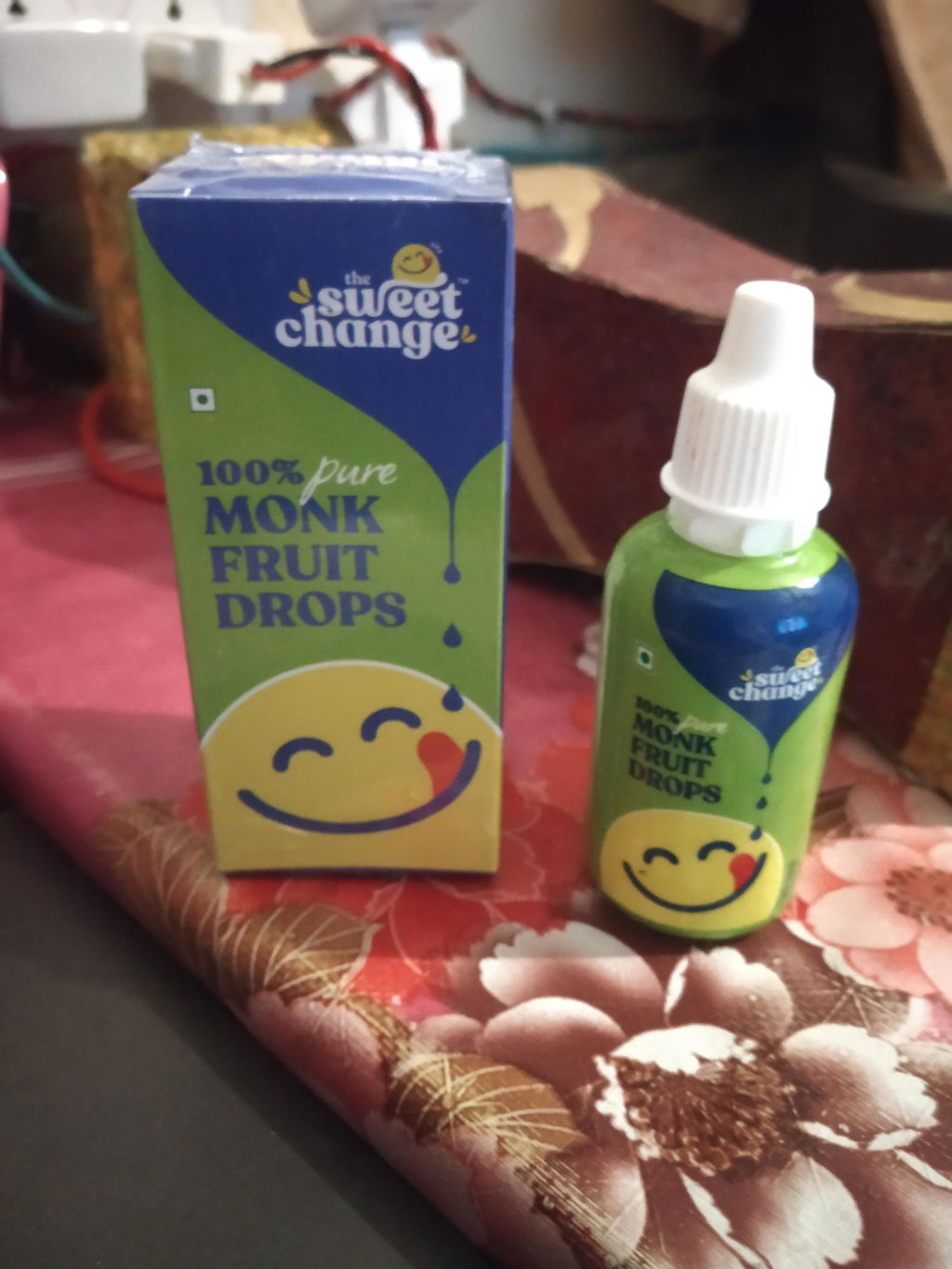
The monk fruit we mean is sold as drops and powder, with sachets coming.
Using a sweetener in chai, kheer and baking
The strip of sugar-free tablets beside the chai kettle is where most of this plays out. In our survey of our own buyers, 9% said they were sweetening with sugar-free tablets or sachets before, and 64% said their sweetener goes into chai.
Heat first, as the sections above show: aspartame drops out of cooking, while sucralose and monk fruit can go into kheer, halwa or a cake [1] [6].
Amount second. Because these are hundreds of times sweeter than sugar, start with less than you think and taste before you add the second tablet or the next drop. Chai with milk and nimbu paani without it carry sweetness differently, so test each drink on its own.
Timing third. Add the sweetener at the end of cooking, once the pot is off the heat, and taste before you add more.
Reading the label on an Indian pack
On an Indian pack, a food additive is declared with its functional class and either its specific name or its INS number [15]. The numbers to know are sucralose 955, aspartame 951 and saccharin 954 [11].
A table-top sweetener pack must also say "Contains" with the name of the sweetener, and carry the warning lines you read above for aspartame and saccharin, plus one for acesulfame K; sucralose sits in that table with only the "Contains" line, and the table does not name monk fruit at all [15].
Ingredients run in descending order by weight, so the first word on the back tells you what most of the sachet is [15]. A pinch of something hundreds of times sweeter than sugar cannot fill a sachet by itself, so that first word can be a bulking agent rather than the sweetener.
Whichever one you choose, the cup is the place to test it: one cup, one tablet or one drop, and a sip before anything else goes in.
The whole page in one table
| Sweetener | Sweetness and heat | Indian pack line | Our score |
|---|---|---|---|
| Monk fruit, no sugar alcohols | 100 to 250 times, heat stable [1] [6] | not named in the table-top sweetener table [15] | 9, High confidence |
| Sucralose | about 600 times, heat stable [1] | "Contains" line only [15] | 6, Moderate confidence |
| Saccharin | 200 to 700 times, no calories [1] | "Not recommended for children" [15] | 6, Moderate confidence |
| Aspartame | about 200 times, loses sweetness when heated [1] | PKU, seizure and pregnancy line [15] | 4, Low confidence |
Scores are ours, from the criteria in the "How we compared" box above.
Cheat sheet
- On its own, no spike: sucralose, aspartame and saccharin add no sugar to the cup; what you eat with them still counts.
- Moderation is the word the diabetes guidelines use: ICMR, RSSDI-ESI and the ADA all allow them in moderation; the WHO's weight advice is not about people with diabetes.
- Aspartame stays out of the pot: it loses its sweetness when heated; sucralose and monk fruit do not.
- Read the box on the back: aspartame and saccharin table-top packs carry warning lines in India; the INS numbers are 955, 951 and 954.
- Our pick for chai: a monk fruit sweetener made without sugar alcohols, drops or powder, with the research limit stated above.
If you are choosing an artificial sweetener for diabetics today, sucralose and aspartame each have a controlled trial of three to four months in people with diabetes, and none of the three has a long-term answer. Our pick sits outside the three. For every kind of sweetener side by side, read our guide to every type of sweetener.
Questions people ask
Which artificial sweetener is best for diabetics?
On our criteria, sucralose and saccharin tie and aspartame comes last, mainly because aspartame loses its sweetness when heated. The Indian Council of Medical Research lists aspartame, acesulfame K, stevia, sucralose and saccharin as approved for use in moderation. Our pick for daily chai is a monk fruit sweetener made without sugar alcohols.
What is the best artificial sweetener for prediabetes?
The same moderation applies. The American Diabetes Association's 2026 standards tell people with diabetes and those at risk that non-nutritive sweeteners can replace sugar-sweetened products in moderation and for the short term, with water first. The WHO's 2023 advice against sweeteners for weight control covers everyone without diabetes, so the rest of the plate matters most.
Can diabetics eat artificial sweeteners every day?
People type "can diabetic eat artificial sweeteners" and the diabetes guidelines we read answer moderation rather than never. The Indian Council of Medical Research says moderation and not in pregnancy, the RSSDI-ESI recommendations allow recommended amounts, and the American Diabetes Association adds "for the short term". A tablet in each cup is moderation; a tablet in everything is not.
Is sucralose safe for diabetics?
In a 13-week trial in people with type 2 diabetes, a daily dose of sucralose well above normal use did not change HbA1c or fasting glucose. A two-week trial in healthy adults found it changed gut bacteria and impaired glucose tolerance in some people, so the gut question is still open. Use it in moderation.
Does aspartame raise blood sugar?
Not in the trials we read. In an 18-week trial in people with type 1 or type 2 diabetes, fasting and post-meal glucose and glycated haemoglobin did not change on aspartame. The US FDA notes that people with phenylketonuria should avoid or restrict it, and Indian table-top sweetener packs carry that warning in a box.
Can I use artificial sweeteners in cooking?
Sucralose yes, aspartame no. The US FDA describes sucralose as heat stable and aspartame as losing its sweetness when heated, so aspartame tablets belong in a poured cup rather than in kheer or a cake. Monk fruit is heat stable too, according to the US National Library of Medicine's patient encyclopedia, and goes in at the end of cooking.
 Monk Fruit Drops (100 servings)
Rs. 497.00
Monk Fruit Drops (300 servings)
Rs. 1,197.00
 Monk Fruit Powder No Erythritol (100 servings)
Rs. 675.00
Monk Fruit Powder No Erythritol (300 servings)
Rs. 1,493.00
Related articles


Written by
Kapil Groverr · Chief Business Officer and Co-Founder
IIM Lucknow alumnus · 18 years in marketing
Kapil Groverr is Co-Founder and Chief Business Officer of The Sweet Change, where he leads growth and marketing. He has 18 years in marketing, most recently as Vice President Marketing at Breathe Well-being and before that Head of Digital Marketing at King Koil. An IIM Lucknow alumnus, he writes our sweetener guides and comparisons.
Writes about: Sweetener guides and comparisons
Disclosure: Co-founder of The Sweet Change

Reviewed by
Jatin Agnihotri · COO and Co-Founder
MBA, Indian School of Business · 12 years in technology and security
Jatin Agnihotri is COO and Co-Founder of The Sweet Change, where he runs operations, from manufacturers and vendors to shipping and logistics, and creates content for our Instagram. He spent 12 years in technology at Honda Cars India, Extramarks Education, where he was Vice President IT, and Jio Platforms. He holds an MBA from ISB.
Disclosure: Co-founder of The Sweet Change

Medically reviewed by
Manvi Agnihotri · CEO and Co-Founder
12 years in clinical nutrition, over 11,000 patients · M.Sc Food and Nutrition, silver medallist
Manvi Agnihotri is CEO and Co-Founder of The Sweet Change. She holds an M.Sc in Food and Nutrition, in which she was a silver medallist, and has led brand strategy and patient and doctor education at Breathe Well-being, a diabetes care programme. She reviews our health and nutrition pages before they go live.
Reviews: Nutrition and food science, Blood sugar and diabetes diet
Disclosure: Co-founder of The Sweet Change
Sources
- US Food and Drug Administration. 2025. Aspartame and Other Sweeteners in Food (content current as of 27 February 2025). FDA, Silver Spring. https://www.fda.gov/food/food-additives-petitions/aspartame-and-other-sweeteners-food
- Indian Council of Medical Research. 2018. ICMR Guidelines for Management of Type 2 Diabetes 2018, section 6.2 (v) Sweeteners. ICMR, New Delhi. https://www.icmr.gov.in/icmrobject/custom_data/pdf/resource-guidelines/ICMR_GuidelinesType2diabetes2018_0.pdf
- World Health Organization. 2023. WHO advises not to use non-sugar sweeteners for weight control in newly released guideline (departmental update, 15 May 2023). WHO, Geneva. https://www.who.int/news/item/15-05-2023-who-advises-not-to-use-non-sugar-sweeteners-for-weight-control-in-newly-released-guideline
- Lohner S, Kullenberg de Gaudry D, Toews I, Ferenci T, Meerpohl JJ. 2020. Non-nutritive sweeteners for diabetes mellitus. Cochrane Database of Systematic Reviews 5:CD012885. https://doi.org/10.1002/14651858.CD012885.pub2
- Tey SL, Salleh NB, Henry J, Forde CG. 2017. Effects of aspartame-, monk fruit-, stevia- and sucrose-sweetened beverages on postprandial glucose, insulin and energy intake. International Journal of Obesity 41(3):450-457. https://doi.org/10.1038/ijo.2016.225
- MedlinePlus Medical Encyclopedia, US National Library of Medicine. 2025. Sweeteners - sugar substitutes (reviewed 3 July 2025). https://medlineplus.gov/ency/article/007492.htm
- Horwitz DL, McLane M, Kobe P. 1988. Response to single dose of aspartame or saccharin by NIDDM patients. Diabetes Care 11(3):230-234. https://doi.org/10.2337/diacare.11.3.230
- Pepino MY, Tiemann CD, Patterson BW, Wice BM, Klein S. 2013. Sucralose affects glycemic and hormonal responses to an oral glucose load. Diabetes Care 36(9):2530-2535. https://doi.org/10.2337/dc12-2221
- Chawla R, Madhu SV, Makkar BM, et al. 2020. RSSDI-ESI Clinical Practice Recommendations for the Management of Type 2 Diabetes Mellitus 2020. Indian Journal of Endocrinology and Metabolism 24(1):1-122. https://doi.org/10.4103/ijem.IJEM_225_20
- American Diabetes Association Professional Practice Committee. 2026. 5. Facilitating Positive Health Behaviors and Well-being to Improve Health Outcomes: Standards of Care in Diabetes 2026. Diabetes Care 49(Suppl 1):S89-S131. https://pmc.ncbi.nlm.nih.gov/articles/PMC12690188/
- Joint FAO/WHO Expert Committee on Food Additives (JECFA). 2026. Evaluations of the JECFA: food additives database. World Health Organization, Geneva. https://apps.who.int/food-additives-contaminants-jecfa-database/
- Grotz VL, Henry RR, McGill JB, et al. 2003. Lack of effect of sucralose on glucose homeostasis in subjects with type 2 diabetes. Journal of the American Dietetic Association 103(12):1607-1612. https://doi.org/10.1016/j.jada.2003.09.021
- Suez J, Cohen Y, Valdés-Mas R, et al. 2022. Personalized microbiome-driven effects of non-nutritive sweeteners on human glucose tolerance. Cell 185(18):3307-3328. https://doi.org/10.1016/j.cell.2022.07.016
- Nehrling JK, Kobe P, McLane MP, Olson RE, Kamath S, Horwitz DL. 1985. Aspartame use by persons with diabetes. Diabetes Care 8(5):415-417. https://doi.org/10.2337/diacare.8.5.415
- Food Safety and Standards Authority of India. 2020. Food Safety and Standards (Labelling and Display) Regulations, 2020, regulations 5(2)(b) and 5(5) and Schedule II, item 1(3) (compendium Version IV, 23 September 2022). FSSAI, New Delhi. https://www.fssai.gov.in/upload/uploadfiles/files/Compendium_Labelling_Display_23_09_2022.pdf
- World Health Organization. 2023. Aspartame hazard and risk assessment results released (news release, 14 July 2023). WHO, Geneva. https://www.who.int/news/item/14-07-2023-aspartame-hazard-and-risk-assessment-results-released
- Serrano J, Smith KR, Crouch AL, et al. 2021. High-dose saccharin supplementation does not induce gut microbiota changes or glucose intolerance in healthy humans and mice. Microbiome 9:11. https://doi.org/10.1186/s40168-020-00976-w
- Iizuka K. 2022. Is the use of artificial sweeteners beneficial for patients with diabetes mellitus? The advantages and disadvantages of artificial sweeteners. Nutrients 14(21):4446. https://doi.org/10.3390/nu14214446
- US Food and Drug Administration. 2010 to 2018. GRAS Notice Inventory, notices for Siraitia grosvenorii (monk fruit) extract and juice concentrate: GRN 301, 359, 522, 556, 627, 706 and 784. FDA. https://www.hfpappexternal.fda.gov/scripts/fdcc/index.cfm?set=GRASNotices&sort=GRN_No&order=DESC&startrow=1&type=basic&search=Siraitia
The Sweet Change makes the products mentioned on this page. How we write and review