Monk fruit: what it is, where it grows and how it tastes
 Written byManvi AgnihotriCEO and Co-Founder, The Sweet Change


Monk fruit (Siraitia grosvenorii) is a small fruit from a climbing vine of the cucumber and melon family, native to southern China [1] [2]. Its sweetness comes from compounds called mogrosides, so its extract is 100 to 250 times sweeter than sugar and adds few or no calories [1]. People use it to sweeten chai, coffee and desserts without sugar, and since 2018 it has been grown in Himachal Pradesh too [3].
Key takeaways
- A vine, not a tree: the fruit grows on a perennial climbing vine of the gourd family [2].
- One compound does most of the work: a single mogroside is the main sweet component of the fruit [2].
- Very concentrated: the extract is 100 to 250 times sweeter than sugar, depending on its mogroside content [1].
- Now grown in India: CSIR-IHBT says it brought the first seeds into the country in March 2018 [3].
- Read the first ingredient: Indian labels list ingredients by weight, and more than half of the powders we checked contain erythritol [4] [5].
On this page
You have seen the word on a pack, a menu or a friend's kitchen counter, and the picture on the front shows a fruit you have never met at any sabzi mandi. So what is this thing, and why does a few drops of it sweeten a whole cup of chai?
This page is about the fruit itself: the plant, the places it grows, what makes it sweet and what you actually get when you buy it. It sits inside our guide to sweetener ingredients, where the other plant-derived sweeteners live too.
What is monk fruit?
Monk fruit (Siraitia grosvenorii) is a small fruit that grows on a climbing vine of the cucumber and melon family, native to southern China [1] [2]. In China it goes by the name luo han guo [2].
The sweetener sold under its name is not the fruit itself. It is an extract, taken from the fruit and concentrated, and it is that extract which is so many times sweeter than sugar [1].
If you search for it in Hindi, you will mostly find the English name written as मोंक फ्रूट, and now and then a word-for-word translation, भिक्षु फल.
So when a label says "monk fruit", it means a little of this extract. How little, and what fills the rest of the pack, is the question the rest of this page builds up to.
Where it comes from, and how it reached Himachal
Ask about monk fruit origin and you land in the hills of southern China. The province of Guangxi holds about 80% of China's growing area, and people there have used the fruit for more than 300 years as a herbal remedy for the throat [2].
That is history, not a modern health claim. It tells you the fruit is an old companion, not a laboratory invention.
How the vine reached India
For most of that history the crop stayed at home. As late as 2021, the scientists who first grew it here wrote that it was not cultivated commercially anywhere outside China [6].
CSIR-IHBT in Palampur says it brought the first seeds into India from China in March 2018, through ICAR-NBPGR, and now grows the plant under farm conditions [3]. The monk fruit plant likes hill country with a mean temperature of about 16 to 20 °C and humid air, which is why Himachal Pradesh suits it [3].
So far that is a research story, not yet a supply story for the sweeteners on Indian shelves.
The plant: a vine, not a tree
Search for a monk fruit tree and you will not find one. What people call a tree is a perennial climbing vine, a liana, in the same family as cucumber and melon [2]. "Tree" is a misnomer that has stuck.
Plants are male or female, and most fruits are globose or oblong, about 5 to 7 cm long, so each one sits comfortably in the palm of your hand [6]. Picture a loofah on a trellis, not an orchard.
Why is it so sweet?
The sweetness is not sugar. It comes from a group of compounds called mogrosides, and one of them, mogroside V, is the main sweet component of the fruit [2].
The fruit earns that sweetness late. The compound builds up slowly and then rises sharply between 70 and 80 days after pollination, so ripeness matters [6].
Depending on how much mogroside it carries, the extract is 100 to 250 times sweeter than sugar, so a tiny amount goes a long way [1]. In kitchen terms: where you would stir in a teaspoon of sugar, you need a couple of drops or a small pinch.
In short: the fruit is sweet because of mogrosides, and the extract is a concentrate of them.
What does it taste like?
Monk fruit taste is the question people ask once they have stopped asking what it is. The honest answer has two parts.
The extract on its own is intensely sweet. What you taste in a product, though, depends mostly on what the extract is mixed with, because most of a powder that measures like sugar is the bulking ingredient, not the fruit.
So two packs with the same fruit on the front can taste quite different in a cup of chai. In our survey of our own buyers, 31% said they chose us for no bitter aftertaste [7].
The practical test is simple: try a few drops in your usual chai before you commit to a big pack, and read the ingredient list before you blame the fruit.
Nutrition, calories and keto
The monk fruit nutrition panel is short, because the extract is a non-nutritive sweetener: it brings sweetness and not much else [8]. Sweeteners of this kind add few or no calories to the diet [1].
The keto question has the same answer for the extract, and what a blended powder adds depends on its bulking ingredient, so for a blend the label decides, not the fruit on the front.
On blood sugar, one human trial is worth stating plainly. In a 2017 trial in 30 healthy men, a drink sweetened with monk fruit did not cause the blood-sugar and insulin spike that a sugar-sweetened drink caused in the first hour [9].
The fuller picture for people watching their sugar is on our page about diabetes and this sweetener.
What it offers, and what the evidence still lacks
Three things make this fruit useful in a kitchen. It gives sweetness without sugar, and it is heat stable, so it can go into baking and cooking without losing that sweetness [8]. Its mogrosides also show antioxidant activity in laboratory and animal studies, which is interesting science, not a benefit you can count on from a cup of chai [2].
Here is the honest limit. Human studies on the extract are small and short: a 2025 systematic review found five randomised trials that met its criteria and called for longer ones [10]. Fewer long-term human studies than older sweeteners have is a gap in the research, not a finding against the fruit.
On safety, the US FDA has not questioned GRAS notices for the extract as a sweetener since 2010, and has not set an acceptable daily intake for it [1] [11]. The studies behind that position, and the questions people raise, are set out in what we know about monk fruit's side effects.
Using it in an Indian kitchen
Chai and coffee lead, by a long way. In our survey of our own buyers, 66% use it in coffee and 64% in chai [7]. Drops go straight into the cup; a powder is stirred in like sugar.
Because it is heat stable, it also works in kheer, halwa and baking, though a recipe written for sugar may need adjusting, because sugar also brings bulk and an extract does not.
Now the label. Indian packaged foods must list ingredients in descending order by weight, so the first ingredient is most of what is in the pack [4].
In our October 2026 check of sweeteners sold as monk fruit online in India, more than half the powders (23 of 40) contained erythritol, a sugar alcohol used as a bulking sweetener [5]. None of the 55 listings said what share of the product was the fruit [5].
That is the single most useful habit this page can give you: turn the pack over and read the first word in the ingredient list. It tells you more than the fruit on the front.
At The Sweet Change
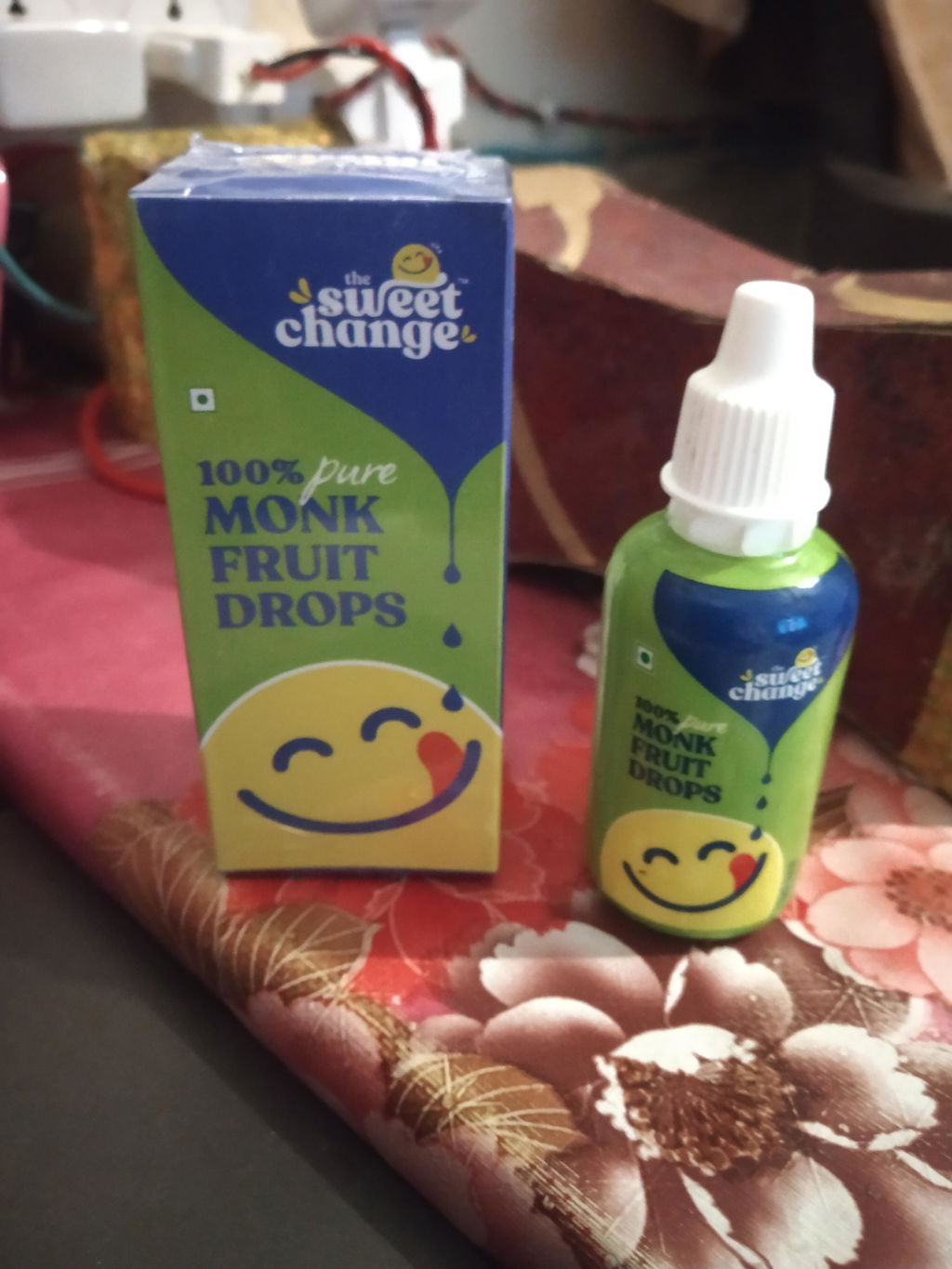
Ours comes as drops and powder, with sachets coming. The drops are made with the fruit's extract, water and vitamin C, and nothing else. Two drops replace a teaspoon of sugar.
The powder is made with monk fruit, guar fibre and allulose (30% / 35% / 35%), with no erythritol. It has no other sugar alcohols either, and the full label is on the product page.
How it compares with other sweeteners
Stevia is the other plant extract you will meet on the same shelf. Its sweetness comes from steviol glycosides, and it is 200 to 400 times sweeter than sugar [1]. Table sugar is the baseline both are measured against, and it brings 4 kcal in every gram [4].
Both extracts add few or no calories [1]. Both are so concentrated that a powder measuring spoon for spoon like sugar has to be mostly a bulking ingredient, and that is where two packs really differ.
So the comparison that matters is the one on the back of the pack. Our take on the jaggery question is on how it compares with jaggery.
| Sweetener | Source | Sweetness vs sugar | Calories | Note |
|---|---|---|---|---|
| Monk fruit (extract) | Fruit of a gourd vine | 100 to 250 times | Few or none | Our pick for daily chai, made without sugar alcohols |
| Stevia (extract) | Leaf | 200 to 400 times | Few or none | Sweetness from steviol glycosides |
| Table sugar | Cane or beet | 1 time | 4 kcal per gram | The baseline |
For a cup you make every day, our pick is a monk fruit sweetener made without sugar alcohols: the sweetness of the fruit, and nothing in the spoon you did not ask for.
Questions people ask
Monk fruit kya hota hai?
Monk fruit is a small, round fruit that grows on a climbing vine of the cucumber and melon family in southern China. The sweetener made from it is a concentrated extract of the fruit, many times sweeter than sugar, which is why a few drops or a small pinch can replace a teaspoon of sugar in your chai.
Monk fruit ko Hindi mein kya kahate hain?
Most Hindi pages simply write the English name in Devanagari, मोंक फ्रूट, and that is the spelling people search with; a few translate it word for word as भिक्षु फल. Botanists call it Siraitia grosvenorii and China has its own name for it, but in an Indian kitchen it is just monk fruit.
What is monk fruit sweetener?
It is the fruit's extract, rich in sweet compounds called mogrosides, sold as drops or blended into a powder. Most powders pair a little extract with a bulking ingredient so they measure like sugar. Under Indian labelling rules, ingredients are listed in descending order by weight, so the first ingredient tells you what most of the pack is.
Is there a monk fruit tree?
No. The plant is a perennial climbing vine, a liana in the gourd family, so the fruits hang from a trellis the way a loofah does. A 2024 review of the plant describes it this way, and the Indian scientists who grew it at Palampur describe separate male and female plants with fruits a few centimetres long.
Is monk fruit keto?
The US FDA describes sweeteners like monk fruit extract as adding few or no calories to the diet. Whether a particular product fits a keto plan depends on what it is blended with, so read the ingredient list and the nutrition panel rather than the fruit on the front.
The comparison above is our view as the makers of The Sweet Change drops and powder. This page is not medical advice; if you take medicine for diabetes or another condition, talk to your doctor before changing what you eat.
 Monk Fruit Drops (100 servings)
Rs. 497.00
Monk Fruit Drops (200 servings)
Rs. 971.00
Monk Fruit Drops (100 servings)
Rs. 497.00
Monk Fruit Drops (200 servings)
Rs. 971.00
 Monk Fruit Powder No Erythritol (100 servings)
Rs. 675.00
Monk Fruit Powder No Erythritol (300 servings)
Rs. 1,493.00
Monk Fruit Powder No Erythritol (100 servings)
Rs. 675.00
Monk Fruit Powder No Erythritol (300 servings)
Rs. 1,493.00
Related articles


Written by
Manvi Agnihotri · CEO and Co-Founder
12 years in clinical nutrition, over 11,000 patients · M.Sc Food and Nutrition, silver medallist
Manvi Agnihotri is CEO and Co-Founder of The Sweet Change. She holds an M.Sc in Food and Nutrition, in which she was a silver medallist, and has led brand strategy and patient and doctor education at Breathe Well-being, a diabetes care programme. She reviews our health and nutrition pages before they go live.
Reviews: Nutrition and food science, Blood sugar and diabetes diet
Disclosure: Co-founder of The Sweet Change
Sources
- US Food and Drug Administration. 2025. Aspartame and Other Sweeteners in Food. FDA, content current as of 27 February 2025. https://www.fda.gov/food/food-additives-petitions/aspartame-and-other-sweeteners-food
- Huang H, Peng Z, Zhan S, Li W, Liu D, Huang S, Zhu Y, Wang W. 2024. A comprehensive review of Siraitia grosvenorii (Swingle) C. Jeffrey: chemical composition, pharmacology, toxicology, status of resources development, and applications. Frontiers in Pharmacology 15:1388747. https://doi.org/10.3389/fphar.2024.1388747
- CSIR-NIScPR. 2021. First-ever Monk Fruit Cultivation in India by CSIR-IHBT. CSIR News, article 290, 12 July 2021. https://csirnews.niscpr.res.in/home/article/290
- Food Safety and Standards Authority of India. 2020. Food Safety and Standards (Labelling and Display) Regulations, 2020, regulations 5(2)(b) (ingredients in descending order of composition by weight) and 5(3)(e)(i) (energy conversion factors). Compendium, Version IV, 23 September 2022. FSSAI, New Delhi. https://www.fssai.gov.in/upload/uploadfiles/files/Compendium_Labelling_Display_23_09_2022.pdf
- The Sweet Change. 2026. Market label scan of sweeteners sold as monk fruit online in India, 13 October 2026 (55 listings; aggregate statements only, no brand names). The Sweet Change, internal research.
- Shivani, Thakur BK, Mallikarjun CP, Mahajan M, Kapoor P, Malhotra J, Dhiman R, Kumar D, Pal PK, Kumar S. 2021. Introduction, adaptation and characterization of monk fruit (Siraitia grosvenorii): a non-caloric new natural sweetener. Scientific Reports 11:6205. https://doi.org/10.1038/s41598-021-85689-2
- The Sweet Change. 2026. Survey of our own buyers (whole-number percentages of the buyers who answered). The Sweet Change, internal research.
- MedlinePlus Medical Encyclopedia. 2025. Sweeteners - sugar substitutes. US National Library of Medicine, reviewed 3 July 2025. https://medlineplus.gov/ency/article/007492.htm
- Tey SL, Salleh NB, Henry J, Forde CG. 2017. Effects of aspartame-, monk fruit-, stevia- and sucrose-sweetened beverages on postprandial glucose, insulin and energy intake. International Journal of Obesity 41(3):450-457. https://doi.org/10.1038/ijo.2016.225
- Kaim U, Labus K. 2025. Monk Fruit Extract and Sustainable Health: A PRISMA-Guided Systematic Review of Randomized Controlled Trials. Nutrients 17(9):1433. https://doi.org/10.3390/nu17091433
- US Food and Drug Administration. 2010 onward. GRAS Notice Inventory, notices for Siraitia grosvenorii (monk fruit) extract, GRN 301 (closed 15 January 2010, "FDA has no questions") and later notices. FDA. https://www.hfpappexternal.fda.gov/scripts/fdcc/index.cfm?set=GRASNotices&sort=GRN_No&order=DESC&startrow=1&type=basic&search=Siraitia
The Sweet Change makes the products mentioned on this page. How we write and review