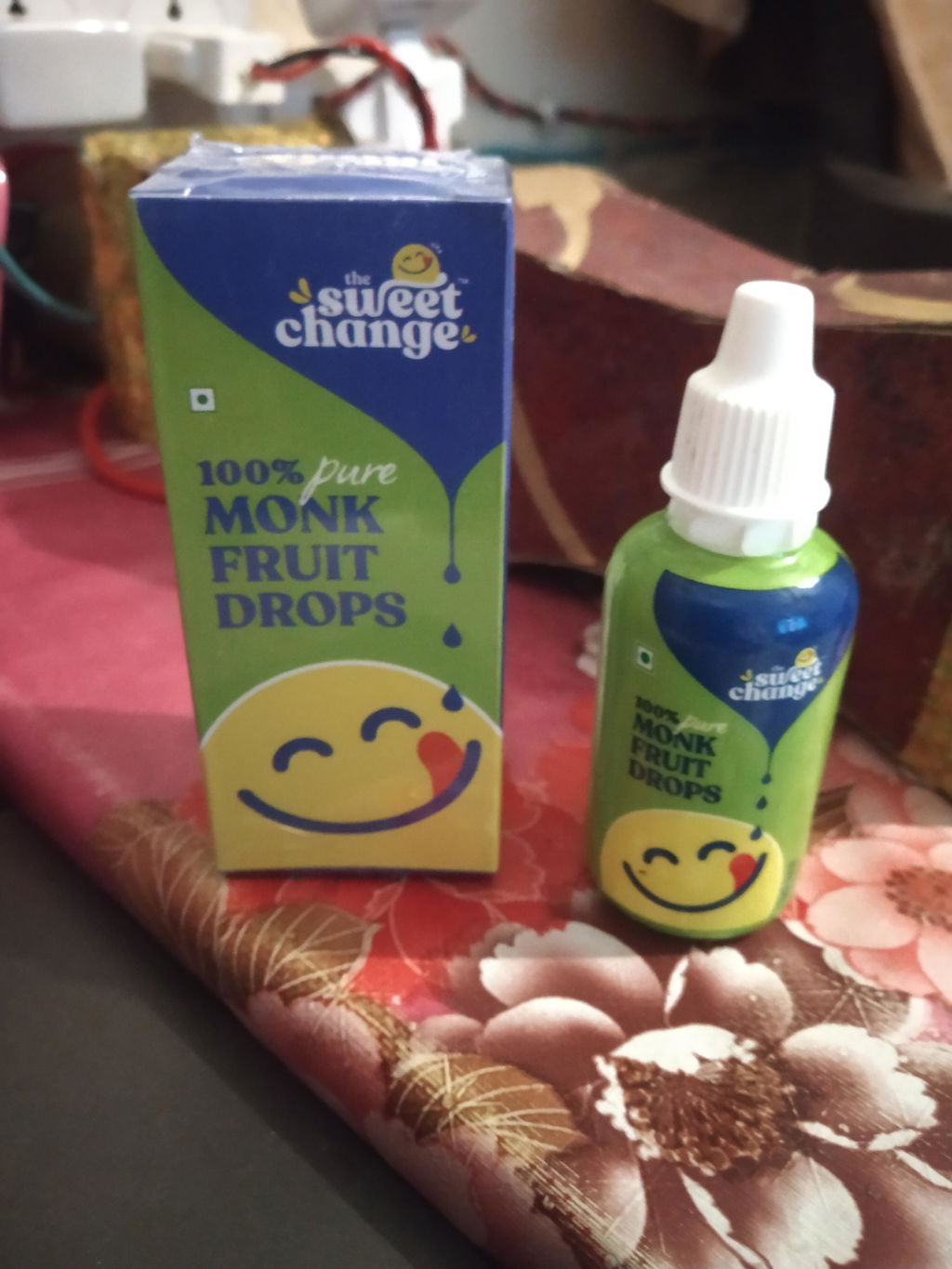
Monk Fruit Drops
monk fruit extract, water and vitamin C. A few drops sweeten a cup of chai.
From ₹3.24 a cup with Buy 2 Get 1₹971 · 100 · 200 servings
Shop Monk Fruit DropsOurs vs the market · Sweeteners
 Written byKapil GroverrChief Business Officer and Co-Founder, The Sweet Change
 Nutrition reviewed byManvi AgnihotriCEO and Co-Founder, The Sweet Change
A monk fruit alternative usually means another monk fruit blend, and the base decides what you get: erythritol and maltitol are sugar alcohols, allulose is a rare sugar. Most of the monk fruit powders we checked in India are blends of this kind. Our pick is monk fruit made without sugar alcohols, which is what The Sweet Change makes; of the three blend types, allulose blends come closest.

Our pick
High confidence
From ₹3.24 a cupWith Buy 2 Get 1
Shop monk fruit drops and powderCommon and cheap
Low confidence
About ₹3.70 a cup
Read the sweetener ingredients guideRare
Low confidence
About ₹4.50 a cup
Read the sweetener ingredients guideThe closest alternative
Moderate confidence
About ₹4.93 a cup
Read the sweetener ingredients guideScores out of 10 from the criteria on this page. How we scored them
The differences that matter when you sweeten chai, coffee and desserts at home.
| What we compared |
 OursOur pick OursOur pick
| Erythritol blend | Maltitol blend | Allulose blend |
|---|---|---|---|---|
| Sweetness against sugar | Monk fruit extract is 100 to 250 times sweeter [1]; our Powder is 4:1 [2] | Erythritol is 60 to 80% as sweet, so a 1:1 blend is mostly erythritol [3] | A sugar alcohol; sugar alcohols run 25% to 100% as sweet as sugar [1] | About 70% as sweet as sugar [4] |
| What is inside | Drops: monk fruit extract, water, vitamin C. Powder: 30% monk fruit, 35% prebiotic guar fibre, 35% allulose [2]Edge | Erythritol listed first in 11 of the 25 we checked; none states a monk fruit share [5] | Maltitol listed first in the one listing we read; no monk fruit share stated [6] | Allulose listed first on every brand website we read that gave an ordered list; none states a monk fruit share [5] |
| Sugar alcohols | NoneEdge | Erythritol | Maltitol, INS 965 [7] | None; allulose is a sugar, not a sugar alcohol [4] |
| Indian label rules | Ingredients in descending order by weight; we state the monk fruit share [8]Edge | A polyol table-top sweetener carries a laxative-effect note [8] | The same polyol note [8] | Counts as a sugar in the Indian definition, a monosaccharide [9] [4] |
| GI and calories of the base | Few or no calories a serving [1] | GI 0 [10]; 0 kcal per g on Indian labels [8] | GI 35, low but above erythritol [10]; 2 kcal per g on Indian labels [8] | 0.4 kcal per g on US labels [4] |
| Digestion notes | No sugar alcohol | 20 to 35 g in one drink was tolerated well in a trial of healthy adults; 50 g brought nausea and rumbling [11] | - | - |
| Heart findings | - | Higher blood erythritol has been linked to heart events in people already under cardiac evaluation [12]; the link has not been shown to be a cause [1] | - | - |
| Formats | Drops and powder, with sachets coming | Powders and sachets [5] | Powder, in the one we read [6] | Powders and sachets [5] |
| Batch lab reports published | Every batch, for heavy metals and microbiology; the reports are on our product page [2]Edge | Not shown on the product page we checked | Not shown in the listing text we read | Not shown on the product page we checked |
| Price per cupSweetened like 1 tsp of sugar | ₹3.32 Powder, ₹3.24 to ₹3.31 Drops, with Buy 2 Get 1 [2]Edge | About ₹3.70 [5] | About ₹4.50 [6] | About ₹4.93 [5] |
You are standing in the sweetener aisle, or scrolling one, with a pack that says monk fruit on the front and a stomach that did not like the last one. That is the moment most people go looking for an alternative to monk fruit sweetener.
The odd thing is that the answer in India is mostly another monk fruit pack, because the extract itself is many times sweeter than sugar and needs a base to measure out [1].
Turn the pack over. Of the 44 monk fruit powders we checked on marketplaces and brand websites, only a handful listed monk fruit alone, and not one stated how much monk fruit was inside [5]. The word on the front is the pitch; the base is the pack.
So the real choice is between bases, and there are three. Erythritol and maltitol are sugar alcohols, also called polyols. Allulose is a rare sugar found in small amounts in wheat and dried fruit [4].
Ours takes a fourth route: the Drops are monk fruit extract, water and vitamin C, and the Powder is 30% monk fruit, 35% prebiotic guar fibre and 35% allulose, with no erythritol [2]. Hold that split in mind; it is the thread through everything below.
Here is the one habit that settles most of this page: read the ingredient list, not the front. In India it must run in descending order by weight, and additives are declared by name or INS number, so the first word is the biggest share [8].
Do that across the market and a pattern shows. Of the 44 powders, 25 contained erythritol, 1 maltitol and 14 allulose, and 11 put erythritol first [5]. Our Powder is 30% monk fruit, 35% prebiotic guar fibre and 35% allulose, and we print the split [2].
For you, that means one question at the shelf: what is the first word, and does the pack tell me how much monk fruit I am paying for.
If a pack with erythritol upset your stomach, allulose is the base you will be pointed to, and for a fair reason: it is not a sugar alcohol.
It is a monosaccharide, present in small amounts in wheat, raisins and figs, and in the United States labels may count it at 0.4 kcal per gram and leave it out of the sugars lines [4].
India reads it differently. The Indian definition of "sugars" covers all monosaccharides and disaccharides, so on an Indian label allulose counts as a sugar [9]. That is a labelling rule, not a verdict on how it behaves in the body, but it explains the sugar line you may spot on an allulose pack's nutrition panel.
Allulose blends are also the dearest base: in our check they cost about 60% more per 100 g than erythritol blends, a median of ₹191 against ₹120 [5].
Our own Powder uses allulose too, so where is the difference. On every brand website we read that gave an ordered ingredient list, allulose came first, which under India's order-by-weight rule makes it most of the pack, and none states its monk fruit share [5] [8]. Ours is 30% monk fruit, 35% prebiotic guar fibre and 35% allulose [2].
So an allulose blend gets you off sugar alcohols. It does not tell you how much monk fruit you bought, and it costs more per cup than ours.
From ₹3.24 a cup with Buy 2 Get 1
More than half the powders we checked are here. Erythritol and maltitol are the two sugar alcohol bases we found, and the first thing to know is what a sugar alcohol does once you swallow it.
Most sugar alcohols are only partly absorbed in the small intestine. The rest travels on, pulls water into the gut and is fermented by bacteria in the colon, which is why a large serving can mean wind, bloating or loose motions [10].
Erythritol is the exception in part: about 90% of it is absorbed and leaves the body unused in urine, so only about a tenth reaches the colon [10].
In India a polyol table-top sweetener carries a note on the pack that polyols may have a laxative effect [8].
Erythritol is the most common base. It is made by fermentation, is 60 to 80% as sweet as sugar, and is approved for food in more than 60 countries, India among them [3]. Its glycaemic index is 0 and Indian labels count it at 0 kcal per gram [10] [8].
How much is too much for the gut. In a trial of healthy young adults, 20 g and 35 g in one drink were tolerated well, and 50 g raised reports of nausea and rumbling [11]. A cup of chai sweetened with a 1:1 blend holds about 4 g, well below the amounts in that trial.
Then there is the heart question you may have read about. Higher blood erythritol has been linked to heart events in people already under cardiac evaluation [12]; the link has not been shown to be a cause [1]. We cover erythritol in more detail in our sweetener ingredients guide.
Maltitol blends are rare in India: one of the 44 powders we checked used it, with maltitol listed first and two INS-numbered additives after the monk fruit [6]. Maltitol carries INS 965 and has no numerical daily intake limit set for it [7].
The difference from erythritol is the glycaemic index: 35 for maltitol, still low, against 0 for erythritol [10]. Indian labels count maltitol at 2 kcal per gram, where erythritol counts at 0 [8]. The same partial digestion applies, so the same laxative-effect note sits on the pack [8].
If erythritol does not agree with you, maltitol swaps one sugar alcohol for another. The base you want in that case is not a polyol at all.
Pack prices mislead here, because the blends are not equally sweet. Our Powder is 4:1: 1 g sweetens like 4 g of sugar, about a level teaspoon [2]. The erythritol and allulose blends we priced are 1:1, so a cup needs 4 g; the maltitol blend states 1 g a teaspoon [5] [6].
Price the cup, then. With Buy 2 Get 1, our 300-serving Powder works out at ₹3.32 a cup and our Drops at ₹3.24 to ₹3.31 [2]. An erythritol blend came to about ₹3.70 a cup and an allulose blend to about ₹4.93 [5].
The maltitol blend came to about ₹4.50 [6].
No sugar alcohols and a stated 30% monk fruit, and still the lowest price per cup of the four we priced: ₹3.32 against about ₹3.70, ₹4.50 and ₹4.93 a cup.
| Per cup |
Our Powder 300Ours
| Our Drops | Erythritol blend | Maltitol blend | Allulose blend |
|---|---|---|---|---|---|
| Sweetness against sugarAs each label states | 4:1 (1 g = 4 g sugar) | One serving a cup | 1:1 | 1 g = 1 tsp sugar | 1:1 |
| To sweeten a cup like 1 tsp of sugar | 1 g | 1 serving | 4 g | 1 g | 4 g |
| Price per cup | ₹3.32Edge | ₹3.24 to ₹3.31 | About ₹3.70 | About ₹4.50 | About ₹4.93 |
| Free of sugar alcohols | none | none | erythritol | maltitol | none |
| Monk fruit share statedOn the pack or listing | 30%Edge | Not stated as a % | Not stated | Not stated | Not stated |

monk fruit extract, water and vitamin C. A few drops sweeten a cup of chai.
From ₹3.24 a cup with Buy 2 Get 1₹971 · 100 · 200 servings
Shop Monk Fruit Drops30% monk fruit, 35% prebiotic guar fibre, 35% allulose; no erythritol. For kheer, halwa and baking.
From ₹3.32 a cup with Buy 2 Get 1₹1,493 · 100 · 300 servings
Shop Monk Fruit Powder| Criterion | What we looked at | Weight |
|---|---|---|
| No sugar alcohols | Erythritol, maltitol or none in the pack | 25% |
| Monk fruit share stated | Whether the pack or listing states its monk fruit percentage | 15% |
| Prebiotic fibre | Whether the pack lists a prebiotic fibre | 10% |
| Cost per cup | Rupees per cup sweetened like 1 tsp of sugar | 20% |
| Formats | Formats on sale | 15% |
| Batch lab reports published | Whether batch reports for heavy metals and microbiology are shown on the product page | 15% |
Each option is scored 1 to 10 on each criterion, multiplied by the weight and totalled out of 100. Our column is scored as our Drops and Powder; the other three as blend types sold in India, from our label check.
Taste is left out: we have not run a same-cup test of the blends. The six criteria are the ones this page can show from labels, prices and published reports; where a product page shows no batch report, we score what is shown, not what the maker may test.
| Criterion (weight) | Ours | Erythritol blends | Maltitol blends | Allulose blends |
|---|---|---|---|---|
| No sugar alcohols (25) | 10: none in the Drops or the Powder | 2: erythritol is the base | 2: maltitol is the base | 10: none |
| Monk fruit share stated (15) | 10: 30% printed | 2: none of the 25 states it | 2: not stated | 2: none of the 14 states it |
| Prebiotic fibre (10) | 10: 35% prebiotic guar fibre | 3: one brand site in our check lists a prebiotic fibre | 2: none in the one we read | 2: none in the blends we checked |
| Cost per cup (20) | 9: ₹3.24 to ₹3.32, the lowest of the four | 8: about ₹3.70 | 6: about ₹4.50 | 5: about ₹4.93 |
| Formats (15) | 8: drops and powder on sale, with sachets coming | 8: powders and sachets | 4: powder only in our check | 9: powders, sachets and one drops listing |
| Batch lab reports published (15) | 10: every batch, nine reports on the product page | 2: not shown on the product page we checked | 2: not shown in the listing text we read | 2: not shown on the product page we checked |
| Weighted total | (250 + 150 + 100 + 180 + 120 + 150) ÷ 100 = 9.5 | (50 + 30 + 30 + 160 + 120 + 30) ÷ 100 = 4.2 | (50 + 30 + 20 + 120 + 60 + 30) ÷ 100 = 3.1 | (250 + 30 + 20 + 100 + 135 + 30) ÷ 100 = 5.7 |
Confidence is how sure we are of the pick for its use, daily chai and cooking: our view, not a grade of the research. Facts come from the sources at the end of this page. Market details come from public labels and listings we checked; we never name other brands.
On monk fruit alternatives, that arithmetic is why monk fruit made without sugar alcohols is our pick, and why an allulose blend is the one we would point you to if you want a 1:1 powder from the market; it loses on the stated share, the fibre and the published reports, not on the base.
You cannot see a trace of lead or a colony of bacteria in a white powder or a clear drop, and neither can we. So every batch is lab tested for heavy metals (lead, arsenic, mercury and cadmium) and microbiology, and the report for each batch is published on our product page [2].
Why those two tests. Monk fruit is a plant extract, and metals are the first thing we rule out in any botanical ingredient.
A food also has to leave us clean of microbes, so each report also counts plate counts, yeast and mould, and named bacteria such as Salmonella [2].
How to read yours. Find the batch code on your bottle or pouch, MFL for the Drops and MFA for the Powder, and open the matching report in the lab reports on our product page. Each report gives the result for every test, with the limit printed beside most of them [2].
"Within limits" means the result sits under the limit printed on that report. The Drops reports state their specifications as per India's food safety regulations, FSSAI, and also run a long pesticide-residue panel; the Powder certificates print their limits without naming a standard [2].
Where a product page shows no report, you take the label's word for it. Ours lets you check the batch in your hand.
Find your batch report
Some readers want an alternative to monk fruit that is not monk fruit at all, a true monk fruit substitute. Stevia is the usual candidate, and we compare the two in monk fruit vs stevia; our stevia page covers that plant on its own.
For the wider field, from jaggery to sucralose, start with our sweeteners guide. It walks through each one with the same sourcing as this page.
One thing no sweetener on this page can do is make you lighter. The World Health Organization advises against using non-sugar sweeteners to control body weight, a conditional recommendation that does not apply to people who already have diabetes and does not cover sugar alcohols [13].
If you take medicine for diabetes or another condition, talk to your doctor before you change what you eat. Pregnant women and parents choosing for young children should ask their doctor too.
Usually another monk fruit blend with a different base. If a pack with erythritol upset your stomach, look for one built on allulose, which is not a sugar alcohol, or for drops made from the extract alone. Read the first ingredient on the label; Indian FSSAI rules list ingredients in descending order by weight.
The US FDA has raised no questions about purified monk fruit extract, and it says the studies linking erythritol to heart events did not establish a causal link. In a trial of healthy young adults, moderate single doses of erythritol were tolerated well. If you have a heart condition, ask your doctor before you choose a sweetener.
Maltitol is a sugar alcohol that JECFA, the WHO and FAO expert committee, evaluated without setting a numerical daily limit. In India a polyol table-top sweetener carries a note that polyols may have a laxative effect, and a 2003 review of polyols gives maltitol a low glycaemic index, higher than erythritol's. Read the pack and start small.
It depends on the base, so read the label. Our Powder is four to one: one gram sweetens like four grams of sugar, about a level teaspoon, as our pack states. Most erythritol and allulose blends in our check are one to one, and the maltitol blend we read states one gram a teaspoon.
In the Indian labelling definition, yes: FSSAI defines sugars as all monosaccharides and disaccharides, and allulose is a monosaccharide. In the United States the FDA lets labels count allulose at a low calorie factor and leave it out of the sugars lines. Both rules are about labels, not about how allulose behaves in the body.
Yes. Every batch is lab tested for heavy metals (lead, arsenic, mercury and cadmium) and microbiology, and the report for each batch is published on our product page. Find the batch code on your bottle or pouch, open the matching report and check each result against the limit printed beside it.
Most alternatives sold in India are other monk fruit blends, and the base is the real difference: erythritol or maltitol, which are sugar alcohols, or allulose, which is a rare sugar. Our pick is monk fruit made without sugar alcohols, which is what we make. Whichever you choose, turn the pack over and read the ingredient list first.
From ₹3.24 a cup with Buy 2 Get 1

Written by
Kapil Groverr · Chief Business Officer and Co-Founder
IIM Lucknow alumnus · 18 years in marketing
Kapil Groverr is Co-Founder and Chief Business Officer of The Sweet Change, where he leads growth and marketing. He has 18 years in marketing, most recently as Vice President Marketing at Breathe Well-being and before that Head of Digital Marketing at King Koil. An IIM Lucknow alumnus, he writes our sweetener guides and comparisons.
Writes about: Sweetener guides and comparisons
Disclosure: Co-founder of The Sweet Change

Nutrition reviewed by
Manvi Agnihotri · CEO and Co-Founder
12 years in clinical nutrition, over 11,000 patients · M.Sc Food and Nutrition, silver medallist
Manvi Agnihotri is CEO and Co-Founder of The Sweet Change. She holds an M.Sc in Food and Nutrition, in which she was a silver medallist, and has led brand strategy and patient and doctor education at Breathe Well-being, a diabetes care programme. She reviews our health and nutrition pages before they go live.
Reviews: Nutrition and food science, Blood sugar and diabetes diet
Disclosure: Co-founder of The Sweet Change
Monk fruit made without sugar alcohols is our pick for daily chai.
Our pick: monk fruitfrom ₹3.24 a cup with Buy 2 Get 1
Shop