Natural sweetener for diabetes: which ones are not sugar, and what to pick
 Written byJatin AgnihotriCOO and Co-Founder, The Sweet Change
 Reviewed byKapil GroverrChief Business Officer and Co-Founder, The Sweet Change
 Medically reviewed byManvi AgnihotriCEO and Co-Founder, The Sweet Change


Monk fruit and stevia add little or no sugar, and allulose causes only a negligible rise in blood glucose. Gur, honey, dates and coconut sugar are natural too, but they are sugar and count as sugar in your cup. So the natural sweetener for diabetes we pick for daily chai is monk fruit made without sugar alcohols; before you buy one, read the label for erythritol.
Key takeaways
- Little or no sugar: monk fruit and stevia sweeten without sugar, and the US FDA has not questioned the safety notices filed for sweeteners made from monk fruit [1].
- Still sugar: the sugars in gur, honey, dates and coconut sugar count as sugars under Indian food rules, which cover every monosaccharide and disaccharide [2].
- The WHO line: its 2023 advice against non-sugar sweeteners for weight control does not apply to people who already have diabetes [3].
- Read the first ingredient: more than half of the monk fruit powders we checked contained erythritol [4].
- Our pick: for daily chai, a monk fruit sweetener made without sugar alcohols.
Discuss with your doctor or dietitian before changing your diet, especially if you take diabetes medicines.
On this page
- What counts as a natural sweetener for diabetes?
- Natural sweeteners that add little or no sugar
- What the WHO, the ADA and Indian guidelines say
- Natural, but still sugar: gur, honey, dates, coconut sugar
- How to read a "natural" sweetener label in India
- Which natural sweetener is best for diabetics?
- Using a natural sweetener in chai and coffee
- Kheer, mithai and baking without sugar
- Sources
If you have diabetes or take medicine for blood sugar, talk to your doctor or dietitian before changing what you eat.
What counts as a natural sweetener for diabetes?
You have seen the word "natural" doing a lot of work on a shelf: on a jar of gur, a bottle of honey, a stevia powder that measures like sugar. After a sugar report it is the first word many of us look for.
The two things people type are "what is a natural sweetener for diabetics" and "are natural sweeteners good for diabetes". Start with the first.
A natural sweetener is one taken from a plant or food, such as monk fruit, stevia leaves, cane or honey; "plant-based" on a label means the same thing. That definition says nothing about sugar, and sugar is the whole question.
The test that matters is simpler than the label. Indian food rules count every monosaccharide and disaccharide as a sugar, whatever plant it came from [2]. And the sugars a cook adds, along with those already in honey and syrups, count as free sugars, the kind health advice asks everyone to cut [5].
That splits the shelf in two. In one group sit monk fruit and stevia, which add no sugar, and allulose, a special case we come to below. In the other sit gur, honey, dates and coconut sugar: natural, and sugar.
When people search for a natural sweetener for diabetes, they usually mean the first group and are sold the second. In our survey of our own buyers, 16% said they had been sweetening with jaggery or honey before they switched [6].
If that is you, nothing was wrong with the instinct; the front of the pack told you half the story.
Our guide to sweeteners for diabetes covers artificial options and formats as well. This page stays with the natural group and sorts it by sugar.
In short: sort by sugar, not by the word natural.
Natural sweeteners that add little or no sugar
Three natural sweeteners for diabetes earn the name, and they are not equal. Here is each one, with the human evidence we could find and its limits.
Monk fruit
Monk fruit (Siraitia grosvenorii, luo han guo) is the fruit of a plant native to southern China, and its sweetness comes mainly from compounds called mogrosides [1]. It is a non-nutritive sweetener, and it is heat-stable, so it goes into the chai pan and the kheer pot [7].
Depending on how much mogroside an extract holds, it is 100 to 250 times sweeter than sugar, so a pinch does the work of a spoon [1]. On safety, the US FDA has not questioned the safety notices filed for sweeteners made from monk fruit and has set no daily limit, saying one may not be necessary [1].
Then the question that brought you here. In a 2017 trial in 30 healthy men, a drink sweetened with monk fruit did not cause the blood-sugar and insulin spike that a sugar-sweetened drink caused in the first hour [8].
The limit is worth saying once. In our search we found no trial of monk fruit in people with diabetes, so for now the human trial we rely on is in healthy men. That is a gap in the research, not a mark against the fruit.
Why we still put it first: it adds no sugar, a tiny amount sweetens, it survives boiling, and we find its taste clean in milky chai. The research in more depth is in our page on monk fruit for people with diabetes, and the fruit itself in what monk fruit is and where it grows.
Stevia
Stevia is the leaf most people meet first, and one often sold as the best natural sweetener for type 2 diabetes. The sweet part is a family of steviol glycosides, 200 to 400 times sweeter than sugar [1].
Here is the trial that matters for this page. For 16 weeks, 122 people with type 2 diabetes took 1,000 mg of rebaudioside A, the main stevia glycoside, or a placebo every day, and their HbA1c and fasting glucose changes did not differ from placebo [9].
In plain words, it neither helped nor harmed blood-sugar control; it took the sugar out of whatever it sweetened and left the rest alone.
The honest downside is taste. Some people notice a bitter aftertaste, which two of the tongue's bitter receptors pick up [10]. In milky chai that bitterness tends to stand out, so stevia suits some cups better than others; our page on stevia and diabetes, in depth goes through the rest of the evidence.
Allulose
Allulose is a rare sugar found in small amounts in raisins and dried figs, and it is a monosaccharide, the same chemical family as glucose [11]. That last fact matters in India: because our food rules count every monosaccharide as a sugar, allulose counts as a sugar on an Indian label [2] [11].
The body treats it differently from table sugar, though. The US FDA has concluded that allulose produces only a negligible rise in blood glucose and insulin, and it lets US labels count allulose at 0.4 kcal per gram [11].
In people with diabetes the trials are small. In a 12-week crossover trial, 16 people with type 2 diabetes took 7 g of allulose twice a day; it had a neutral effect on their blood-sugar control, and their HDL cholesterol fell from 51 to 41 mg/dL over the allulose weeks [12].
A 2024 meta-analysis of six small trials, 126 people in all, found lower post-meal glucose with allulose and said the long-term effects still need research [13].
So allulose is a fair swap for baking, where its bulk helps, as long as you know an Indian label will count it as a sugar. How much is comfortable in one go, and how it behaves in a pan, is in our page on allulose, how much and how it behaves.
What the WHO, the ADA and Indian guidelines say
The people who write the guidelines have answered whether natural sweeteners are good for diabetics, and with more care than any shelf label. None of the three positions below ranks one natural sweetener for diabetes above another; they speak about the group.
The WHO's 2023 guideline advises against using non-sugar sweeteners to control weight, and says in the same breath that this applies to everyone except people who already have diabetes; it covers natural and synthetic non-sugar sweeteners alike and leaves out low-calorie sugars and sugar alcohols [3].
So the headline you may have seen, "WHO says avoid sweeteners", never applied to you if you have diabetes.
The American Diabetes Association's 2026 Standards of Care say people with diabetes can use non-nutritive sweeteners in place of sugar-sweetened products, in moderation and for the short term, to cut calories and carbohydrate; the sweeteners themselves do not appear to have a significant effect on blood-sugar management [14].
Closer to home, ICMR-NIN's 2024 dietary guidelines ask adults to keep sugar under 5% of the day's energy [15].
What this means in the kitchen: a swap takes the sugar out of the cup; it does not treat diabetes, and eating less sweet overall still counts. Both are worth doing.
Natural, but still sugar: gur, honey, dates, coconut sugar
This is the part the "healthy sweetener" lists skip, and it is where most of us get caught. A natural sweetener for diabetes that is itself sugar is the same spoon with a nicer name.
Gur (jaggery) first, because it is the one we reach for with the best intentions. Cane jaggery carries about 354 kcal and 84 g of sugars in every 100 g, so a level 4 g teaspoon holds about 3.4 g of sugar, with about 0.2 mg of the iron people mention beside it [16].
The minerals are real; in a teaspoon they are tiny next to the sugar.
Honey and table sugar sit close together on the glycemic index. On the international tables, table sugar is 65 and honey 61, both medium, where low means 55 or under and high means 70 or over; raw dates come in at 42, which is low [17].
But the glycemic index says how fast, not how much: a low GI tells you the sugar in a date arrives slowly, not that there is less of it.
Coconut sugar has the best marketing of the four and the simplest chemistry: it is mostly sucrose, the same sugar as table sugar [18]. There is no standard GI value for it in the international tables, so any number you see quoted for it did not come from there [17].
So gur, honey and coconut sugar land in the free-sugar group we met at the top, and so does date syrup; whole dates are fruit, but their sugar still counts in your day. Agave and yacon syrup turn up on these lists too; we have not opened their research for this page, so they stay out of our verdict.
In the kitchen: a spoon of gur in chai is a spoon of sugar in chai. If gur's taste is the point, keep it for the one cup it matters in and swap the rest. Our page on jaggery vs sugar has the full comparison.
,,.
How to read a "natural" sweetener label in India
You will not find the best natural sweetener for diabetics in India on the front of the pack. You find it on the back, in the ingredient list, and the rule for reading it is short.
A label lists ingredients in descending order by weight, so the first ingredient is the one there is most of [19]. If a "monk fruit" or "stevia" powder measures spoon for spoon like sugar, something has to fill that spoon, because a pinch of extract cannot. Very often that something is erythritol.
In our own scan, more than half of the monk fruit powders we checked (13 October 2026) contained erythritol [4].
Erythritol is a sugar alcohol, and in 2023 a study linked higher blood levels of it to heart events in people who were already under heart evaluation; it showed a link, not proof, and it sent many people back to reading labels [20].
The US FDA reviewed that paper and said its observational studies did not establish a causal link [1].
Our own buyers tell the same story. In our survey of our own buyers, 49% said they chose us for no erythritol [6].
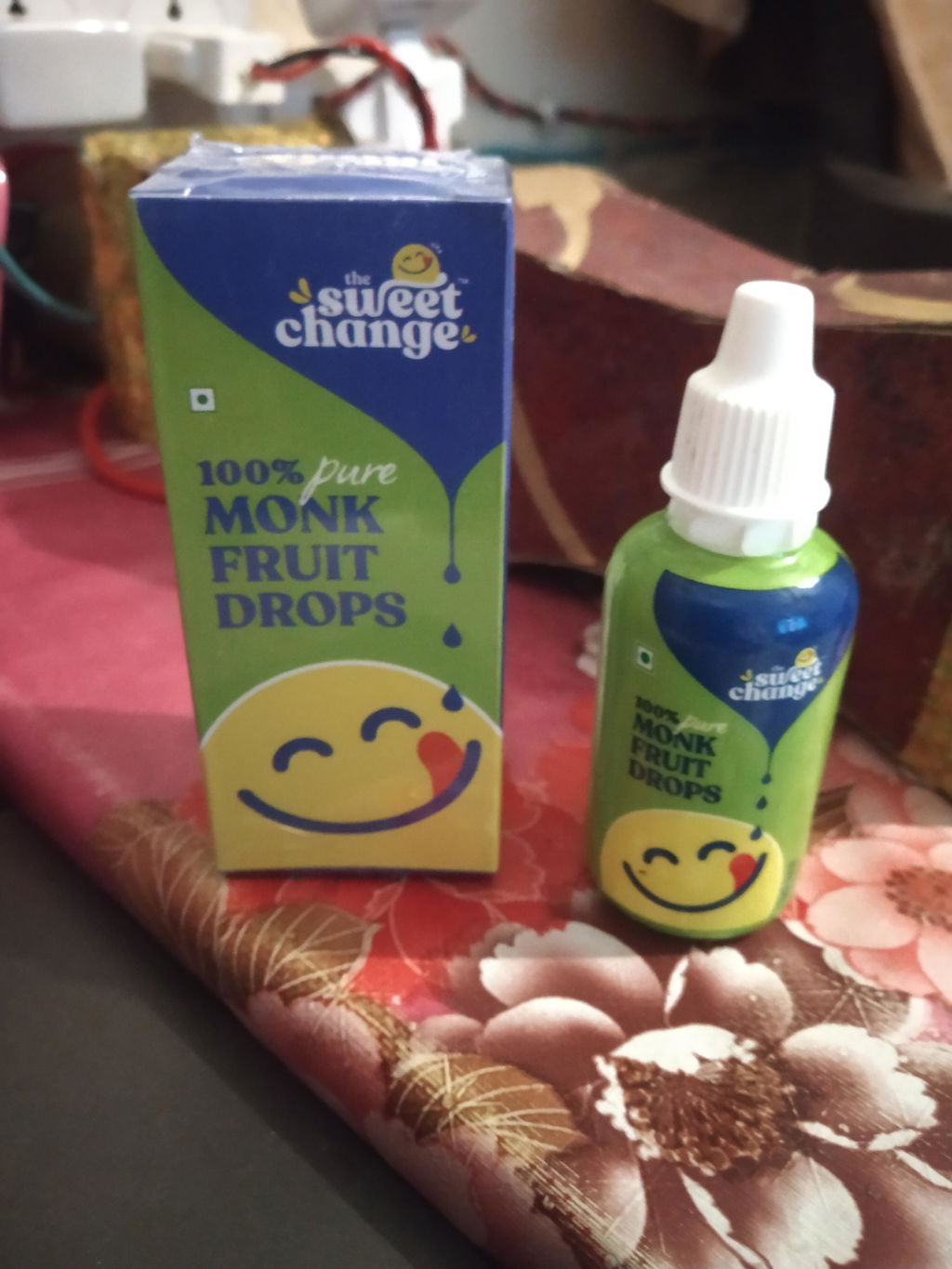
At The Sweet Change: our monk fruit powder is made with monk fruit, guar fibre and allulose, with no erythritol, and our drops with monk fruit extract, water and vitamin C; neither contains erythritol or other sugar alcohols. We chose that after the 2023 study: a link, not proof.
Our monk fruit sweetener comes as drops and powder, with sachets coming.
One more habit while the pack is in your hand: jaggery powder, coconut sugar, date syrup and honey in an ingredient list are sugar, whatever the front says.
Which natural sweetener is best for diabetics?
Our pick, stated as ours: for daily chai and coffee, the best natural sweetener for diabetes is a monk fruit sweetener made without sugar alcohols.
Here is why, against the things we care about in a cup that gets made three times a day:
- Monk fruit adds no sugar: its sweetness comes from mogrosides, not a mono- or disaccharide; if a powder is bulked with allulose, that part counts as a sugar on an Indian label.
- No sugar alcohols: made without erythritol, the spoon-for-spoon question goes away.
- A tiny amount sweetens: a few drops or a small pinch does a cup, so the pack lasts and the taste stays light.
- Heat-stable: it goes in before or after the boil without losing sweetness.
- Clean taste in milky chai: we find it has none of the bitter edge some people notice with stevia.
Stevia comes next if the aftertaste does not bother you; it has the longer trial record in people with type 2 diabetes, and we say so. Allulose is the baking pick, with the Indian-label caveat. Gur, honey, dates and coconut sugar are sugar: use them as sugar, counted.
How we compared: we scored each option on whether it adds sugar on an Indian label, whether it contains sugar alcohols, how little of it sweetens a cup, whether it survives boiling and how it tastes in milky chai, using the sources numbered on this page. Confidence is how sure we are of the pick for daily chai and cooking; it is our view, not a grade of the research.
| Sweetener | Adds sugar? | Our view for daily chai | Confidence |
|---|---|---|---|
| Monk fruit, no sugar alcohols | No from the monk fruit; any allulose in a powder counts as a sugar on Indian labels | Our pick | High confidence |
| Stevia | No | Good if the aftertaste suits you | Moderate confidence |
| Allulose | Counted as a sugar on Indian labels; a negligible blood-glucose rise per the US FDA | Better for baking | Moderate confidence |
| Erythritol and other sugar alcohols | No, but read the 2023 study and the FDA position above | We avoid them | Low confidence |
| Gur, honey, dates, coconut sugar | Yes | Count them as sugar | No label |
Using a natural sweetener in chai and coffee
In our survey of our own buyers, 66% said their sweetener goes into coffee and 64% into chai, so this is the cup to get right [6]. A natural sweetener for diabetes goes into that cup the way sugar did, with a few small changes.
- Add it after the boil: tasting at the end lets you stop at "sweet enough" rather than "as sweet as before".
- Start with less: a sweetener this strong is easy to overdo; put in half of what you think, stir, taste, then add.
- Drops for a cup, powder where bulk matters: a cup needs sweetness only; a kheer or a halwa needs something to take sugar's place in the pan.
- Do not let the saved spoon become a biscuit: a cup without added sugar is a small win, and the plate next to it decides the rest.
The chai itself does not change: same patti, same adrak, same boil.
Kheer, mithai and baking without sugar
Festival cooking tests a "natural" swap hardest, because sugar does more than sweeten there: it gives body to kheer and colour to a nankhatai.
Monk fruit holds its sweetness through a long simmer; what it cannot do is thicken. In kheer the milk reduces and thickens on its own, so a little more time on the flame stands in for the sugar's body.

In baking, something has to fill the cup the sugar used to fill; that is where a powder with bulk, allulose included, earns its place.
The carbohydrate still on the plate is the milk, the rice and the flour, so the portion matters as much as the sweetener. If you are choosing flour as well, our page on choosing atta when you have diabetes is the pair to this one.
A natural sweetener for diabetes earns its place in the festival pot the same way it does in the cup: by taking the sugar out and leaving the dish alone. For the wider map of every option, there is our full guide to every type of sweetener.
A katori of kheer made this way is still a katori of kheer.
Cheat sheet
- Sort by sugar, not by the word natural: monk fruit and stevia add none; gur, honey, dates and coconut sugar are sugar.
- Read the first ingredient: more than half of the monk fruit powders we checked had erythritol in them.
- Allulose is a special case: a negligible rise in blood glucose per the US FDA, and still a sugar on an Indian label.
- The WHO 2023 advice is not about you if you have diabetes: it was written about weight control.
- Our pick for daily chai: a monk fruit sweetener made without sugar alcohols.
Questions people ask
What is the healthiest natural sweetener for diabetics?
No sweetener treats diabetes, so "healthiest" means "adds the least sugar for the taste you want". Monk fruit and stevia add none; gur, honey and dates are sugar. For daily chai our pick is a monk fruit sweetener made without sugar alcohols, and the ICMR-NIN guidelines still ask adults to keep sugar under 5% of daily energy.
What is the best natural sweetener for diabetics type 2?
Pick one that adds no sugar. Stevia has a 16-week trial in 122 people with type 2 diabetes in which HbA1c did not change against placebo; the monk fruit trial we found is in 30 healthy men, with no glucose or insulin spike from the drink. Our pick for daily chai is still monk fruit made without sugar alcohols.
What is the best natural sweetener for prediabetes?
Cutting added sugar overall matters most, and the American Diabetes Association's 2026 guidance says non-nutritive sweeteners can replace sugar-sweetened products in moderation and for the short term. For the sweetener that remains in your chai, the pick is the same as for diabetes: monk fruit made without sugar alcohols, with stevia next if its aftertaste suits you.
Are natural sweeteners good for diabetes?
It depends which one. Monk fruit and stevia add little or no sugar, and the American Diabetes Association says non-nutritive sweeteners can stand in for sugar in moderation and for the short term. Natural sugars such as gur, honey and coconut sugar are still sugar, so count them as sugar in your day.
Are non-caloric sweeteners good for diabetes?
Used in place of sugar, yes, within limits: the American Diabetes Association's 2026 Standards of Care say they can replace sugar-sweetened products in moderation and for the short term. The WHO's 2023 advice against them was about weight control and does not apply to people who already have diabetes. They are a swap, not a treatment.
 Monk Fruit Drops (100 servings)
Rs. 497.00
Monk Fruit Drops (200 servings)
Rs. 971.00
Monk Fruit Drops (100 servings)
Rs. 497.00
Monk Fruit Drops (200 servings)
Rs. 971.00
 Monk Fruit Powder No Erythritol (100 servings)
Rs. 675.00
Monk Fruit Powder No Erythritol (300 servings)
Rs. 1,493.00
Monk Fruit Powder No Erythritol (100 servings)
Rs. 675.00
Monk Fruit Powder No Erythritol (300 servings)
Rs. 1,493.00
Related articles


Written by
Jatin Agnihotri · COO and Co-Founder
MBA, Indian School of Business · 12 years in technology and security
Jatin Agnihotri is COO and Co-Founder of The Sweet Change, where he runs operations, from manufacturers and vendors to shipping and logistics, and creates content for our Instagram. He spent 12 years in technology at Honda Cars India, Extramarks Education, where he was Vice President IT, and Jio Platforms. He holds an MBA from ISB.
Disclosure: Co-founder of The Sweet Change

Reviewed by
Kapil Groverr · Chief Business Officer and Co-Founder
IIM Lucknow alumnus · 18 years in marketing
Kapil Groverr is Co-Founder and Chief Business Officer of The Sweet Change, where he leads growth and marketing. He has 18 years in marketing, most recently as Vice President Marketing at Breathe Well-being and before that Head of Digital Marketing at King Koil. An IIM Lucknow alumnus, he writes our sweetener guides and comparisons.
Writes about: Sweetener guides and comparisons
Disclosure: Co-founder of The Sweet Change

Medically reviewed by
Manvi Agnihotri · CEO and Co-Founder
12 years in clinical nutrition, over 11,000 patients · M.Sc Food and Nutrition, silver medallist
Manvi Agnihotri is CEO and Co-Founder of The Sweet Change. She holds an M.Sc in Food and Nutrition, in which she was a silver medallist, and has led brand strategy and patient and doctor education at Breathe Well-being, a diabetes care programme. She reviews our health and nutrition pages before they go live.
Reviews: Nutrition and food science, Blood sugar and diabetes diet
Disclosure: Co-founder of The Sweet Change
Sources
- US Food and Drug Administration. 2025. Aspartame and Other Sweeteners in Food (content current as of 27 February 2025). FDA, Silver Spring. https://www.fda.gov/food/food-additives-petitions/aspartame-and-other-sweeteners-food
- Food Safety and Standards Authority of India. 2018. Food Safety and Standards (Advertising and Claims) Regulations, 2018, regulation 2(1)(o) (compendium Version III, 4 October 2022). FSSAI, New Delhi. https://www.fssai.gov.in/upload/uploadfiles/files/Compendium_Advertising_Claims_Regulations_04_10_2022.pdf
- World Health Organization. 2023. WHO advises not to use non-sugar sweeteners for weight control in newly released guideline (departmental update, 15 May 2023). WHO, Geneva. https://www.who.int/news/item/15-05-2023-who-advises-not-to-use-non-sugar-sweeteners-for-weight-control-in-newly-released-guideline
- The Sweet Change. 2026. Market label scan of monk fruit sweeteners sold online in India, checked 13 October 2026 (internal record; brand names not published). https://www.thesweetchange.com/pages/editorial-policy
- World Health Organization. 2026. Healthy diet (fact sheet, 26 January 2026). WHO, Geneva. https://www.who.int/news-room/fact-sheets/detail/healthy-diet
- The Sweet Change. 2026. Survey of our own buyers (internal record; whole-number percentages of buyers who answered). https://www.thesweetchange.com/pages/editorial-policy
- MedlinePlus Medical Encyclopedia, US National Library of Medicine. 2025. Sweeteners - sugar substitutes (reviewed 3 July 2025). Bethesda. https://medlineplus.gov/ency/article/007492.htm
- Tey SL, Salleh NB, Henry J, Forde CG. 2017. Effects of aspartame-, monk fruit-, stevia- and sucrose-sweetened beverages on postprandial glucose, insulin and energy intake. International Journal of Obesity 41(3):450-457. https://doi.org/10.1038/ijo.2016.225
- Maki KC, Curry LL, Reeves MS, et al. 2008. Chronic consumption of rebaudioside A, a steviol glycoside, in men and women with type 2 diabetes mellitus. Food and Chemical Toxicology 46(Suppl 7):S47-S53. https://doi.org/10.1016/j.fct.2008.05.007
- Hellfritsch C, Brockhoff A, Stähler F, Meyerhof W, Hofmann T. 2012. Human psychometric and taste receptor responses to steviol glycosides. Journal of Agricultural and Food Chemistry 60(27):6782-6793. https://doi.org/10.1021/jf301297n
- US Food and Drug Administration. 2020. The Declaration of Allulose and Calories from Allulose on Nutrition and Supplement Facts Labels: Guidance for Industry (October 2020). FDA, Silver Spring. https://www.fda.gov/media/123342/download
- Preechasuk L, Luksameejaroenchai C, Tangjittipokin W, Kunavisarut T. 2023. Short-term effects of allulose consumption on glucose homeostasis, metabolic parameters, incretin levels, and inflammatory markers in patients with type 2 diabetes: a double-blind, randomized, controlled crossover clinical trial. European Journal of Nutrition 62(7):2939-2948. https://doi.org/10.1007/s00394-023-03205-w
- Ayesh H, Suhail S, Ayesh S. 2024. Impact of allulose on blood glucose in type 2 diabetes: a meta-analysis of clinical trials. Metabolism Open 24:100329. https://doi.org/10.1016/j.metop.2024.100329
- American Diabetes Association Professional Practice Committee. 2026. 5. Facilitating Positive Health Behaviors and Well-being to Improve Health Outcomes: Standards of Care in Diabetes 2026. Diabetes Care 49(Suppl 1):S89-S131. https://doi.org/10.2337/dc26-s005
- ICMR-National Institute of Nutrition. 2024. Dietary Guidelines for Indians. ICMR-NIN, Hyderabad. https://www.nin.res.in/downloads/DGI_Booklet_English_CMYK.pdf
- Longvah T, Ananthan R, Bhaskarachary K, Venkaiah K. 2017. Indian Food Composition Tables 2017 (food I001, Jaggery, cane). ICMR-National Institute of Nutrition, Hyderabad. https://www.nin.res.in/ebooks/IFCT2017.pdf
- Atkinson FS, Foster-Powell K, Brand-Miller JC. 2008. International Tables of Glycemic Index and Glycemic Load Values: 2008. Diabetes Care 31(12):2281-2283. https://doi.org/10.2337/dc08-1239
- Saraiva A, Carrascosa C, Ramos F, Raheem D, Lopes M, Raposo A. 2023. Coconut Sugar: Chemical Analysis and Nutritional Profile; Health Impacts; Safety and Quality Control; Food Industry Applications. International Journal of Environmental Research and Public Health 20(4):3671. https://doi.org/10.3390/ijerph20043671
- Food Safety and Standards Authority of India. 2020. Food Safety and Standards (Labelling and Display) Regulations, 2020, regulation 5(2)(b) (compendium Version IV, 23 September 2022). FSSAI, New Delhi. https://www.fssai.gov.in/upload/uploadfiles/files/Compendium_Labelling_Display_23_09_2022.pdf
- Witkowski M, Nemet I, Alamri H, et al. 2023. The artificial sweetener erythritol and cardiovascular event risk. Nature Medicine 29(3):710-718. https://doi.org/10.1038/s41591-023-02223-9
The Sweet Change makes the products mentioned on this page. How we write and review