PCOD diet: an Indian food chart that is easy to follow
 Written bySheen HitaishiChief Brand Officer and Co-Founder, The Sweet Change
 Reviewed byJatin AgnihotriCOO and Co-Founder, The Sweet Change
 Medically reviewed byManvi AgnihotriCEO and Co-Founder, The Sweet Change


There is no single PCOD diet that beats the rest: there is no evidence that any one type of diet works better than another, and healthy eating brings benefits even without weight loss [1]. A PCOD diet chart Indian families can keep to puts whole grains and millets in place of maida, adds dal and other pulses, plenty of vegetables and whole fruit, and takes far less sugar in chai and sweets [2] [3].
Key takeaways
- No one best diet: no type of diet has been shown to work better than another in PCOS [1].
- The scale is not the only goal: a healthy lifestyle brings benefits even without weight loss [1].
- Why sugar and maida matter: many women with PCOS have insulin resistance, where the body's cells do not respond normally to insulin [4].
- The Indian rule of thumb: whole grains and millets over refined grains, and sugar under 5% of the day's energy [2].
- Nothing is banned: strict, unbalanced diets are discouraged, so milk, rice and fruit stay on our chart [1].
Discuss with your doctor or dietitian before changing your diet, especially if you take diabetes medicines.
On this page
- What is the best PCOD diet? The honest answer
- Why food matters in PCOD: insulin, in plain words
- The PCOD plate: a simple Indian template
- PCOD diet chart: what to eat, group by group
- Foods to limit, not ban
- PCOD me kya khana chahiye? The quick list
- A sample day you can print
- Sugar in chai, mithai and "healthy" jaggery
- Where The Sweet Change fits
- Movement belongs on the chart too
- The short version for your kitchen
- Sources
This is general information. Talk to your doctor or dietitian before big diet changes, especially if you are trying to conceive, take medicines or have diabetes.
What is the best PCOD diet? The honest answer
You come home from the gynaecologist with a new word, and by evening someone in the family group has forwarded a PCOD diet chart. It bans rice, milk, fruit and anything white, and because it looks strict, it feels right.
The question underneath is simple: which PCOD diet actually works?
The 2023 international PCOS guideline looked for a winner and did not find one. There is no evidence that any one type of diet works better than another for body size, metabolic health, hormones, reproductive health or mood, and any way of eating that follows healthy-eating advice for the general population brings health benefits [1].
It goes a step further. A healthy lifestyle brings benefits even when the scale does not move, and unduly restrictive or nutritionally unbalanced diets should be avoided [1].
So the forwarded chart has it backwards. The best PCOD diet is the one you can still follow in six months, built from food your family already cooks.
You are also far from alone. Across India, PCOS was found in 7.2% to 19.6% of women aged 18 to 40, depending on the diagnostic criteria used [5].
A word on names. In medical writing, polycystic ovary disease (PCOD) is listed as one of the older names for PCOS [6], and in 2026 an international consensus agreed a new name, polyendocrine metabolic ovarian syndrome, or PMOS [7]. Our guide to what PCOD means explains all three.
Why food matters in PCOD: insulin, in plain words
Most food advice for PCOD comes back to one hormone, insulin. In insulin resistance the body's cells do not respond normally to insulin, so insulin levels in the blood rise [4].
Many women with PCOS have insulin resistance [4]. By one US estimate, more than half do, and patches of thickened, dark, velvety skin are one sign linked to it [8].
It matters for the long run too. Women with PCOS have a higher risk of impaired glucose tolerance and type 2 diabetes, whatever their age or body weight [1].
At the plate, that means starting with the sugar dabba and the maida tin, the easiest places to cut back. Whole grains, millets, pulses, nuts and vegetables are the fibre-rich foods to eat more of [2]. That is the whole logic behind a PCOD diet.
No diet chart makes PCOD go away, and this one does not promise to. What it can do is give your everyday meals a steady, sensible shape. and
The PCOD plate: a simple Indian template
Charts with exact grams look precise, but few of us weigh dal at dinner. A plate is easier to carry in your head, and it is the simplest way to keep a PCOD diet going at every meal.
A widely used plate model, built for diabetes, fills half the plate with non-starchy vegetables, a quarter with protein and a quarter with good-quality carbohydrate such as whole grains [9]. We borrow it for PCOD because it builds a meal from the foods healthy-eating advice already asks for.
Here is how it looks on a steel thali:
- Half the plate, vegetables: a big katori of palak, lauki, bhindi or beans sabzi, plus a salad of cucumber, tomato and onion.
- A quarter, protein: a katori of dal, rajma or chana, a few pieces of paneer, a katori of curd, eggs, fish or chicken.
- A quarter, grain: one or two rotis of whole wheat, jowar, bajra or ragi atta, or a katori of rice.
- On the side: a glass of chaas or a small katori of curd if the protein quarter has none.
These portions are an example for a typical adult, not a prescription. Your dietitian may change them for your height, activity and goals.
PCOD diet chart: what to eat, group by group
This is the part most people print: a PCOD food diet built from ordinary Indian food. What changes is which version you pick and how much.
Carbohydrates should come mainly from whole grains, vegetables, fruit and pulses, and whole grains include millet, oats and wheat [3]. Whole grains and millets are the better pick over refined grains and ultra-processed food [2].
Grains and millets
- Atta: whole wheat, with jowar, bajra or ragi rotis on a few days a week.
- Breakfast grains: poha with peas and peanuts, vegetable upma, oats or dalia, in place of white bread.
- Rice: a measured katori, always with dal and sabzi.
Which flour to buy is its own question, and our guide to flours and atta compares the common ones.
Protein: dal, paneer, curd and eggs
- Pulses: moong, masoor, rajma, chana and lobia, as dal, sundal or chilla.
- Dairy: curd, chaas and paneer.
- Eggs, fish and chicken: if you eat them, cooked with little oil.
- Soy: tofu or soya chunks now and then.
Vegetables, greens and fruit
Aim for at least 400 g of fruit and vegetables a day, and at least 25 g of fibre from food [3]. By our rough kitchen arithmetic, a katori of sabzi at lunch and at dinner, a plate of salad and one piece of fruit get most people close to 400 g.
Seasonal is fine and cheaper: guava, orange, papaya, apple, jamun, and whatever greens the sabziwala has that week.
Fats, nuts and seeds
A small handful of nuts or seeds a day (almonds, walnuts, peanuts, flax or til) and cooking oil measured by the spoon, not poured from the bottle.
The PCOD diet food groups in one table:
| Food group | Pick more often | Pick less often |
|---|---|---|
| Grains | whole wheat, jowar, bajra, ragi, oats, dalia, a measured katori of rice | maida, white bread, pav, bakery |
| Protein | dal, rajma, chana, paneer, curd, eggs, fish | batter-fried or heavy cream dishes |
| Vegetables and fruit | sabzi, greens, salad, whole seasonal fruit | packaged juice, fruit in syrup |
| Fats | nuts, seeds, oil by the spoon | deep-fried snacks, namkeen |
| Sweet | a little, by choice | sugar, gur and honey by the spoon, mithai |
Foods to limit, not ban
Limit is the word we use on purpose. Since no single diet wins, there is no food you must never touch again. A few foods are simply the easiest places to start.
- Maida and bakery: biscuits, rusk, white bread, pav and cake, the refined carbohydrates most of us eat without counting. A biscuit with chai can become a handful of roasted chana.
- Sugary drinks: cola, sweetened lassi, packaged juice and cold coffee from the café.
- Mithai and desserts: keep them for festivals, and share the plate.
- Packaged and fried snacks: namkeen, bhujia, chips and samosas. A healthy diet is built on foods low in unhealthy fats, free sugars and salt [3], so read the pack before any snack becomes a daily habit.

Three myths worth checking
- "Give up milk and curd": in the guideline text we read, dairy is not mentioned at all, and no food group is named to cut out [1]. If milk does not suit you, that is a question for your dietitian, not a PCOD rule.
- "No rice": brown rice is itself a whole grain [3]. White rice in a measured katori, with dal and sabzi beside it, still fits the plate.
- "No fruit, it has sugar": whole fruit belongs in the 400 g a day. The warning is about juice: most juice, even with no added sugar, carries free sugars that should be limited [3].
And one more: a PCOD diet is not automatically a weight-loss diet. In the Indian study, 43.2% of women with PCOS were obese, which means most were not [5].
PCOD me kya khana chahiye? The quick list
If you searched in Hinglish, here is the whole answer in five habits:
- A protein at every meal: dal, curd, paneer, eggs or chana.
- Grain in a measured portion: whole wheat or millet roti, or a katori of rice.
- Half the plate vegetables: sabzi plus salad.
- Fruit whole: one or two pieces, not a glass of juice.
- Sugar down slowly: chai first, then snacks.
People also search "diet of PCOD patient" when they cook for someone else. The answer does not change: this list suits the whole family, so nobody needs a separate plate.
A sample day you can print
Here is one ordinary day on a PCOD diet plan, vegetarian, with egg, fish and chicken swaps. Treat it as an example to adjust with your dietitian, not a prescription.
| Time | Vegetarian | Swap |
|---|---|---|
| Early morning | Water, then chai with less sugar | None |
| Breakfast | 2 moong or besan chillas with a katori of curd | 2-egg bhurji with a whole wheat roti |
| Mid-morning | 1 guava, orange or apple | None |
| Lunch | 2 jowar or wheat rotis (or a katori of rice), dal, sabzi, salad | Fish curry in place of dal |
| Evening | Chai with less sugar and a handful of roasted chana | A boiled egg |
| Dinner | Paneer or dal with vegetables and 1 roti | Chicken or fish with vegetables |
To turn this PCOD diet plan into a week, rotate the breakfast (poha, vegetable upma, idli with sambar, dalia) and the dal (moong, masoor, rajma, chana). The shape of the plate stays the same.
Packing a lunch box? Rotis, a dry sabzi, a katori of chana salad and curd in a small steel dabba travel well.
Sugar in chai, mithai and "healthy" jaggery
Here is the spoon most charts skip. Two spoons in the morning chai, two in the evening cup, a piece of mithai after dinner: none of it looks like much on its own.
For an adult of healthy weight eating about 2,000 calories, 10% of energy from free sugars is about 50 g, or 12 level teaspoons [3]. The Indian advice is to keep sugar under 5% of energy [2], which is half that: about 25 g, or six teaspoons, for the whole day.
Three cups of chai with two spoons each already passes six.

Gur (jaggery) and honey do not get a pass. Sugar added by the cook or at the table counts as free sugar, and so does the sugar naturally in honey and syrups [3]. Our jaggery vs sugar comparison sets them side by side.
PCOS comes up in our own customers' homes too. In our survey of our own buyers, 10% said someone at home keeps an eye on hormones or PCOS [10].
The practical move is to cut half a spoon a week, cup by cup, until you reach a sweetness you enjoy.
When you still want chai to taste sweet, a monk fruit sweetener made without sugar alcohols is our pick. Monk fruit extract is reported to be 100 to 250 times sweeter than sugar, depending on its mogroside content, and the US FDA has not questioned the GRAS notices filed for it [11].
The goal is less sugar overall. A sweetener keeps the cups you love sweet; it is not a reason to add sweetness to more food. More on how monk fruit is made and used.
Start with the cup you drink most often. For most of us, that is the morning chai.
Where The Sweet Change fits
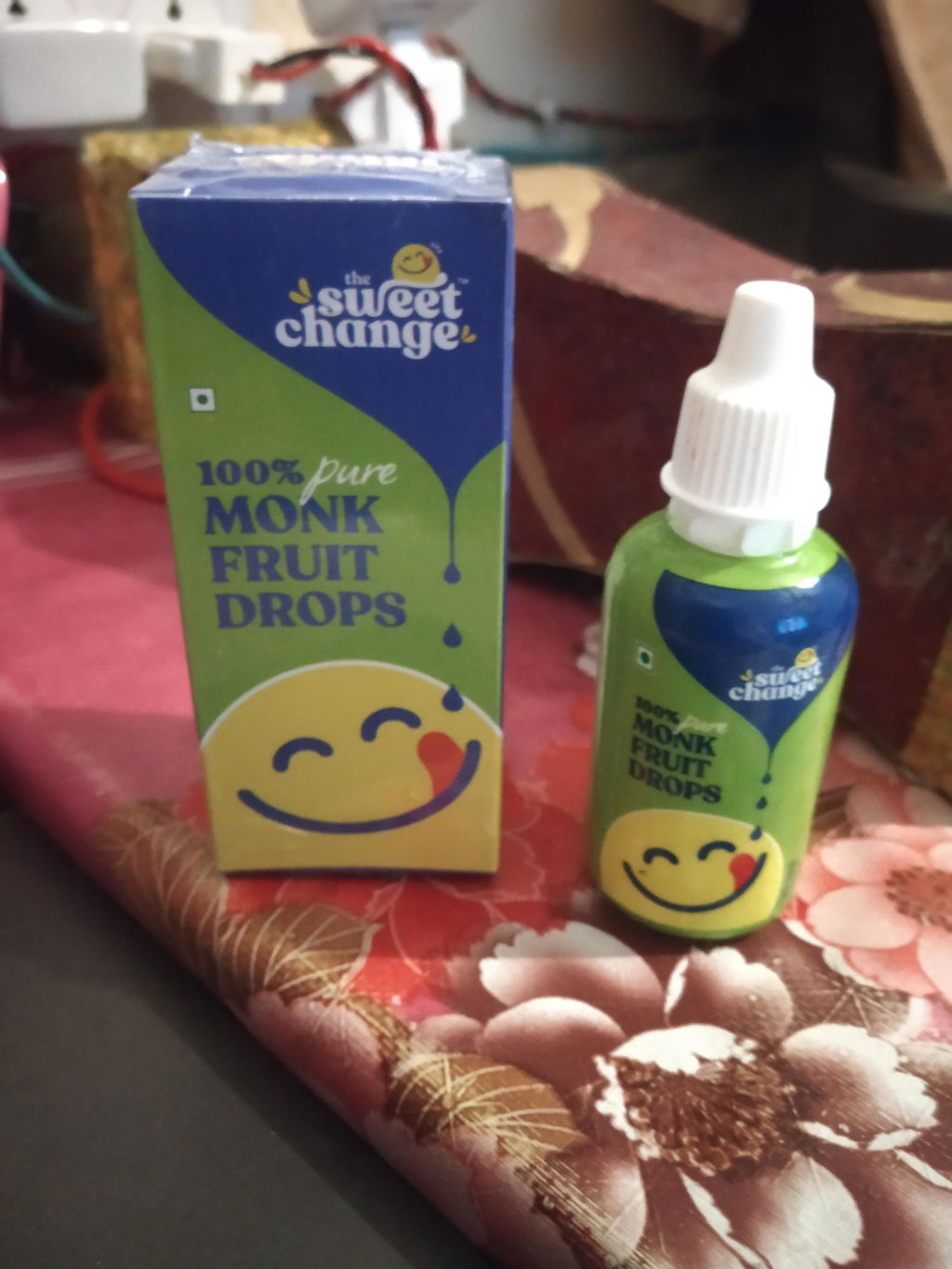
At The Sweet Change: our monk fruit sweetener comes as drops and powder, with sachets coming. The Powder is made with monk fruit, guar fibre and allulose (30% / 35% / 35%), with no erythritol, and both the Drops and the Powder contain no erythritol or other sugar alcohols. With the Drops, two drops replace a teaspoon of sugar.
Movement belongs on the chart too
A PCOD diet is half of the routine. Healthy eating and physical activity are recommended for every woman with PCOS, and no one type or intensity of exercise has been shown to beat another [1].
The general target for adults is at least 150 minutes of moderate activity a week, and any activity is better than none; time spent sitting should be limited too [12]. A brisk 30-minute walk after dinner on five days of the week adds up to 150 minutes.
When to see your doctor
See your doctor if your periods are irregular, very heavy or have stopped, or if you notice severe acne, increased hair growth on the face, chest or belly, or dark, velvety skin patches [8].
Ask about your blood sugar too. Glycaemic status should be checked at diagnosis in every adult with PCOS and rechecked every 1 to 3 years, depending on other risk factors [1].
Supplements and medicines are a conversation for your doctor; this page does not cover them.
The short version for your kitchen
A good PCOD diet looks a lot like a good Indian diet with the sugar turned down: whole grains and millets, dal and curd, a full plate of sabzi, whole fruit, and fewer spoons in the chai. No single plan is proven better, so pick the version your family will eat every day.
Cheat sheet
- The plate: half vegetables, a quarter protein, a quarter whole grain or millet.
- Nothing banned: limit maida, sugary drinks, mithai and fried snacks; keep milk, rice and fruit.
- Sugar: under 5% of the day's energy, about six teaspoons; gur and honey count.
- Check-ups: ask about your blood sugar at diagnosis and every 1 to 3 years.
- Move: at least 150 minutes of moderate activity a week; any amount helps.
Monk fruit sweetener, drops and powder, with sachets coming. Contains no erythritol or other sugar alcohols. See the monk fruit sweetener
Questions people ask
What not to eat in PCOS?
Nothing has to be banned: the 2023 international PCOS guideline found no evidence that one type of diet beats another and advises against unduly restrictive diets, so milk, rice and fruit can stay. The foods worth cutting back first are maida and bakery items, sugary drinks and packaged juice, mithai, and fried or packaged snacks.
PCOD me kya nahi khana chahiye?
Start by limiting the foods that carry the most sugar and refined flour: biscuits, white bread, cola, packaged juice and mithai, plus namkeen and fried snacks. The WHO's healthy-diet advice counts the sugar in honey, and sugar added by the cook such as gur in chai, as free sugar to keep low.
PCOS me kya khaye?
Build each meal on a plate: half vegetables, a quarter protein such as dal, paneer, curd or eggs, and a quarter whole grain or millet. ICMR-NIN's dietary guidelines for Indians advise whole grains and millets over refined grains, and keeping sugar under 5% of the day's energy.
Lean PCOS me kya khana chahiye?
The same healthy plate, without a calorie cut unless your doctor asks for one. The 2023 international PCOS guideline says a healthy lifestyle brings benefits even without weight loss. India's 2024 national study of women aged 18 to 40 found that 43.2% of women with PCOS were obese, so most were not.
 Monk Fruit Drops (100 servings)
Rs. 497.00
Monk Fruit Drops (300 servings)
Rs. 1,197.00
 Monk Fruit Powder No Erythritol (100 servings)
Rs. 675.00
Monk Fruit Powder No Erythritol (300 servings)
Rs. 1,493.00
Related articles


Written by
Sheen Hitaishi · Chief Brand Officer and Co-Founder
4 years in content writing · Sri Venkateswara College, University of Delhi
Sheen Hitaishi is Chief Brand Officer and Co-Founder of The Sweet Change, which she started with her sister, Manvi Agnihotri. She runs our social media, customer retention and customer care. Before The Sweet Change she spent four years as a content writer, most recently Senior Content Writer at Univest. She studied at Sri Venkateswara College, University of Delhi.
Disclosure: Co-founder of The Sweet Change

Reviewed by
Jatin Agnihotri · COO and Co-Founder
MBA, Indian School of Business · 12 years in technology and security
Jatin Agnihotri is COO and Co-Founder of The Sweet Change, where he runs operations, from manufacturers and vendors to shipping and logistics, and creates content for our Instagram. He spent 12 years in technology at Honda Cars India, Extramarks Education, where he was Vice President IT, and Jio Platforms. He holds an MBA from ISB.
Disclosure: Co-founder of The Sweet Change

Medically reviewed by
Manvi Agnihotri · CEO and Co-Founder
12 years in clinical nutrition, over 11,000 patients · M.Sc Food and Nutrition, silver medallist
Manvi Agnihotri is CEO and Co-Founder of The Sweet Change. She holds an M.Sc in Food and Nutrition, in which she was a silver medallist, and has led brand strategy and patient and doctor education at Breathe Well-being, a diabetes care programme. She reviews our health and nutrition pages before they go live.
Reviews: Nutrition and food science, Blood sugar and diabetes diet
Disclosure: Co-founder of The Sweet Change
Sources
- Teede HJ, Tay CT, Laven JJE, et al. (2023). Recommendations From the 2023 International Evidence-based Guideline for the Assessment and Management of Polycystic Ovary Syndrome. Journal of Clinical Endocrinology & Metabolism, 108(10), 2447-2469. DOI https://doi.org/10.1210/clinem/dgad463 and full text https://pmc.ncbi.nlm.nih.gov/articles/PMC10505534/
- ICMR-National Institute of Nutrition (2024). Dietary Guidelines for Indians, English booklet. ICMR-NIN, Hyderabad. https://www.nin.res.in/downloads/DGI_Booklet_English_CMYK.pdf
- World Health Organization (2026). Healthy diet, fact sheet, 26 January 2026. WHO, Geneva. https://www.who.int/news-room/fact-sheets/detail/healthy-diet
- US Department of Health and Human Services, Office on Women's Health (accessed October 2026). Polycystic ovary syndrome. womenshealth.gov. https://womenshealth.gov/a-z-topics/polycystic-ovary-syndrome
- Ganie MA, Chowdhury S, Malhotra N, et al. (2024). Prevalence, Phenotypes, and Comorbidities of Polycystic Ovary Syndrome Among Indian Women. JAMA Network Open, 7(10), e2440583. DOI https://doi.org/10.1001/jamanetworkopen.2024.40583 and full text https://pmc.ncbi.nlm.nih.gov/articles/PMC11581580/
- Meczekalski B (2023). Polycystic Ovary Syndrome: Past, Present and Future. Journal of Clinical Medicine, 12(11), 3808. DOI https://doi.org/10.3390/jcm12113808 and full text https://pmc.ncbi.nlm.nih.gov/articles/PMC10254039/
- Teede HJ, Khomami MB, Morman R, et al.; Global Name Change Consortium (2026). Polyendocrine metabolic ovarian syndrome, the new name for polycystic ovary syndrome: a multistep global consensus process. The Lancet, 407, 2329-2339. DOI https://doi.org/10.1016/S0140-6736(26)00717-8
- US National Institute of Child Health and Human Development (2024). What are the symptoms of PCOS? Last reviewed 21 August 2024. NICHD, Bethesda. https://www.nichd.nih.gov/health/topics/pcos/conditioninfo/symptoms
- American Diabetes Association (undated). Tips for Eating Well: the Diabetes Plate. ADA, Arlington. https://diabetes.org/food-nutrition/eating-healthy
- The Sweet Change (2026). Post-purchase survey of our own buyers. Internal data; percentages are whole-number shares of the buyers who answered each question. https://www.thesweetchange.com/
- US Food and Drug Administration (2025). Aspartame and Other Sweeteners in Food. FDA, content current as of 27 February 2025. https://www.fda.gov/food/food-additives-petitions/aspartame-and-other-sweeteners-food
- World Health Organization (2024). Physical activity, fact sheet, 26 June 2024. WHO, Geneva. https://www.who.int/news-room/fact-sheets/detail/physical-activity
The Sweet Change makes the products mentioned on this page. How we write and review