Natural sweetener for weight loss: which to pick, and the honest catch
 Written byJatin AgnihotriCOO and Co-Founder, The Sweet Change
 Reviewed byKapil GroverrChief Business Officer and Co-Founder, The Sweet Change
 Medically reviewed byManvi AgnihotriCEO and Co-Founder, The Sweet Change


No sweetener makes you lose weight on its own, and the WHO advises against relying on non-sugar sweeteners for weight control. A natural sweetener for weight loss helps only when it takes the place of sugar you were already eating, such as the spoons in your chai, and the calories do not come back elsewhere. If you do swap, our pick is monk fruit made without sugar alcohols.
Key takeaways
- Small effect at best: swapping sugar for a sweetener showed a weight difference of about 1.35 kg in trials, and one review found no effect in people actively dieting [1] [2].
- The WHO advice: the 2023 guideline recommends against using non-sugar sweeteners to control body weight, and it is rated conditional [3].
- The chai sum: three cups a day with two teaspoons each add about 100 kcal a day [4] [5].
- Still sugar: cane jaggery has about 354 kcal per 100 g, so gur is not a lighter sugar [6].
- Our pick: for daily chai, a monk fruit sweetener made without sugar alcohols.
Discuss with your doctor or dietitian before changing your diet, especially if you take diabetes medicines.
On this page
- What a natural sweetener for weight loss can and cannot do
- What the WHO said in 2023, and what it did not
- Where sugar calories hide in an Indian day
- Natural sweeteners for weight loss, one by one
- Artificial sweeteners and "sugar free" tablets
- Sugar alcohols: low calorie, with a catch
- Gur, honey and dates: natural, but still sugar
- Which sweetener is best for weight loss: our verdict
- Making the swap stick in chai and coffee
- Sugar substitutes for weight loss in mithai and baking
- Sources
If you are trying to lose weight with a medical condition or on medicines, talk to your doctor or a dietitian before changing your diet.
What a natural sweetener for weight loss can and cannot do
You are doing the work. The early alarm for the walk, dal and roti instead of the 4 pm samosa, the biscuit tin moved out of sight. Then the office chai arrives with two spoons of sugar, and quietly takes back a little of the day.
So the question is fair: if a sweetener replaces that sugar, does the weight follow? Here the honest answer matters more than the hopeful one, and the honest answer has two halves.
The first half is encouraging. When trials gave people a sweetener in place of sugar for anywhere from four weeks to forty months, the sweetener group ended up about 1.35 kg lighter across nine comparisons [1].
The second half is sobering. A review commissioned for the WHO found no evidence of any effect from sweeteners in overweight adults or children who were actively trying to lose weight, with very low to moderate certainty [2].
Both can be true. A swap saves calories only if they stay saved, and people differ.
In one small trial of 30 men, the calories saved by a sweetened drink were eaten back at the meals that followed [7]. In another single-day study of 31 adults, people given stevia or aspartame before meals did not eat more later [8].
A non-sugar sweetener is an ingredient that tastes sweet but adds little or no sugar and few or no calories to a food or drink. Our guide to every type of sweetener covers the whole shelf; this page asks only what each one does for someone cutting sugar to lose weight.
In short: a natural sweetener for weight loss is a swap, not a tool. It earns its place when the spoon of sugar leaves your chai and nothing sweeter sneaks in to replace it.
What the WHO said in 2023, and what it did not
The WHO looked at the evidence in 2023 and recommended against using non-sugar sweeteners to control body weight or to cut the risk of long-term disease. The recommendation covers natural and synthetic sweeteners alike, it is conditional because the long-term links in the evidence might be confounded, and it applies to everyone except people who already have diabetes [3].
One thing it did not cover: low-calorie sugars and sugar alcohols, which it does not count as non-sugar sweeteners [3]. The surer advice from the same body is to cut free sugars and make the whole diet less sweet, without leaning on sweeteners to do it [3] [4].
If you have diabetes, the weight advice is not written for you; our guide to sweeteners for diabetes covers that ground.
Using a sweetener for weight loss still makes sense as a swap, with your eyes open: cut the spoons first. A sweetener keeps the chai pleasant while you do, and that is the whole of its job.
Where sugar calories hide in an Indian day
Nobody in India eats sugar from the dabba with a spoon. It goes into chai, into the coffee at 4 pm, into the kheer on Sunday, and into the biscuits that come with every cup.
Here is our own arithmetic, so you can check it. A level teaspoon of sugar is about 4.2 g, and sugar gives about 387 kcal per 100 g, so one teaspoon is roughly 16 kcal [4] [5]. Three cups of chai with two teaspoons each is six teaspoons, about 100 kcal a day, close to 3,000 kcal a month, from chai alone.
Set that against the limits. The WHO puts free sugars under 10% of daily energy, which is 50 g or about 12 level teaspoons on a 2,000 kcal day, and says 5% is better still [4].
ICMR-National Institute of Nutrition, in its 2024 dietary guidelines, asks adults to keep sugar under 5% of daily energy [9]. Six spoons of chai sugar, about 25 g, is already about all of that on a 2,000 kcal day.
This is why "sugar free for weight loss" is really a question about cutting sugar, and the sweetener is the smaller part of it. In our survey of our own buyers, 46% said a weight or fitness goal nudged them to cut down on sugar [10].
In short: count the spoons before you choose a natural sweetener for weight loss. The chai alone can use up half the WHO's daily free-sugar limit.
Natural sweeteners for weight loss, one by one
Which natural sweetener is best for weight loss depends on what you want it to do in the cup: add no sugar, add few or no calories, taste clean, and survive the heat of a boiling chai. Three plant-derived options come up again and again, and each has a limit worth knowing.
Monk fruit
Monk fruit (Siraitia grosvenorii, luo han guo) is a fruit whose extract is a non-nutritive sweetener, so it adds few or no calories, and it is heat-stable, so it goes into cooking and baking [11].
The plant is native to southern China, and depending on the mogroside content the extract is 100 to 250 times sweeter than sugar. The US FDA has not questioned the GRAS notices for the extract and has set no daily limit, saying one may not be needed [12].
People ask whether monk fruit sugar is good for weight loss, and the honest claim is this: it adds no sugar to the cup. In the 30-man trial above, a 65 g sugar drink caused large spikes in blood sugar and insulin in the first hour, and the monk fruit drink did not [7].
The limit is history, not harm. Monk fruit has fewer long-term human studies than older sweeteners, and in our own search of the trial registers we found no long trial that tested monk fruit as a weight-loss tool in people. The evidence on its safety is a separate question, covered in is monk fruit safe.
One kitchen note. A pinch of extract cannot fill a spoon, so if a "monk fruit" pack measures spoon for spoon like sugar, turn it over and read what fills the spoon; when we checked 40 monk fruit powders sold online in India on 13 October 2026, more than half contained erythritol.
Stevia
Stevia is a non-nutritive sweetener from a leaf, and it provides zero calories [11]. Its steviol glycosides are 200 to 400 times sweeter than sugar [12]. In the single-day study above, stevia before meals did not lead to eating more later, which is a point in its favour as a swap.
The catch is taste. Some people notice a bitter aftertaste, and researchers have traced it to two bitter-taste receptors on the tongue that respond to steviol glycosides [13]. If you are one of those people, hot chai is where you will notice it most.
Allulose
Allulose is a rare sugar found in small amounts in wheat, raisins and dried figs [14]. It is the odd one out here because it has bulk. An allulose sweetener for weight loss makes most sense in baking, where it measures more like sugar in a batter than a few drops of extract do.
Read the Indian label with care. In the US, labels count allulose at 0.4 kcal per gram [14]. Indian labelling rules list no separate factor for allulose and count carbohydrate at 4 kcal per gram, so a pack sold here may show it as sugar and count its calories like sugar's [15].
Artificial sweeteners and "sugar free" tablets
Which artificial sweetener is best for weight loss is the question behind most "sugar free" tablets on an Indian shelf, because that is usually what they are. Sucralose is about 600 times sweeter than sugar and heat-stable; aspartame is about 200 times sweeter and loses its sweetness when heated [12].
Both are artificial, and both sit inside the WHO advice above. Indian labelling rules also require table-top sweeteners with aspartame to carry a warning that they are not recommended for people with phenylketonuria, children with seizure disorders, or pregnant or breastfeeding women [15].
The answer to "is sugar free good for weight loss" is: only as a swap. A tablet adds almost nothing to the cup, and that is useful. It does not change what is on the plate, and a "sugar-free" biscuit is still a biscuit.
Our view is that monk fruit without sugar alcohols does the same job in the cup without being artificial. The full list is in the artificial sweeteners list.
Sugar alcohols: low calorie, with a catch
Erythritol, xylitol and the other sugar alcohols are what give many "monk fruit" and "stevia" powders their spoon-for-spoon bulk. Indian labelling rules count most sugar alcohols at 2 kcal per gram and erythritol at 0, and they note that sugar alcohols can have a laxative effect [15]. In plain words: large amounts can mean loose motions.
Then, in 2023, a study of people already under heart evaluation linked higher blood erythritol to heart attack, stroke and death over the following three years [16]. That study is a link, not proof; the US FDA said its observational data did not establish a causal link [12].
It still sent many people back to reading labels. More on the whole class is in are sweeteners safe.
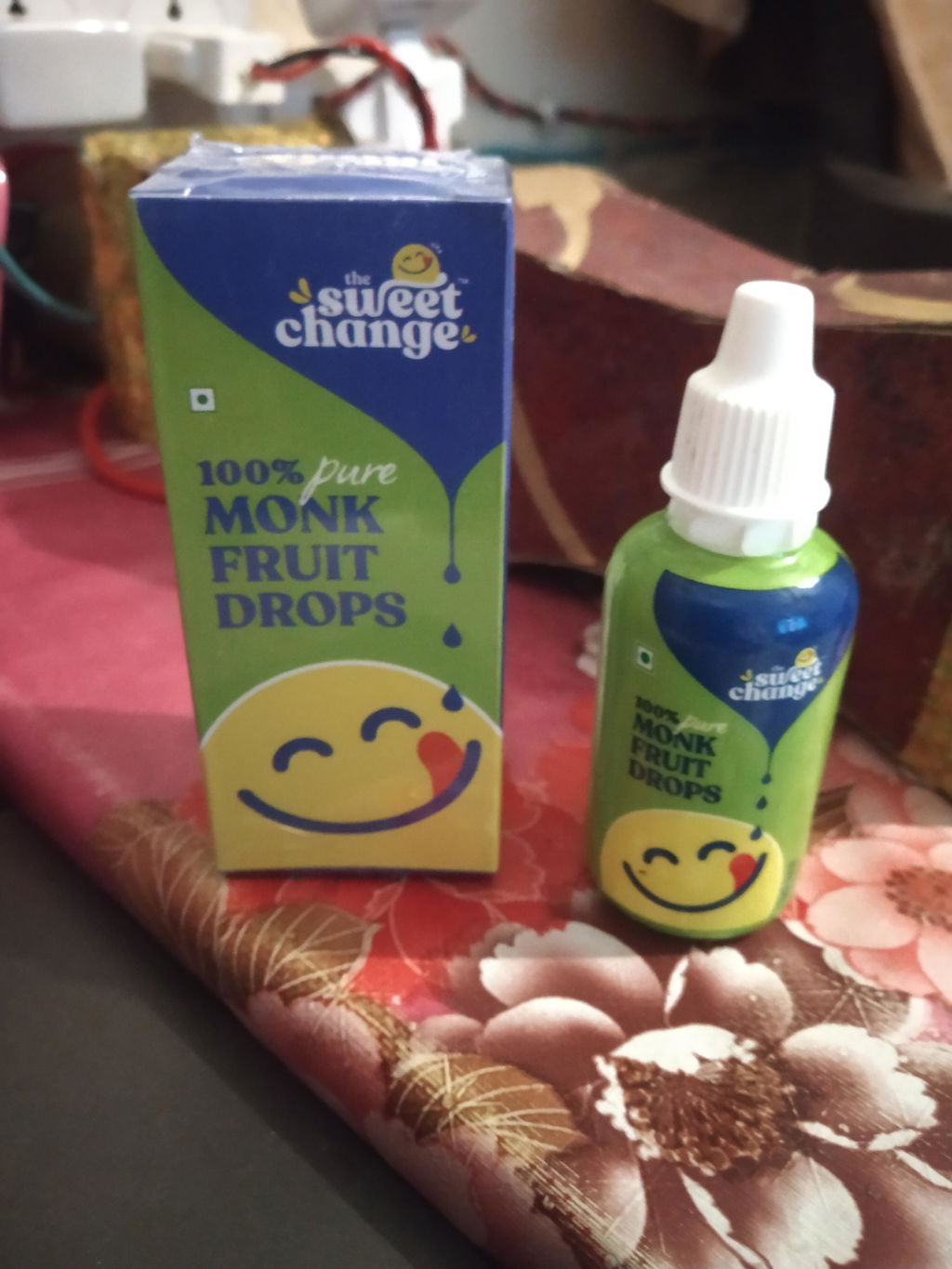
At The Sweet Change: our Powder is made with monk fruit, guar fibre and allulose, with no erythritol, and our Drops contain no erythritol or other sugar alcohols. Our monk fruit sweetener comes as drops and powder, with sachets coming.
Gur, honey and dates: natural, but still sugar
The best sugar for weight loss is less of it. That line is not a dodge; it is what the numbers say when you look at the "healthier" sugars. This is where the phrase natural sweetener for weight loss misleads people, because gur, honey and dates are natural, and they are mostly sugar.
Cane jaggery gives about 354 kcal per 100 g, and 84 g of every 100 g is sugar [6]. Honey has a glycemic index of 61 against table sugar's 65, so both sit in the medium band [17]. The free-sugar limits above count honey and syrups as well as the white sugar in the dabba [4].
Dates and coconut sugar belong in the same drawer. Medjool dates are about two-thirds sugar, at 277 kcal per 100 g [18], and coconut sugar added by the cook is a free sugar [4].
Swapping the spoon of sugar in your chai for a spoon of gur changes the flavour, and barely the calories. The full comparisons are in jaggery vs sugar and monk fruit vs jaggery.
Which sweetener is best for weight loss: our verdict
For daily chai and coffee, our pick of natural sweetener for weight loss is a monk fruit sweetener made without sugar alcohols. We judged every option on six things: no sugar added, few or no calories, no sugar alcohols, not artificial, a clean taste in hot chai, and it survives cooking.
Monk fruit without sugar alcohols passes all six.
The best sweetener for weight loss after that is stevia, if the aftertaste does not bother you. Allulose is the best sugar substitute for weight loss when you are baking, as long as you know an Indian label may count it as sugar.
Sucralose and aspartame work in the cup, and they are artificial. Gur, honey and dates are mostly sugar.
So the best sugar alternative for weight loss is not a magic ingredient. It is the one that lets you take the spoon out of your chai and keep drinking the chai.
How we compared: confidence is how sure we are of the pick for daily chai and cooking; it is our view, not a grade of the research. It weighs the six criteria above equally.
| Option | Calories it adds | Our view for daily chai | Confidence |
|---|---|---|---|
| Monk fruit, no sugar alcohols | None or almost none | Our pick | High confidence |
| Stevia | None | Good if the aftertaste suits you | Moderate confidence |
| Allulose | Few on US labels; counted as sugar in India | Better for baking | Moderate confidence |
| Sucralose, aspartame | None or few | Artificial | Low confidence |
| Erythritol and other sugar alcohols | 0 to 2 kcal/g on Indian labels | Gut catch | Low confidence |
| Gur, honey, dates | Close to sugar's | Still sugar | No label |
Making the swap stick in chai and coffee
The cup you drink most often is where a natural sweetener for weight loss pays off, so start there and nowhere else. Sugar alternatives for tea for weight loss fail for one reason: the change is too big on day one, the chai tastes wrong, and by Thursday the spoon is back.
Halve the sugar for a week first. Your tongue resets faster than you expect, and the half-sweet chai becomes the normal one.
Then swap the remaining spoon for the sweetener, a little at a time. These ingredients are concentrated, so one drop or a small pinch too many tips a cup from pleasant to cloying. Taste, then add.
Last, watch the biscuit. A "free" cup has a way of inviting cravings for a second Marie, and that is exactly how the calories saved in the cup come back on the plate. The chai is the swap; the biscuit is the habit.
Sugar substitutes for weight loss in mithai and baking
Sugar substitutes for weight loss do their best work in the cup and their worst work on the label of a sweet. A "sugar-free" kaju katli or a "no added sugar" biscuit still has its maida, its ghee and its calories; only the white sugar has moved out.
Read the energy line on the pack before the "sugar-free" badge on the front. If the kcal per 100 g sits close to the regular version, the sweetener has changed the sugar, not the sweet.
At home the rule is a measured swap. Work out how much sweetener stands in for the sugar the recipe asks for, add it to the kheer or the halwa in one go, and taste before you serve.
Kheer stays kheer when the milk reduces slowly and the cardamom goes in at the end.
Cheat sheet
- The rule: a natural sweetener for weight loss helps only as a swap for sugar you already eat, and only if the calories stay saved.
- The advice: the WHO recommends against relying on non-sugar sweeteners for weight control; cut free sugars first.
- The sum: six teaspoons of chai sugar a day is about 100 kcal and close to 3,000 kcal a month.
- Still sugar: gur, honey and dates add calories like sugar does; honey's GI is 61, table sugar's 65.
- Our pick: monk fruit without sugar alcohols for chai; stevia if the aftertaste suits you; allulose for baking.
A sweetener is a small lever, and you have pulled bigger ones already. Keep the walk, keep the dal, and let a natural sweetener for weight loss do the one thing it can: keep the chai sweet while the sugar stays in the dabba.
Questions people ask
Can I use sweetener for weight loss?
Yes, as a swap for sugar you already eat, such as the spoons in your chai. The WHO's 2023 guideline advises against relying on non-sugar sweeteners for weight control, because the long-term evidence shows no lasting benefit, so cut the spoons too. A sweetener keeps the chai pleasant while you do; it is not a weight-loss tool on its own.
Which sweetener to use for weight loss?
For daily chai our pick of natural sweetener for weight loss is monk fruit made without sugar alcohols: it adds no sugar, few or no calories, and tastes clean when boiled. Stevia is next if its aftertaste suits you, and allulose suits baking. Gur and honey count as free sugars for the WHO, so swapping to them saves little.
Is sugar free good for weight loss?
"Sugar free" tablets are usually artificial sweeteners such as sucralose or aspartame. They add almost no calories to a cup, which helps a little, but the WHO's 2023 advice against relying on sweeteners for weight control covers them too. A sugar-free sweet can still be high in calories from maida and ghee, so read the energy line.
Do artificial sweeteners slow weight loss?
The reviews do not show that. A 2019 systematic review prepared for the WHO found no evidence of any effect, in either direction, in overweight adults or children actively trying to lose weight, at very low to moderate certainty. What can slow you down is eating the saved calories back, which a 2017 trial in 30 men saw.
Is monk fruit sugar good for weight loss?
It adds no sugar and almost no calories to the cup, so it can replace the sugar in your chai; in a 2017 trial of 30 men the monk fruit drink caused no spike in glucose or insulin, unlike the sugar drink. No sweetener is a weight-loss tool on its own. Check the pack's label for erythritol or other fillers.
What is the best sugar for weight loss?
No sugar slims. The WHO counts gur, honey, coconut sugar and brown sugar as free sugars, and cane jaggery has nearly as many calories as white sugar in the ICMR-NIN and USDA food tables. The best amount is less: the WHO wants free sugars kept to a small share of daily energy, and ICMR-NIN sets a tighter limit for adults.
 Monk Fruit Drops (100 servings)
Rs. 497.00
Monk Fruit Drops (200 servings)
Rs. 971.00
Monk Fruit Drops (100 servings)
Rs. 497.00
Monk Fruit Drops (200 servings)
Rs. 971.00
 Monk Fruit Powder No Erythritol (100 servings)
Rs. 675.00
Monk Fruit Powder No Erythritol (300 servings)
Rs. 1,493.00
Monk Fruit Powder No Erythritol (100 servings)
Rs. 675.00
Monk Fruit Powder No Erythritol (300 servings)
Rs. 1,493.00
Related articles


Written by
Jatin Agnihotri · COO and Co-Founder
MBA, Indian School of Business · 12 years in technology and security
Jatin Agnihotri is COO and Co-Founder of The Sweet Change, where he runs operations, from manufacturers and vendors to shipping and logistics, and creates content for our Instagram. He spent 12 years in technology at Honda Cars India, Extramarks Education, where he was Vice President IT, and Jio Platforms. He holds an MBA from ISB.
Disclosure: Co-founder of The Sweet Change

Reviewed by
Kapil Groverr · Chief Business Officer and Co-Founder
IIM Lucknow alumnus · 18 years in marketing
Kapil Groverr is Co-Founder and Chief Business Officer of The Sweet Change, where he leads growth and marketing. He has 18 years in marketing, most recently as Vice President Marketing at Breathe Well-being and before that Head of Digital Marketing at King Koil. An IIM Lucknow alumnus, he writes our sweetener guides and comparisons.
Writes about: Sweetener guides and comparisons
Disclosure: Co-founder of The Sweet Change

Medically reviewed by
Manvi Agnihotri · CEO and Co-Founder
12 years in clinical nutrition, over 11,000 patients · M.Sc Food and Nutrition, silver medallist
Manvi Agnihotri is CEO and Co-Founder of The Sweet Change. She holds an M.Sc in Food and Nutrition, in which she was a silver medallist, and has led brand strategy and patient and doctor education at Breathe Well-being, a diabetes care programme. She reviews our health and nutrition pages before they go live.
Reviews: Nutrition and food science, Blood sugar and diabetes diet
Disclosure: Co-founder of The Sweet Change
Sources
- Rogers PJ, Hogenkamp PS, de Graaf C, et al. 2016. Does low-energy sweetener consumption affect energy intake and body weight? A systematic review, including meta-analyses, of the evidence from human and animal studies. International Journal of Obesity 40(3):381-394. https://doi.org/10.1038/ijo.2015.177
- Toews I, Lohner S, Küllenberg de Gaudry D, Sommer H, Meerpohl JJ. 2019. Association between intake of non-sugar sweeteners and health outcomes: systematic review and meta-analyses of randomised and non-randomised controlled trials and observational studies. BMJ 364:k4718. https://doi.org/10.1136/bmj.k4718
- World Health Organization. 2023. WHO advises not to use non-sugar sweeteners for weight control in newly released guideline. Departmental update, 15 May 2023. WHO, Geneva. https://www.who.int/news/item/15-05-2023-who-advises-not-to-use-non-sugar-sweeteners-for-weight-control-in-newly-released-guideline
- World Health Organization. 2026. Healthy diet, fact sheet. WHO, Geneva. https://www.who.int/news-room/fact-sheets/detail/healthy-diet
- US Department of Agriculture, Agricultural Research Service. 2019. FoodData Central, SR Legacy 169655, Sugars, granulated. USDA, Beltsville. https://fdc.nal.usda.gov/fdc-app.html#/food-details/169655/nutrients
- Longvah T, Ananthan R, Bhaskarachary K, Venkaiah K. 2017. Indian Food Composition Tables 2017, food I001, Jaggery, cane. ICMR-National Institute of Nutrition, Hyderabad. https://www.nin.res.in/ebooks/IFCT2017.pdf
- Tey SL, Salleh NB, Henry J, Forde CG. 2017. Effects of aspartame-, monk fruit-, stevia- and sucrose-sweetened beverages on postprandial glucose, insulin and energy intake. International Journal of Obesity 41(3):450-457. https://doi.org/10.1038/ijo.2016.225
- Anton SD, Martin CK, Han H, et al. 2010. Effects of stevia, aspartame, and sucrose on food intake, satiety, and postprandial glucose and insulin levels. Appetite 55(1):37-43. https://doi.org/10.1016/j.appet.2010.03.009
- ICMR-National Institute of Nutrition. 2024. Dietary Guidelines for Indians (English booklet). ICMR-NIN, Hyderabad. https://www.nin.res.in/downloads/DGI_Booklet_English_CMYK.pdf
- The Sweet Change. 2026. Survey of our own buyers (whole-number percentages of buyers who answered). The Sweet Change, as quoted on our sweeteners guide. https://www.thesweetchange.com/blogs/sweeteners/sweeteners-detailed-guide
- MedlinePlus Medical Encyclopedia, US National Library of Medicine. 2025. Sweeteners - sugar substitutes (reviewed 3 July 2025). https://medlineplus.gov/ency/article/007492.htm
- US Food and Drug Administration. 2025. Aspartame and Other Sweeteners in Food (content current as of 27 February 2025). FDA, Silver Spring. https://www.fda.gov/food/food-additives-petitions/aspartame-and-other-sweeteners-food
- Hellfritsch C, Brockhoff A, Stähler F, Meyerhof W, Hofmann T. 2012. Human psychometric and taste receptor responses to steviol glycosides. Journal of Agricultural and Food Chemistry 60(27):6782-6793. https://doi.org/10.1021/jf301297n
- US Food and Drug Administration. 2020. The Declaration of Allulose and Calories from Allulose on Nutrition and Supplement Facts Labels: Guidance for Industry. FDA, Silver Spring. https://www.fda.gov/media/123342/download
- Food Safety and Standards Authority of India. 2020. Food Safety and Standards (Labelling and Display) Regulations, 2020 (compendium Version IV, 23 September 2022), regulations 5(2)(b) and 5(3)(e)(i). FSSAI, New Delhi. https://www.fssai.gov.in/upload/uploadfiles/files/Compendium_Labelling_Display_23_09_2022.pdf
- Witkowski M, Nemet I, Alamri H, et al. 2023. The artificial sweetener erythritol and cardiovascular event risk. Nature Medicine 29(3):710-718. https://doi.org/10.1038/s41591-023-02223-9
- Atkinson FS, Foster-Powell K, Brand-Miller JC. 2008. International Tables of Glycemic Index and Glycemic Load Values: 2008. Diabetes Care 31(12):2281-2283. https://doi.org/10.2337/dc08-1239
- US Department of Agriculture, Agricultural Research Service. 2019. FoodData Central, SR Legacy 168191, Dates, medjool. USDA, Beltsville. https://fdc.nal.usda.gov/fdc-app.html#/food-details/168191/nutrients
The Sweet Change makes the products mentioned on this page. How we write and review