Allulose sweetener: what it is, how it tastes and is it safe?
 Written byKapil GroverrChief Business Officer and Co-Founder, The Sweet Change
 Reviewed byJatin AgnihotriCOO and Co-Founder, The Sweet Change
 Nutrition reviewed byManvi AgnihotriCEO and Co-Founder, The Sweet Change


Allulose sweetener is a rare sugar, found in tiny amounts in figs and raisins, that tastes close to sugar but gives the body almost no energy. It is usually described as about 70% as sweet as sugar, browns like sugar in cooking, and large single servings can upset the stomach. In India it is allowed through FSSAI product approvals, and labels count it as a sugar.
Key takeaways
- A sugar the body cannot use: allulose is absorbed but not burned for energy, and most of it leaves in the urine [1] [2].
- A sugar on Indian labels: FSSAI's definition of "sugars" covers every monosaccharide, allulose included [3].
- The stomach line: in 30 young healthy adults, single servings up to 0.4 g per kg of body weight caused no severe symptoms; 0.5 g per kg did [4].
- It browns: baked goods made with allulose come out with a darker crust, so watch the heat [5].
- For daily chai, monk fruit does the sweetening: its extract is 100 to 250 times sweeter than sugar [6], while allulose is better for bulk.
On this page
- What is allulose?
- How sweet is it, and how many calories?
- Does allulose count as sugar on Indian labels?
- What it does to blood sugar
- In chai, halwa and baking: it browns
- Side effects: how much is too much?
- Is allulose sweetener safe? What regulators say
- Can the pack say "natural"?
- Next to monk fruit: two different jobs
- At The Sweet Change
- Cheat sheet
- Sources
You turn the pack over, as we keep telling you to, and the second ingredient says "allulose". It ends in "-ose", like glucose and sucrose, so the obvious worry follows: is this just sugar wearing a new name?
That is the right question to ask about any allulose sweetener, and the answer has two halves, one for your body and one for the Indian label. This page covers both, and where it sits among the other ingredients in our guide to sweetener ingredients.
What is allulose?
Allulose is a rare sugar, also called D-psicose, with the same formula as fructose but a different shape. It occurs naturally, in tiny amounts, in figs, raisins and wheat [1].
Nobody is pressing figs to fill a pack, though. The allulose on sale starts as fructose, which an enzyme flips into the allulose shape [1] [2].
Here is the part that makes it interesting. Your gut absorbs it, but your body has no enzyme that can break it down for energy, so most of what you eat passes out unchanged in the urine [2].
So it is a sugar by shape and a near-zero by use. It is not a sugar alcohol either: erythritol and maltitol belong to that different family, and the difference matters when you read a label [6].
One more label habit. "Pure allulose" means the pack is only allulose; most sweeteners sold here are blends, and a blend takes its character from whatever is listed first.
How sweet is it, and how many calories?
An allulose sweetener does not match sugar spoon for spoon. It is usually described as about 70% as sweet as sugar, so a recipe needs a little more of it, not less [1].
People also search for "allulose sweetener aftertaste". Among the sources we read there is no study on that, so taste it in your own cup before you judge a whole pack.
Calories are where India and the US part ways. US nutrition labels count allulose at 0.4 kcal per gram, about a tenth of sugar's 4 [1]. FSSAI's energy factors have no separate line for allulose, so an Indian label counts it with the other carbohydrates, at 4 kcal per gram [7].
What that means in the shop: the same spoon of allulose can show one calorie number on an imported pack and ten times that on an Indian one. Neither label is lying; they are using different rulebooks.
Does allulose count as sugar on Indian labels?
Yes. FSSAI defines "sugars" as all monosaccharides and disaccharides, and allulose is a monosaccharide, so it counts toward the sugars line on an Indian pack [3] [1].
The US went the other way. There, the FDA lets brands leave allulose out of Total Sugars and Added Sugars on the Nutrition Facts label [1]. Indian labelling rules have no such exception, which is why a pack that reads "0 g sugar" abroad cannot say the same thing here.
So on an Indian shelf the sugars line can look alarming for a product that your body barely uses. The honest fix is to read the ingredient list as well as the sugars line, and see which sugar it is.
What it does to blood sugar
The US FDA's conclusion is the one to hold on to: allulose produces only a negligible rise in blood glucose and insulin [1].
That sentence says a lot and it stops there. It is a finding about the ingredient, not a licence for any product, and it says nothing about what the rest of the recipe does. If you are reading this for someone with diabetes, our guide to sweeteners for diabetes goes through every option, and your doctor knows your numbers.
In chai, halwa and baking: it browns
Allulose is a sugar, so it does the one thing an extract cannot: it fills the spoon and browns in the pan.
In a study of scones, the ones made with allulose came out with a darker crust, which the researchers put down to the Maillard and caramelisation reactions; of the allulose versions, a mix of 30% allulose with xanthan gum came closest to the sugar version [5].
In your kitchen that means ladoo, cake or a tray of halwa will colour sooner than you expect. Lower the flame a notch, pull it a few minutes early, and check the colour rather than the clock.
For chai and coffee the browning does not come into it. There you only need sweetness, which is why a few drops of extract cover a cup while a baking sweetener needs bulk, and allulose supplies the bulk.
Side effects: how much is too much?
Allulose side effects are mostly about one organ, the gut, and they depend on how much you take at once: a large single serving can bring loose stools, bloating or stomach pain [4].
The study people quote tested exactly where that line sits.
In 30 healthy adults aged 21 to 30, a single dose of up to 0.4 g per kg of body weight caused no severe symptoms, 0.5 g per kg brought severe diarrhoea, and the authors suggested capping it at 0.4 g per kg at once and 0.9 g per kg over a day [4].
A longer trial adds the other half of the picture. Fifty healthy adults took 24 or 36 g a day for 30 days; about half reported mild, short-lived stomach symptoms, mostly in the first three days (we have read only the study's published summary, not the full paper) [8].
Its authors proposed a provisional limit of 0.4 g per kg of body weight a day for adults, until longer and larger studies confirm it [8].
One honest limit. The trials we read were short and in healthy young adults, so they do not tell you what happens to a child, an older parent or someone with IBS. If you have a digestive condition, check with your doctor before adding any new sweetener in quantity.
Our arithmetic from the single-dose study, for a quick kitchen check:
| Body weight | At most in one go | Daily cap in the single-dose study |
|---|---|---|
| 50 kg | 20 g | 45 g |
| 60 kg | 24 g | 54 g |
| 70 kg | 28 g | 63 g |
Is allulose sweetener safe? What regulators say
"Is allulose safe" and "allulose dangers" are two of the questions people ask most about it, so here is what the regulators that matter to an Indian kitchen have actually said.
India first. FSSAI permits allulose through product-by-product approvals under its non-specified food rules; the first allulose approval on its list dates from January 2020 and several more have followed [9]. That is approval for named products from named applicants, not a blanket ruling on the ingredient, so "FSSAI approved" on a pack is a claim to read carefully.
In the US, the FDA raised no questions about GRAS notices for allulose as a sugar substitute, for example GRAS Notice 693 in 2017 [10]. "No questions" is the FDA's way of accepting a company's safety case; it is not the same as a food-additive approval.
One question is still open, and it is fair to say so. In laboratory studies some gut bacteria can feed on allulose, and researchers want to know whether a high daily intake changes anything; we found no study showing harm in people from this, and the review we read lists it as an open question [2].
Can the pack say "natural"?
It depends what you mean, and in India the label has a rule. As we saw above, allulose exists in figs and raisins, but the allulose in a pack is made from fructose in a plant.
Indian claims rules let a label say "natural" only for a single food with nothing added and only the simple processing that makes it fit to eat, such as roasting, drying or freezing; a product with several ingredients may at most say "made from natural ingredients" if every one of them qualifies [3].
An enzyme converting one sugar into another is not on that list, so we would not put the word on an allulose pack, and we do not.
Next to monk fruit: two different jobs
Think of them as two different jobs. Monk fruit extract is 100 to 250 times sweeter than sugar, depending on its mogroside content, so a pinch does the work of a spoon [6]. Allulose sits much nearer to sugar in sweetness, so it gives a recipe body and browning, which an extract cannot.
For a cup of chai or coffee you want sweetness and nothing else, and here our pick is clear: monk fruit made without sugar alcohols. If you are weighing the safety side of that, our page on whether monk fruit is safe lays out the evidence.
Allulose earns its place when the dish needs bulk, which is why most allulose sweetener blends pair it with an extract such as monk fruit or stevia.
Our view, in one table:
| Pick | Best use | Confidence |
|---|---|---|
| Monk fruit (made without sugar alcohols) | Daily chai and coffee | High confidence |
| Allulose | Baking, halwa, anything that needs bulk | Moderate confidence |
Confidence is our view of how sure we are of the pick for that use, not a grade of the research. Every sweetener type in one place: the full guide to sweetener types.
At The Sweet Change
We use allulose for exactly the job above. Our Monk Fruit Sweetener Powder is made with monk fruit, guar fibre and allulose (30% / 35% / 35%), with no erythritol, so the monk fruit sweetens and the allulose and fibre fill the spoon.
That is the whole formula for a sweetener with allulose from us, printed on the back where you can read it in four seconds. In our survey of our own buyers, 31% said they chose us for no bitter aftertaste.
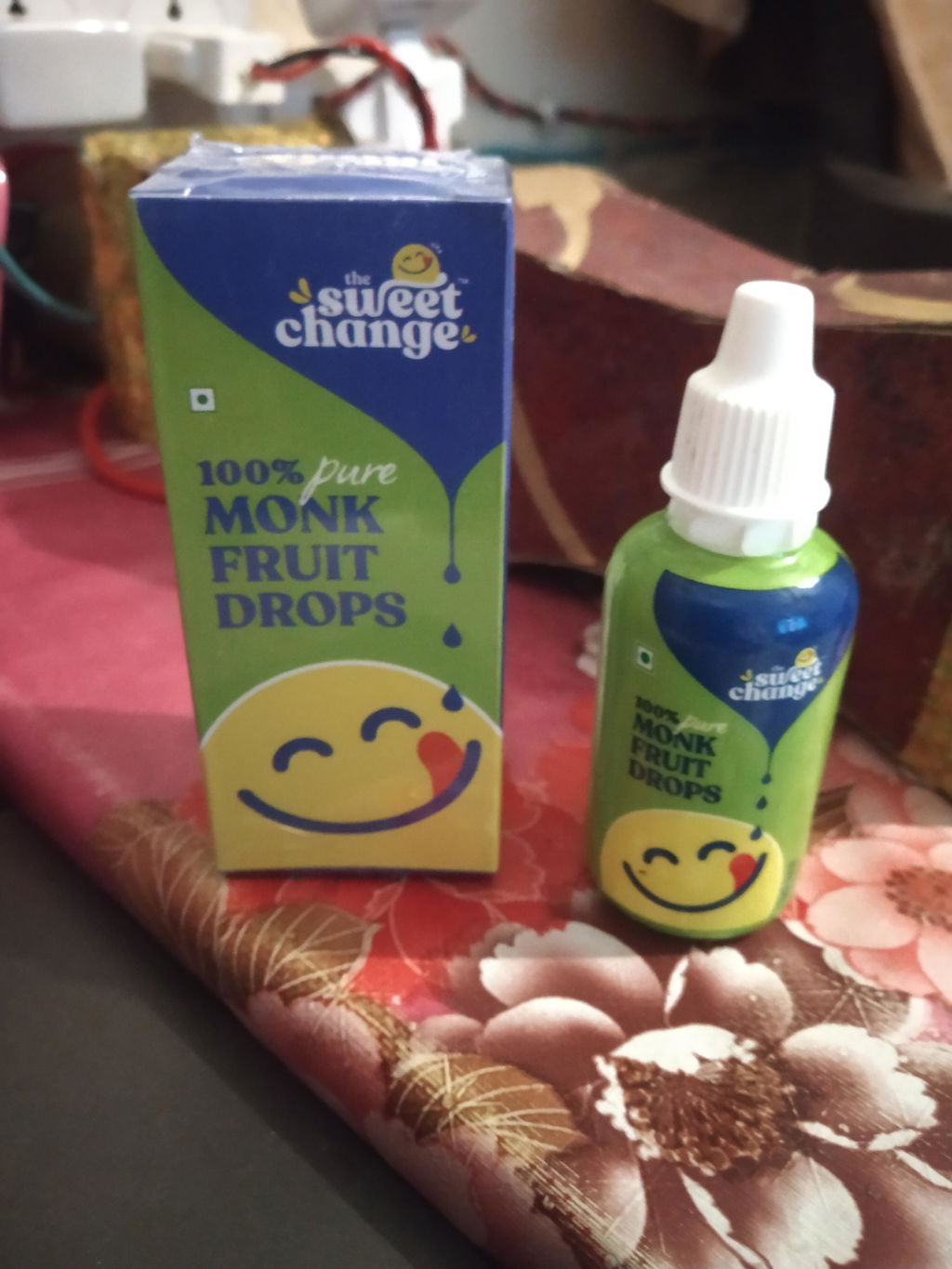
Monk fruit from us comes as drops and powder, with sachets coming.
Cheat sheet
- Allulose is a rare sugar your body absorbs but cannot burn, so most of it leaves in the urine.
- On an Indian label it counts as a sugar, and an Indian pack counts its calories at 4 kcal per gram; a US pack shows 0.4.
- Keep single servings under 0.4 g per kg of body weight, about 24 g for a 60 kg adult, and expect loose stools above that.
- It browns, so lower the flame for ladoo, cake and halwa.
- Which to use: monk fruit made without sugar alcohols for daily chai and coffee; allulose when a recipe needs bulk. Any allulose sweetener you buy, read the first ingredient.
Questions people ask
Is allulose safe?
For most healthy adults at normal amounts, the record is reassuring. FSSAI has approved allulose products case by case since 2020, and the US FDA raised no questions about its GRAS notices as a sugar substitute. The one documented problem is stomach upset from large single servings, shown in a small study of healthy young adults.
Is allulose natural?
Only in the loose sense. Allulose does occur in figs, raisins and wheat, but the allulose in a pack is made from fructose with an enzyme. Under FSSAI's claims rules, "natural" is reserved for single foods with nothing added and only simple processing, so an allulose pack should not carry the word in India.
Is allulose a sugar alcohol?
No. Allulose is a rare sugar, a monosaccharide shaped like fructose, which is why the US FDA describes it that way in its labelling guidance. Erythritol, maltitol, xylitol and sorbitol are sugar alcohols, a different chemical family with their own digestion and labelling rules. On a label, look for the "-ose" ending for allulose and "-ol" for sugar alcohols.
Does allulose raise blood sugar?
The US FDA concluded that allulose produces only a negligible rise in blood glucose and insulin, which is why US labels treat it differently from other sugars. That is a finding about the ingredient on its own. If you have diabetes, the rest of the dish and your doctor's advice still decide how a food fits your plate.
Does allulose cause bloating or diarrhoea?
It can, in large single servings. A study of 30 healthy young adults found no severe symptoms up to a set amount per kilogram of body weight and severe diarrhoea just above it; a 30-day trial in 50 adults saw mild, short-lived symptoms mostly in the first days. The side-effects section above turns those amounts into grams for your weight.
Is allulose keto-friendly?
That depends on how you count. A US label keeps allulose inside total carbohydrate, even though the FDA lets it count at 0.4 kcal per gram and leave the sugars lines; an Indian label counts it as a sugar at 4 kcal per gram. People tracking carbohydrates usually treat it as near-zero, but no label will say so.
 Monk Fruit Drops (100 servings)
Rs. 497.00
Monk Fruit Drops (200 servings)
Rs. 971.00
Monk Fruit Drops (100 servings)
Rs. 497.00
Monk Fruit Drops (200 servings)
Rs. 971.00
 Monk Fruit Powder No Erythritol (100 servings)
Rs. 675.00
Monk Fruit Powder No Erythritol (300 servings)
Rs. 1,493.00
Monk Fruit Powder No Erythritol (100 servings)
Rs. 675.00
Monk Fruit Powder No Erythritol (300 servings)
Rs. 1,493.00
Related articles


Written by
Kapil Groverr · Chief Business Officer and Co-Founder
IIM Lucknow alumnus · 18 years in marketing
Kapil Groverr is Co-Founder and Chief Business Officer of The Sweet Change, where he leads growth and marketing. He has 18 years in marketing, most recently as Vice President Marketing at Breathe Well-being and before that Head of Digital Marketing at King Koil. An IIM Lucknow alumnus, he writes our sweetener guides and comparisons.
Writes about: Sweetener guides and comparisons
Disclosure: Co-founder of The Sweet Change

Reviewed by
Jatin Agnihotri · COO and Co-Founder
MBA, Indian School of Business · 12 years in technology and security
Jatin Agnihotri is COO and Co-Founder of The Sweet Change, where he runs operations, from manufacturers and vendors to shipping and logistics, and creates content for our Instagram. He spent 12 years in technology at Honda Cars India, Extramarks Education, where he was Vice President IT, and Jio Platforms. He holds an MBA from ISB.
Disclosure: Co-founder of The Sweet Change

Nutrition reviewed by
Manvi Agnihotri · CEO and Co-Founder
12 years in clinical nutrition, over 11,000 patients · M.Sc Food and Nutrition, silver medallist
Manvi Agnihotri is CEO and Co-Founder of The Sweet Change. She holds an M.Sc in Food and Nutrition, in which she was a silver medallist, and has led brand strategy and patient and doctor education at Breathe Well-being, a diabetes care programme. She reviews our health and nutrition pages before they go live.
Reviews: Nutrition and food science, Blood sugar and diabetes diet
Disclosure: Co-founder of The Sweet Change
Sources
- US Food and Drug Administration. 2020. The Declaration of Allulose and Calories from Allulose on Nutrition and Supplement Facts Labels: Guidance for Industry. FDA, Silver Spring. https://www.fda.gov/media/123342/download
- Daniel H, Hauner H, Hornef M, Clavel T. 2022. Allulose in human diet: the knowns and the unknowns. British Journal of Nutrition 128(2):172-178. https://doi.org/10.1017/S0007114521003172
- Food Safety and Standards Authority of India. 2018. Food Safety and Standards (Advertising and Claims) Regulations, 2018, regulation 2(1)(o) and Schedule V (compendium Version III, 4 October 2022). FSSAI, New Delhi. https://www.fssai.gov.in/upload/uploadfiles/files/Compendium_Advertising_Claims_Regulations_04_10_2022.pdf
- Han Y, Choi BR, Kim SY, Kim SB, Kim YH, Kwon EY, Choi MS. 2018. Gastrointestinal Tolerance of D-Allulose in Healthy and Young Adults. A Non-Randomized Controlled Trial. Nutrients 10(12):2010. https://doi.org/10.3390/nu10122010
- Lee SJ, Oh HJ, Jung JH, Jeong EA, Kim MR. 2024. Effects of alternative sweeteners with or without xanthan gum on the physicochemical properties of scone products. Food Science and Biotechnology 33(5):1093-1101. https://doi.org/10.1007/s10068-023-01416-9
- US Food and Drug Administration. 2025. Aspartame and Other Sweeteners in Food (content current as of 27 February 2025). FDA, Silver Spring. https://www.fda.gov/food/food-additives-petitions/aspartame-and-other-sweeteners-food
- Food Safety and Standards Authority of India. 2020. Food Safety and Standards (Labelling and Display) Regulations, 2020, regulation 5(3)(e)(i) (compendium Version IV, 23 September 2022). FSSAI, New Delhi. https://www.fssai.gov.in/upload/uploadfiles/files/Compendium_Labelling_Display_23_09_2022.pdf
- Qi L, Ning J, Han J, et al. 2026. D-Allulose as a Low-Calorie Sweetener: A 30-Day Randomized, Double-Blind Study on Gastrointestinal Tolerance and Systemic Safety to Support Its Application in Healthy Diets. Food Science & Nutrition 14(7):e72042. https://doi.org/10.1002/fsn3.72042
- Food Safety and Standards Authority of India. 2026. List of applications Approved / Rejected / Closed / Withdrawn / Under Process under the FSS (Approval of Non-Specified Food and Food Ingredients) Regulations, 2017, as on 15 July 2026. FSSAI, New Delhi. https://fssai.gov.in/upload/uploadfiles/files/Status%20of%20NSF%20Application%20as%20on%2015_07_2026.pdf
- US Food and Drug Administration. 2017. GRAS Notice No. 693: D-psicose (notifier Samyang Corporation; closed 28 August 2017, "FDA has no questions"). FDA, College Park. https://www.hfpappexternal.fda.gov/scripts/fdcc/index.cfm?set=GRASNotices&id=693
The Sweet Change makes the products mentioned on this page. How we write and review