Keto sweetener: which ones fit your chai, and which to skip
 Written byKapil GroverrChief Business Officer and Co-Founder, The Sweet Change
 Reviewed bySheen HitaishiChief Brand Officer and Co-Founder, The Sweet Change
 Medically reviewed byManvi AgnihotriCEO and Co-Founder, The Sweet Change


The best keto sweetener adds sweetness with little or no carbohydrate that counts toward your day. Our first pick for chai and coffee is monk fruit made without sugar alcohols: a few drops carry the sweetness of a teaspoon of sugar. Stevia and allulose also fit, with a bitter note and a sugar line on Indian labels respectively, while maltitol, honey, gur and dates stay on the sugar side.
Key takeaways
- The carb budget: keto keeps carbohydrate to about 5% to 10% of the day's energy, and a teaspoon of sugar is about 4.2 g of carbohydrate [1] [2].
- Allulose on the label: Indian rules count it as a sugar; US labels may leave it out of total sugars [3] [4].
- Sugar alcohols: maltitol has a GI of 35 and erythritol 0; large single doses upset the stomach; and the US FDA says the 2023 erythritol heart findings do not show cause [5] [6] [7].
- Still sugar: honey (GI 61) sits close to table sugar (65) [8].
Discuss with your doctor or dietitian before changing your diet, especially if you take diabetes medicines.
On this page
- What does a keto sweetener need to do?
- Monk fruit: our first pick for keto chai and coffee
- Stevia: keto-fit, with a taste catch
- Allulose: few calories, but your label may say sugar
- Sugar alcohols and the erythritol question
- Sucralose and other artificial sweeteners
- Keto-sounding sweeteners that are still sugar: honey, gur, dates
- How to read an Indian label for keto
- Using a keto sweetener in chai, coffee and baking
- Sources
If you take medicine for diabetes or blood pressure, or have a health condition, talk to your doctor before starting keto or changing what you eat.
What does a keto sweetener need to do?
Day three of keto. The second cup of chai is on the stove, the sugar dabba has gone to the back of the shelf, and the question is no longer whether to give up sugar but what goes in the cup instead.
Most lists of sweeteners for keto are written for an American pantry and never read an Indian pack. This one does.
Start with the budget. Keto is a high-fat, very low-carbohydrate way of eating, and a typical split gives about 5% to 10% of the day's energy to carbohydrate [1]. On a 2,000 kcal day, by our arithmetic, that is about 25 to 50 g of carbohydrate.
Now the chai. A teaspoon of sugar is about 4.2 g of carbohydrate [2], so two cups a day with two teaspoons each use about 17 g, a third or more of the whole budget before lunch.
That is the job. A keto sweetener is one that tastes sweet while adding little or no carbohydrate that counts toward your day; the labels and the studies below all follow from that line.
We found no trial that tested monk fruit, or any sweetener, on ketosis itself; the keto case rests on carbohydrate per serving, which is why we count so carefully below. In our survey of our own buyers, 46% said a weight or fitness goal made them cut sugar, so you are in large company.
Keto friendly sweeteners on an Indian shelf fall into four groups: plant extracts (monk fruit, stevia), a rare sugar (allulose), sugar alcohols (erythritol, xylitol, maltitol) and artificial sweeteners (sucralose and its cousins). A fifth group sells itself as "natural" and is still sugar. Our full guide to sweeteners covers all of them; here each one faces the carb budget.
Monk fruit: our first pick for keto chai and coffee
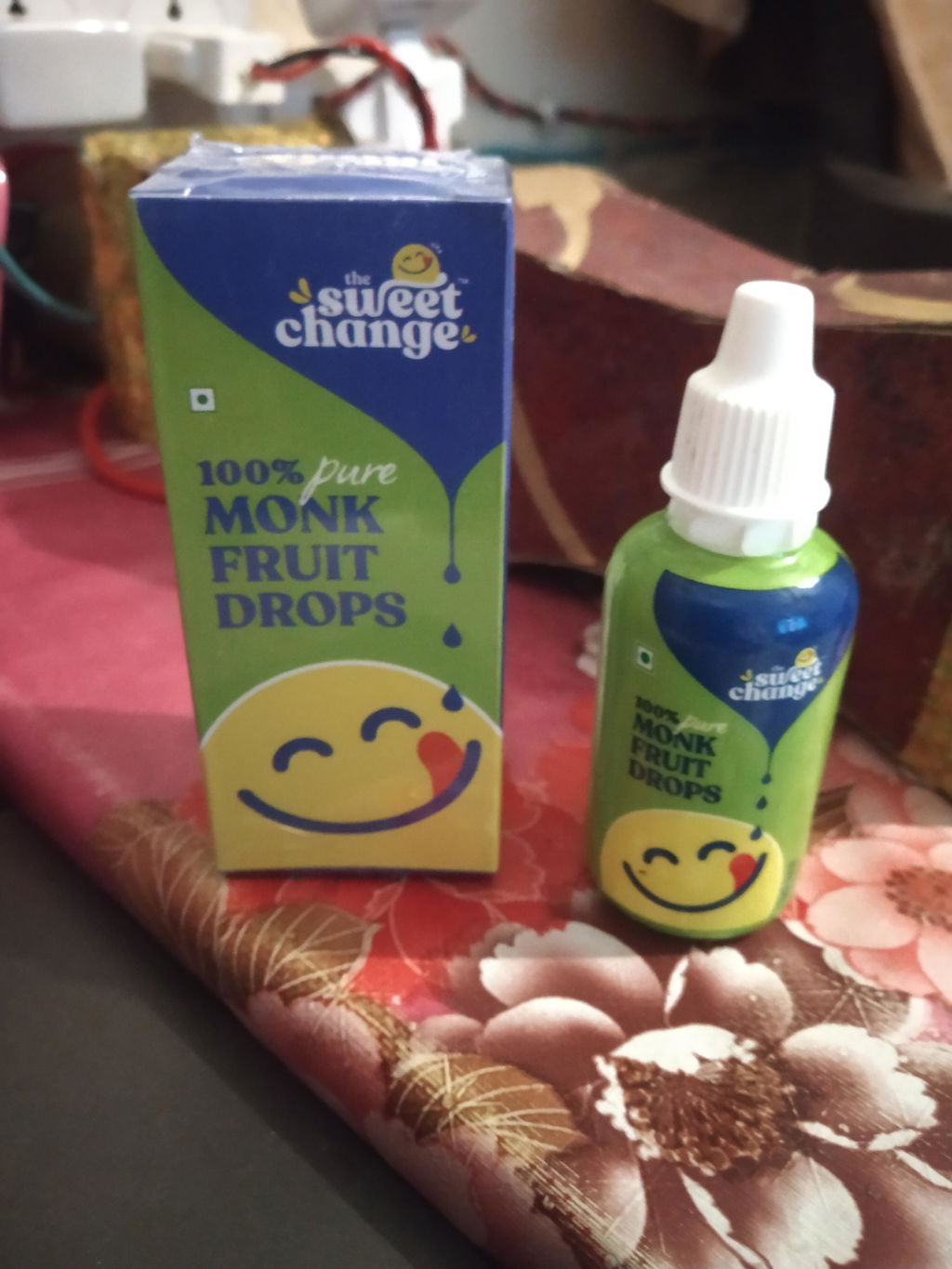
Our pick, with High confidence: monk fruit made without sugar alcohols. If you want one answer for the chai that is boiling right now, that is it.
Monk fruit (Siraitia grosvenorii, luo han guo) is a fruit from southern China whose extract is 100 to 250 times sweeter than sugar, depending on how much mogroside it carries [7]. A few drops do the work of a teaspoon, so the carbohydrate they bring is too small to count, which is the whole test for a keto sweetener.
On the regulator side, the US Food and Drug Administration (FDA) has answered seven GRAS notices for monk fruit extract since 2010 with no questions, and has set no acceptable daily intake for it [9] [7]. That is not "FDA approved", and we will not call it that; the agency saw no reason to object at sweetening amounts.
The human evidence is thin but points one way. In a 2017 trial in 30 healthy men, a monk fruit drink caused no spike in blood glucose or insulin, unlike a sugar drink [10]. The honest limit: monk fruit has fewer long-term human studies than the older sweeteners, because it is newer to the market.
What studies and regulators say about monk fruit goes through those studies one by one, and our monk fruit entry covers the fruit itself.
Here is the catch, and it is the pack rather than the fruit. Among keto natural sweeteners sold in India, the pack decides: when we checked 44 monk fruit powders on 13 October 2026, more than half (25) contained erythritol. The first ingredient tells you which kind you are holding; the label section below shows how.
Takeaway: drops, or a powder whose first ingredient is not a sugar alcohol; monk fruit first.
Stevia: keto-fit, with a taste catch
Moderate confidence. Stevia fits the carb budget as well as monk fruit does; what holds it back in our ranking is the cup.
The sweet part is a family of steviol glycosides, 200 to 400 times sweeter than sugar [7], so the amount in a cup adds no carbohydrate worth counting. On an Indian pack it appears as INS 960 [11].
The catch is a bitter off-taste. Two of the human bitter taste receptors respond to steviol glycosides, and how bitter a product tastes depends on which glycosides it uses [12]. That is why one brand of tablets is drinkable and another is not: the structure differs, not your tongue.
In the kitchen, strong masala chai hides the bitter aftertaste better than plain black coffee, and milk softens it further. Start with less than you think you need; the sweetness arrives late and builds.
Among keto sweeteners for a plain filter coffee, this is where stevia loses to monk fruit. Our stevia guide has the sourcing, the forms and the dosing.
Takeaway: fine for the carb count, a taste you may or may not get used to; try it in your strongest chai first.
Allulose: few calories, but your label may say sugar
Moderate confidence. Allulose is the keto sweetener where an Indian pack and an imported pack of the same powder tell you two different stories.
Allulose is a rare sugar, a monosaccharide found in small amounts in wheat, raisins and dried figs [4]. In the US, labels may count it at 0.4 kcal per gram and leave it out of "Total Sugars" and "Added Sugars", though it stays in total carbohydrate [4].
India takes the other path. Indian rules define sugars as all monosaccharides and disaccharides, so allulose counts as a sugar on an Indian label and in an Indian claim [3]. The same allulose powder can show grams of sugar on an Indian pack while a US pack shows none.
What it means for keto: compare the carbohydrate line, not the slogan on the front. Neither pack is lying; they follow different rules. explains what allulose is and how it behaves.
In baking, allulose browns and caramelises more than sugar does, so crusts come out darker; one bakery study found exactly that in scones [13]. Lower the oven a little or pull the tray earlier.
At The Sweet Change: our powder is made with monk fruit, guar fibre and allulose (30% / 35% / 35%), with no erythritol. Because Indian labels count allulose as sugar, for the strictest carb count in chai our drops are the simpler choice.
Takeaway: allulose fits a keto day; read the Indian carbohydrate line and expect a sugar figure that the US pack would not show.
Sugar alcohols and the erythritol question
Low confidence for erythritol and xylitol; maltitol gets no label at all. This is the group most keto sweetener powders in India are built on, so it deserves the longest look.
Sugar alcohols (polyols) are sweeteners the body absorbs only partly, which is why they carry fewer calories than sugar. On the glycemic index, with glucose at 100, erythritol scores 0, sorbitol 9, xylitol 13 and maltitol 35 [5].
Maltitol is the one to skip on keto: it scores about a third of glucose, the highest of the group, so check "sugar free" chocolate labels for it.

On an Indian nutrition panel, energy is calculated at 2 kcal per gram for most sugar alcohols and 0 for erythritol [14]. On the ingredient list, look for xylitol as INS 967, maltitol as INS 965 and sorbitol as INS 420 [11].
The stomach is the first downside. In a study of single doses in healthy young adults, 50 g of erythritol in a drink raised nausea and stomach rumbling, while xylitol at 35 and 50 g caused watery stools [6]. A teaspoon in chai is far below those amounts; a tray of "keto" ladoos is not.
Erythritol then has a question of its own, and the order matters. The US FDA has said the 2023 observational findings do not show that erythritol causes heart events [7]. The study behind that statement found higher blood erythritol linked to a higher rate of heart attack, stroke or death over three years, in people already under cardiac evaluation [15].
A 2024 follow-up gave one 30 g erythritol drink to healthy volunteers, 10 per group, and saw more reactive platelets afterwards [16]. A link, not proof; reading labels for it is still reasonable.
At The Sweet Change: our drops and powder contain no erythritol or other sugar alcohols. In our survey of our own buyers, 49% said they chose us for no erythritol.
For the wider picture on additives, are artificial sweeteners safe? covers the regulators' positions one by one.
Takeaway: erythritol and xylitol fit the carb count, with a stomach limit and, for erythritol, open questions; maltitol does not fit.
Sucralose and other artificial sweeteners
Low confidence. These add no carbohydrate, so they pass the carb test; what they do not pass is our tolerance for open questions.
Sucralose is about 600 times sweeter than sugar [7]. On an Indian pack the artificial sweeteners appear as sucralose INS 955, aspartame INS 951, acesulfame K INS 950 and saccharin INS 954 [11]; an aspartame pack must also carry a note that it is not recommended for people with phenylketonuria [14].
The gut findings are specific, so we will keep them specific. In a two-week study in healthy adults, sucralose and saccharin changed the gut bacteria and worsened the blood-sugar response in some people, with effects that differed from person to person [17]. One study, healthy adults, some people; that is the size of the claim.
If weight is your reason for keto, one more position matters. The World Health Organization (WHO) advised in 2023 against non-sugar sweeteners for weight control, a conditional recommendation that does not apply to people who already have diabetes and does not cover sugar alcohols [18]. Readers managing diabetes alongside keto should also read sweeteners if you have diabetes.
Takeaway: carb-free, yes; but our pick for the cup is monk fruit, which that gut study did not test.
Keto-sounding sweeteners that are still sugar: honey, gur, dates
They arrive with the best intentions: the gur a relative swears by, the dates in the fridge, the honey bought "for the winter". On keto all three are sugar in another form.
The glycemic index tables put glucose at 103, table sugar at 65, honey at 61 and dates at 42, with 55 or less counted as low [8]. Dates look reasonable on that scale, and that is the trap: a low GI is not a low carb count.
Gur makes the point plainly. Cane jaggery is about 84 g of sugars per 100 g [19], so a small piece in the evening is roughly the teaspoon of sugar you gave up in the morning. Coconut sugar belongs in the same box. and take each one further.
Takeaway: on keto, count honey, gur, dates and coconut sugar as sugar, whatever the front of the pack calls them.
How to read an Indian label for keto
The ranking above is only useful if you can tell which keto sweetener you are holding. Indian packs give you enough to do it, in a slightly different shape from the US panels most keto advice assumes.
An Indian nutrition panel must show energy, protein, carbohydrate, total sugars and added sugars per 100 g, along with the serving size and the number of servings in the pack [14]. "Net carbs" is not a required line, so do not wait for one; scale the carbohydrate per 100 g to your serve.
Ingredients are listed in descending order of weight [14]. If erythritol, dextrose or maltodextrin comes first, the monk fruit or stevia on the front is a small part of what is inside. Low carb sweeteners sold spoon for spoon are almost always bulked with something, and the first word tells you with what.
Four checks, in order:
- First ingredient: is it the sweetener you came for, or a bulking agent?
- Carbohydrate, scaled to your serve: the figure that goes against your 25 to 50 g; dextrose and maltodextrin count in full.
- Sugar alcohols named: erythritol, xylitol (INS 967), maltitol (INS 965), sorbitol (INS 420); maltitol fails the keto test.
- Serving size: a "0 g per serve" built on a tiny serving is a rounding, not a sweetener.
Our ingredient library has an entry for every name you will meet on the back of a pack.
Using a keto sweetener in chai, coffee and baking
In our survey of our own buyers, 66% said their sweetener goes into coffee and 64% into chai, so this is where the choice gets tested every morning.
Chai and coffee
Liquid drops suit a cup best: they dissolve in hot liquid and add no bulk, so nothing settles at the bottom. For our drops, two drops replace a teaspoon of sugar [20]. Add after the chai has boiled, taste, then adjust; concentrated sweeteners punish a heavy hand.
A keto sweetener for coffee has a harder job than one for chai, because black coffee hides nothing. We sell drops and powder, with sachets coming; for a flask of office coffee the drops travel better.
Baking and Indian sweets
Baking needs bulk, so this is where powders earn their place. And remember that the flour and the nuts carry carbohydrate of their own; the sweetener is the easy part of a keto ladoo.
covers the plate; this page covers the cup.
One cup at a time, then. Pick a keto sweetener by what it adds to your 25 to 50 g, read the first ingredient before the front of the pack, and keep the honey for guests who are not counting.
How we compared: we ranked each sweetener for daily keto chai and coffee on four things: carbohydrate that counts, how clear the label is, taste, and the evidence behind it. "Confidence" is how sure we are of the pick for that use; it is our view, not a grade of the research.
Keto sweeteners list, ranked for daily chai
| Sweetener | Carbs that count in a cup | Our keto pick | Watch out for |
|---|---|---|---|
| Monk fruit made without sugar alcohols | None worth counting | High confidence | The pack: check the first ingredient for erythritol |
| Stevia | None worth counting | Moderate confidence | A bitter note, stronger in plain coffee |
| Allulose | Few calories; shows as sugar on Indian labels | Moderate confidence | Compare the carbohydrate line, not the front of the pack |
| Erythritol | GI 0; 0 kcal per gram on Indian labels | Low confidence | Nausea at 50 g; the 2023 and 2024 studies, a link, not proof |
| Xylitol | GI 13; 2 kcal per gram on Indian labels | Low confidence | Watery stools at 35 g and above |
| Sucralose | None worth counting | Low confidence | Gut and blood-sugar findings in one study |
| Maltitol | GI 35 | Skip | Check "sugar free" chocolate labels for it |
| Honey, gur, dates | Sugar | Not a swap | Honey GI 61, dates 42; gur about 84 g sugars per 100 g |
Cheat sheet
- Our pick for the cup: monk fruit made without sugar alcohols; drops for chai and coffee.
- Also fits: stevia (taste it in strong chai first) and allulose (expect a sugar line on an Indian pack).
- Read the back first: first ingredient, carbohydrate per serve, INS numbers for sugar alcohols, serving size.
- Skip: maltitol; and count honey, gur, dates and coconut sugar as sugar.
- Beyond keto: ranks the sugar substitutes for every reader.
Questions people ask
What is the best sweetener for keto?
For chai and coffee our pick is monk fruit made without sugar alcohols: a few drops replace a teaspoon of sugar and add no carbohydrate worth counting. Stevia and allulose also fit a keto day. Whatever you choose, read the ingredient list: when we checked monk fruit powders sold in India, more than half contained erythritol.
Is a zero calorie sweetener keto?
Usually, if it adds no carbohydrate that counts toward your day. The catch is the filler: dextrose or maltodextrin listed first means a sachet carries carbohydrate even when the sweetener itself does not. Under the Food Safety and Standards Authority of India's labelling rules, Indian packs must show carbohydrate and sugars per 100 g; scale that to your serve.
Can you have artificial sweeteners on keto?
They add no carbohydrate, so they pass the carb test. In one two-week study in healthy adults, sucralose and saccharin changed gut bacteria and worsened blood-sugar responses in some people, and the World Health Organization advises against non-sugar sweeteners for weight control. Our pick for the cup is still monk fruit, which that gut study did not include.
What natural sweetener is keto?
Monk fruit first, then stevia; both are plant extracts that add no carbohydrate worth counting in a cup. Allulose is a rare sugar that fits a keto day but is counted as a sugar on Indian labels. Honey, gur, dates and coconut sugar are natural, and they are still sugar.
Which sweetener is best for black coffee on keto?
The best keto sweetener for coffee is a liquid drop, because drops dissolve without bulk and black coffee hides nothing. Monk fruit drops are our pick; stevia's bitter note shows more in coffee than in masala chai. Start with less than you expect, taste, and add a drop at a time.
 Monk Fruit Drops (100 servings)
Rs. 497.00
Monk Fruit Drops (200 servings)
Rs. 971.00
Monk Fruit Drops (100 servings)
Rs. 497.00
Monk Fruit Drops (200 servings)
Rs. 971.00
 Monk Fruit Powder No Erythritol (100 servings)
Rs. 675.00
Monk Fruit Powder No Erythritol (300 servings)
Rs. 1,493.00
Monk Fruit Powder No Erythritol (100 servings)
Rs. 675.00
Monk Fruit Powder No Erythritol (300 servings)
Rs. 1,493.00
Related articles


Written by
Kapil Groverr · Chief Business Officer and Co-Founder
IIM Lucknow alumnus · 18 years in marketing
Kapil Groverr is Co-Founder and Chief Business Officer of The Sweet Change, where he leads growth and marketing. He has 18 years in marketing, most recently as Vice President Marketing at Breathe Well-being and before that Head of Digital Marketing at King Koil. An IIM Lucknow alumnus, he writes our sweetener guides and comparisons.
Writes about: Sweetener guides and comparisons
Disclosure: Co-founder of The Sweet Change

Reviewed by
Sheen Hitaishi · Chief Brand Officer and Co-Founder
4 years in content writing · Sri Venkateswara College, University of Delhi
Sheen Hitaishi is Chief Brand Officer and Co-Founder of The Sweet Change, which she started with her sister, Manvi Agnihotri. She runs our social media, customer retention and customer care. Before The Sweet Change she spent four years as a content writer, most recently Senior Content Writer at Univest. She studied at Sri Venkateswara College, University of Delhi.
Disclosure: Co-founder of The Sweet Change

Medically reviewed by
Manvi Agnihotri · CEO and Co-Founder
12 years in clinical nutrition, over 11,000 patients · M.Sc Food and Nutrition, silver medallist
Manvi Agnihotri is CEO and Co-Founder of The Sweet Change. She holds an M.Sc in Food and Nutrition, in which she was a silver medallist, and has led brand strategy and patient and doctor education at Breathe Well-being, a diabetes care programme. She reviews our health and nutrition pages before they go live.
Reviews: Nutrition and food science, Blood sugar and diabetes diet
Disclosure: Co-founder of The Sweet Change
Sources
- Daley SF, Masood W, Annamaraju P, Khan Suheb MZ. 2025. The Ketogenic Diet: Clinical Applications, Evidence-based Indications, and Implementation. StatPearls, NCBI Bookshelf NBK499830. https://www.ncbi.nlm.nih.gov/books/NBK499830/
- US Department of Agriculture, Agricultural Research Service. 2019. FoodData Central, SR Legacy 169655, Sugars, granulated. https://fdc.nal.usda.gov/food-details/169655/nutrients
- Food Safety and Standards Authority of India. 2018. Food Safety and Standards (Advertising and Claims) Regulations, 2018, regulation 2(1)(o). FSSAI, New Delhi. https://www.fssai.gov.in/upload/uploadfiles/files/Compendium_Advertising_Claims_Regulations_04_10_2022.pdf
- US Food and Drug Administration. 2020. The Declaration of Allulose and Calories from Allulose on Nutrition and Supplement Facts Labels: Guidance for Industry. FDA, Silver Spring. https://www.fda.gov/media/123342/download
- Livesey G. 2003. Health potential of polyols as sugar replacers, with emphasis on low glycaemic properties. Nutrition Research Reviews 16(2):163-191. https://doi.org/10.1079/NRR200371
- Storey D, Lee A, Bornet F, Brouns F. 2007. Gastrointestinal tolerance of erythritol and xylitol ingested in a liquid. European Journal of Clinical Nutrition 61(3):349-354. https://doi.org/10.1038/sj.ejcn.1602532
- US Food and Drug Administration. 2025. Aspartame and Other Sweeteners in Food (content current as of 27 February 2025). FDA, Silver Spring. https://www.fda.gov/food/food-additives-petitions/aspartame-and-other-sweeteners-food
- Atkinson FS, Foster-Powell K, Brand-Miller JC. 2008. International tables of glycemic index and glycemic load values: 2008. Diabetes Care 31(12):2281-2283. https://doi.org/10.2337/dc08-1239
- US Food and Drug Administration. 2010 to 2018. GRAS Notice Inventory, notices for Siraitia grosvenorii (monk fruit) extract, GRN 301 to GRN 784. FDA, Silver Spring. https://www.hfpappexternal.fda.gov/scripts/fdcc/index.cfm?set=GRASNotices&sort=GRN_No&order=DESC&startrow=1&type=basic&search=Siraitia
- Tey SL, Salleh NB, Henry J, Forde CG. 2017. Effects of aspartame-, monk fruit-, stevia- and sucrose-sweetened beverages on postprandial glucose, insulin and energy intake. International Journal of Obesity 41(3):450-457. https://doi.org/10.1038/ijo.2016.225
- Joint FAO/WHO Expert Committee on Food Additives (JECFA). 2026. Evaluations of the JECFA: food additives database, detail pages. WHO, Geneva. https://apps.who.int/food-additives-contaminants-jecfa-database/
- Hellfritsch C, Brockhoff A, Stähler F, Meyerhof W, Hofmann T. 2012. Human psychometric and taste receptor responses to steviol glycosides. Journal of Agricultural and Food Chemistry 60(27):6782-6793. https://doi.org/10.1021/jf301297n
- Lee SJ, Oh HJ, Jung JH, Jeong EA, Kim MR. 2024. Effects of alternative sweeteners with or without xanthan gum on the physicochemical properties of scone products. Food Science and Biotechnology 33:1263-1273. https://doi.org/10.1007/s10068-023-01416-9
- Food Safety and Standards Authority of India. 2020. Food Safety and Standards (Labelling and Display) Regulations, 2020, regulations 5(2)(b), 5(3) and 5(5). FSSAI, New Delhi. https://www.fssai.gov.in/upload/uploadfiles/files/Compendium_Labelling_Display_23_09_2022.pdf
- Witkowski M, Nemet I, Alamri H, et al. 2023. The artificial sweetener erythritol and cardiovascular event risk. Nature Medicine 29(3):710-718. https://doi.org/10.1038/s41591-023-02223-9
- Witkowski M, Wilcox J, Province V, et al. 2024. Ingestion of the non-nutritive sweetener erythritol, but not glucose, enhances platelet reactivity and thrombosis potential in healthy volunteers: brief report. Arteriosclerosis, Thrombosis, and Vascular Biology 44(9):2136-2141. https://doi.org/10.1161/ATVBAHA.124.321019
- Suez J, Cohen Y, Valdés-Mas R, et al. 2022. Personalized microbiome-driven effects of non-nutritive sweeteners on human glucose tolerance. Cell 185(18):3307-3328. https://doi.org/10.1016/j.cell.2022.07.016
- World Health Organization. 2023. WHO advises not to use non-sugar sweeteners for weight control in newly released guideline (departmental update, 15 May 2023). WHO, Geneva. https://www.who.int/news/item/15-05-2023-who-advises-not-to-use-non-sugar-sweeteners-for-weight-control-in-newly-released-guideline
- Longvah T, Ananthan R, Bhaskarachary K, Venkaiah K. 2017. Indian Food Composition Tables 2017, food I001, Jaggery, cane. ICMR-National Institute of Nutrition, Hyderabad. https://www.nin.res.in/ebooks/IFCT2017.pdf
- The Sweet Change. 2026. Monk Fruit Sweetener without Erythritol, product page (drops dosage table and ingredients). https://www.thesweetchange.com/products/monk-fruit-sweetener-without-erythritol
The Sweet Change makes the products mentioned on this page. How we write and review