Monk fruit vs jaggery: sugar, calories and how each one cooks
 Written byManvi AgnihotriCEO and Co-Founder, The Sweet Change


Monk fruit vs jaggery comes down to one fact: jaggery is cane sugar in its traditional block form, about 84% sugar by weight [1]. Monk fruit extract is 100 to 250 times sweeter than sugar, so the extract adds almost no sugar, while a powder that measures spoon for spoon like sugar is mostly another ingredient [2]. Jaggery brings colour, flavour and bulk; an extract brings sweetness only, so on either pack the label decides.
Key takeaways
- Jaggery is sugar: about 84 g of sugars in every 100 g, with its iron measured in fractions of a milligram per teaspoon [1].
- Monk fruit extract is concentrated: 100 to 250 times sweeter than sugar, so a few drops or a pinch do the work of a spoon [2].
- The GI tables skip gur: table sugar sits at 65 and honey at 61 in the international tables, and jaggery is not listed there [3].
- Gur counts as free sugar: sugar you add yourself goes towards the WHO's under-10%-of-energy limit, about 12 level teaspoons on a 2,000-calorie day [4].
On this page
You have a dabba of gur on the shelf because Nani swore by it, and a new monk fruit pack on the counter because a friend would not stop talking about it. Both are sweet, and nothing on either pack tells you how they differ.
You are not alone in weighing this switch. In our survey of our own buyers, 16% said they had been sweetening with jaggery or honey before.
So here is monk fruit vs jaggery on what you can check: sugar, calories, how each one cooks and what the label tells you. No health ranking, because one of these is a food and the other is a sweetener, and the fair comparison is about what each does in your kitchen.
What monk fruit is, and what fills the pack
The front of the pack shows a small round fruit you have never seen at a sabzi mandi, which is a fair reason to ask what you are buying.
Monk fruit (Siraitia grosvenorii, sold as luo han guo) comes from a plant native to southern China, and its sweetness comes from compounds called mogrosides [2]. The extract made from it is 100 to 250 times sweeter than sugar, depending on how much mogroside it carries [2].

So a serving is a few drops or a pinch. A pinch cannot fill a teaspoon, though, and most of us want a sweetener that measures like sugar.
Something has to make up the spoon. A powder that measures like sugar has to be mostly a bulking ingredient, such as erythritol, dextrose or allulose, so the pack you carry home is mostly that ingredient, not fruit.
Regulators have not spoken with one voice either. The US FDA has not questioned the safety (GRAS) notices filed for monk fruit extract and has set no daily intake limit for it [2].
Europe's food safety authority, EFSA, looked at the data in 2019 and said there was not enough of it to conclude on the extract's safety as a food additive [5].
Both positions are laid out in full in what regulators say about monk fruit. For this page, the point is simpler: the sweetness is in the fruit, and the spoonful is in the bulking ingredient.
What jaggery is
You know gur by sight: a dark block that softens in a warm hand, sold by the kilo, grated into the kheer at the end.
Jaggery is made by concentrating sugarcane juice, and it keeps the minerals and vitamins the juice carried [6]. Its dark colour and deep, molasses-like flavour come with that whole juice. Palm and coconut jaggery are sold too; this page means cane gur, the block most of us buy.
Per 100 g, Indian cane jaggery carries about 84 g of sugars (58 g sucrose, 22 g fructose and 4 g glucose) and about 11 g of water [1].
The minerals are real and small. The same 100 g holds about 4.6 mg of iron and 107 mg of calcium [1]. A level teaspoon is about 4 g, so a spoon of gur in your chai brings roughly 0.2 mg of iron along with its sugar [1] [4].
That is the honest downside of jaggery: it is sugar first, and the minerals ride along in amounts too small to plan a diet around. If the sugars themselves are new to you, the entries on sucrose, fructose and glucose in the sugars in our ingredient library explain each one.
Sugar, the baseline
Sugar earns its place on this page because it is what both the others are measured against.
White sugar is almost entirely sucrose: 387 kcal and about 100 g of carbohydrate per 100 g [7]. Jaggery comes to about 354 kcal per 100 g, and the gap between the two is mostly jaggery's water [1].
Per level teaspoon, that works out to about 15.5 kcal for sugar and about 14 kcal for gur [1] [7]. So swapping sugar for gur, spoon for spoon, saves you a calorie and a half a cup.
Sugar, calories and glycemic index side by side
"Monk fruit sugar vs jaggery" is one way people type the question, and it hides the real one: how much sugar each puts in your cup.
For jaggery, the answer is the spoonful itself, as the last two sections showed. For the extract used in drops or pinches, the answer is that sweeteners of this kind contribute few or no calories to the day [2]. What the powder's bulking ingredient adds is a separate question, and the label answers it.
Then there is the glycemic index. The GI measures how a food containing 50 g of carbohydrate moves blood glucose over two hours in ten or more healthy people, scored against glucose at 100; 70 and above counts as high, 55 and below as low [8].
In the international tables, table sugar scores 65 and honey 61, both medium, while glucose is 103; jaggery is not in those tables at all [3].
So where does the "jaggery GI 84" you see everywhere come from? From a 1987 study in Madras of 18 people with type 2 diabetes, who drank 75 g of glucose and, in turn, equal-calorie amounts of sucrose, honey and jaggery, with blood taken at one and two hours [9].
At one hour jaggery read about 84 and sucrose 69; at two hours all three sugars were alike; and by the whole two-hour curve, jaggery came to about 87 and sucrose about 84 [9].

What that means for your chai: the 84 is a one-hour reading in people with diabetes, not a value from the standard method, and by that study's own full curve gur and sugar sat in the same high band. Treat gur as sugar.
If you want the method explained on foods you eat every day, see how GI works for atta and rotis.
One more number that applies to gur and sugar alike. The sugar a cook or a drinker adds counts as free sugar, and the WHO's advice is to keep free sugars under 10% of daily energy, which is about 50 g, or 12 level teaspoons, on a 2,000-calorie day [4]. Gur in the kheer is in that count.
And a downside on the monk fruit side, in the same spirit. In 2023 the WHO advised against using non-sugar sweeteners, a class that covers non-nutritive extracts like monk fruit, as a way to control body weight or cut disease risk; the advice is conditional and does not apply to people who already have diabetes [10].
Some people swap the sugar spoon for a sweetener anyway, because they want the chai to taste the way it always has. That is a choice about taste, and the label tells you what you are swapping to.
Cooking and baking: where each one works
Monk fruit sweetener vs jaggery in the kitchen is not a fair fight, because they do different jobs.
Gur gives a dish three things at once: sweetness, a brown colour and a deep, smoky flavour, plus the bulk that holds a chikki or a til ladoo together. Kheer, payasam, puran poli and gajak are built around that bulk as much as the taste.
Baking shows the trade-off. In a study of muffins, swapping the sugar for jaggery raised the flour's pasting temperature more than sugar did, and gave muffins that were less soft and scored lower overall than the sugar version, yet were still judged acceptable [6]. Good, then, with a recipe written for it; not quite the same as a straight swap.
An extract does the opposite. It brings sweetness and nothing else: no bulk, no browning, because caramel is sugar browning in heat and a few drops carry almost no sugar to brown.
In baking that means a bulking ingredient or a recipe built for the sweetener; in chai, coffee, nimbu paani or dahi it means nothing changes except the spoon you reach for.

In short: pick by dish. Gur where its colour, flavour and body are the point; the extract where sweetness alone is the job.
Reading the label on either pack
Turn the monk fruit pack over before you buy it. In Europe, the law requires the ingredient list to run in descending order of weight, so the first name on it is the one there is most of [11].
Indian packs follow the same rule, by weight or volume at the time of manufacture, so if "monk fruit" is on the front and erythritol or dextrose is first on the back, the spoon is mostly that [12].
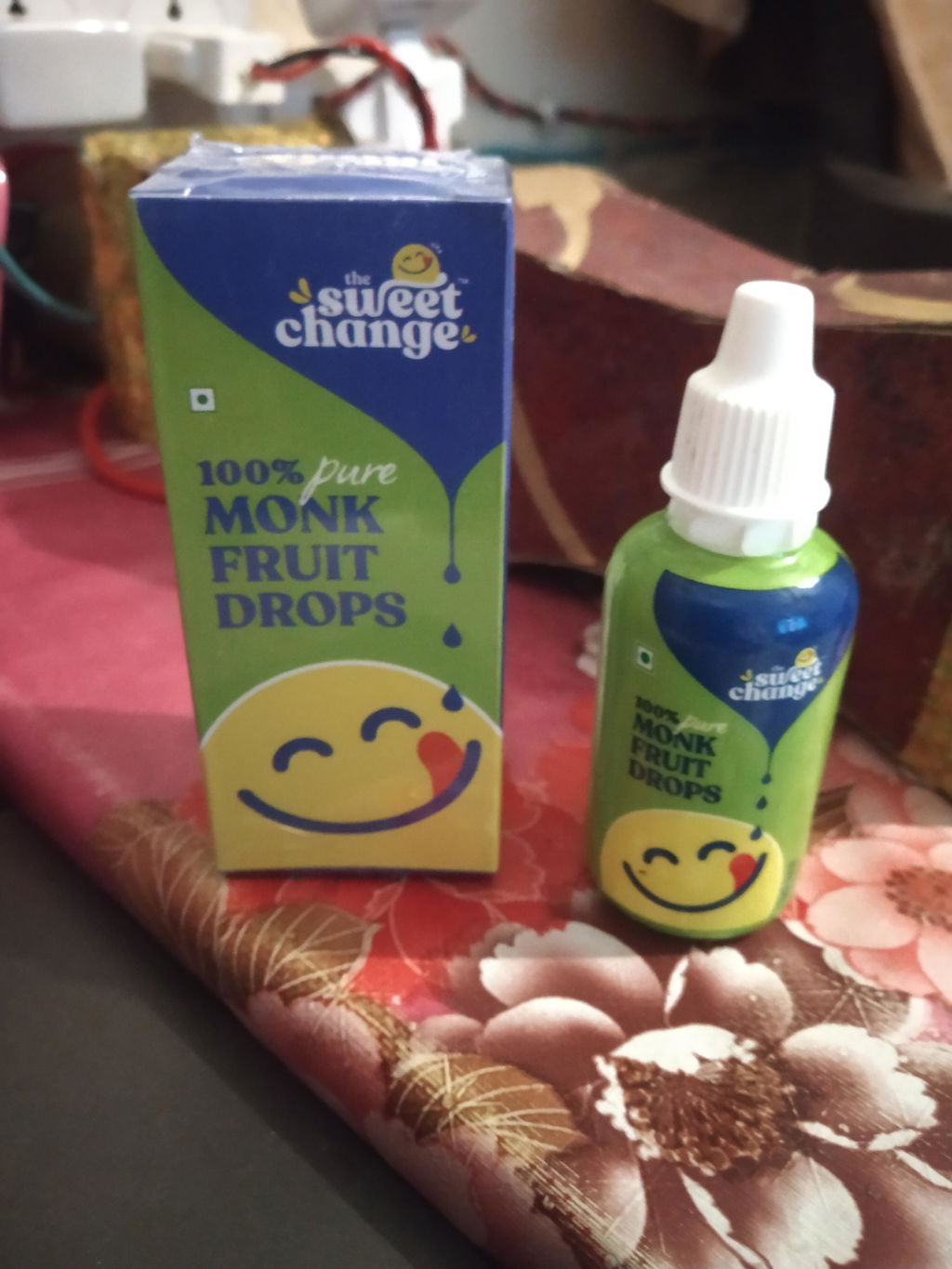
At The Sweet Change: our Monk Fruit Sweetener Powder is made with monk fruit, guar fibre and allulose (30% / 35% / 35%), with no erythritol or other sugar alcohols. Our Monk Fruit Drops are monk fruit extract, water and vitamin C; two drops replace a teaspoon of sugar.
Gur has a shorter label, often one word. The number to read there is the weight you are buying, because most of that weight is sugar, and the spoon count at the end of the month is what adds up.
So, monk fruit or jaggery?
If you came to monk fruit vs jaggery for a winner, you will not find one here, because the two do different work. One is a traditional sugar with flavour and body; the other is a concentrated sweetener that depends on what it is blended with.
Choose gur for the dishes that need it: chikki, ladoo, kheer, the winter sweets that taste of it. Count it as sugar when you do, because that is what it is.
Some people choose monk fruit for the cup when they would rather not add sugar to it; if that is you, read the back of the pack first. Where it sits among the other options is in our guide to the types of sweeteners.
It comes down to a job for the dish and a job for the cup, and most kitchens keep both: one for the ladoo tin, one for the chai.
Cheat sheet
- Gur is sugar: about 84 g of sugars per 100 g, with a spoon's iron in fractions of a milligram.
- The extract is strong, the scoop is mostly bulking ingredient: 100 to 250 times sweeter than sugar, so most of what is in the scoop is the bulking ingredient that makes it measure like sugar; read the first name on the label.
- GI tables leave gur out: sugar 65 and honey 61 are medium; the "84" for jaggery is a one-hour reading from a 1987 study, and over the full curve jaggery came to about 87 and sugar about 84.
- Cook by job: gur for colour, flavour and bulk; monk fruit for sweetness alone, in chai, coffee and cold drinks.
Monk fruit vs jaggery at a glance
Here is monk fruit vs jaggery in one table, with white sugar as the baseline both are measured against.
| Monk fruit (extract) | Jaggery (gur) | White sugar | |
|---|---|---|---|
| What it is | Fruit extract plus a bulking ingredient | Cane juice boiled down and set | Refined sucrose |
| Sweetness against sugar | Extract 100 to 250 times | Not rated in our sources | 1 |
| Sugars per 100 g | Depends on the bulking ingredient | About 84 g | About 100 g |
| kcal per level teaspoon | Depends on the pack | About 14 | About 15.5 |
| GI in the international tables | Not given | Not listed | 65 (medium) |
| Browns and caramelises | No | Yes | Yes |
| Best for | Chai, coffee, cold drinks | Chikki, ladoo, kheer | Baking that needs structure |
Questions people ask
Is monk fruit better than jaggery?
Neither is better for everyone; the jaggery vs monk fruit question is about the job. Jaggery is sugar with colour, flavour and bulk, so it suits traditional sweets and counts towards the free-sugar limit the WHO sets. Monk fruit extract adds sweetness without sugar, but what fills a powder's spoon is the pack's bulking ingredient.
Does monk fruit sweetener have sugar like jaggery?
The extract itself has almost none, which is why a few drops do a spoon's work; the US FDA describes sweeteners of this kind as adding few or no calories. A powder may still carry sugar from a bulking ingredient such as dextrose, so check its label. Jaggery, in the Indian Food Composition Tables, is about four-fifths sugar by weight.
Can I use monk fruit instead of jaggery in sweets?
For sweetness, yes; for colour, flavour and body, no, because those come from the sugar mass in gur. A 2018 Indian baking study found that even replacing sugar with jaggery changed muffin texture, so a sweetener swap needs a recipe written for it. Chai and coffee take the change more easily than a chikki or a ladoo does.
What is the glycemic index of jaggery?
The international GI tables compiled by the University of Sydney group give no value for jaggery. The 84 quoted online is a one-hour reading from a small 1987 Madras study in people with type 2 diabetes, where sugar read 69 by the same method and all three sugars were alike at two hours. Treat gur as you would sugar.
Is it safe to use monk fruit?
The US FDA has not questioned the safety notices filed for monk fruit extract, while EFSA said in 2019 that the data were not enough to conclude. A blend's bulking ingredient is a separate question, answered on its label. For the full picture, read our page Is monk fruit safe?, which sets out both positions and the studies behind them.
How many times sweeter than sugar is monk fruit?
The US FDA puts monk fruit extract at 100 to 250 times sweeter than table sugar, depending on how much mogroside it holds. That is why a serving is a few drops or a pinch, never a spoon, and why any powder that measures like sugar must be mostly a bulking ingredient rather than fruit.
 Monk Fruit Drops (100 servings)
Rs. 497.00
Monk Fruit Drops (200 servings)
Rs. 971.00
Monk Fruit Drops (100 servings)
Rs. 497.00
Monk Fruit Drops (200 servings)
Rs. 971.00
 Monk Fruit Powder No Erythritol (100 servings)
Rs. 675.00
Monk Fruit Powder No Erythritol (300 servings)
Rs. 1,493.00
Monk Fruit Powder No Erythritol (100 servings)
Rs. 675.00
Monk Fruit Powder No Erythritol (300 servings)
Rs. 1,493.00
Related articles


Written by
Manvi Agnihotri · CEO and Co-Founder
12 years in clinical nutrition, over 11,000 patients · M.Sc Food and Nutrition, silver medallist
Manvi Agnihotri is CEO and Co-Founder of The Sweet Change. She holds an M.Sc in Food and Nutrition, in which she was a silver medallist, and has led brand strategy and patient and doctor education at Breathe Well-being, a diabetes care programme. She reviews our health and nutrition pages before they go live.
Reviews: Nutrition and food science, Blood sugar and diabetes diet
Disclosure: Co-founder of The Sweet Change
Sources
- Longvah T, Ananthan R, Bhaskarachary K, Venkaiah K. 2017. Indian Food Composition Tables 2017, food I001 "Jaggery, cane". National Institute of Nutrition (ICMR), Hyderabad. https://www.nin.res.in/ebooks/IFCT2017.pdf
- US Food and Drug Administration. 2025. Aspartame and Other Sweeteners in Food. FDA, content current as of 27 February 2025. https://www.fda.gov/food/food-additives-petitions/aspartame-and-other-sweeteners-food
- Atkinson FS, Foster-Powell K, Brand-Miller JC. 2008. International Tables of Glycemic Index and Glycemic Load Values: 2008. Diabetes Care 31(12):2281-2283. https://doi.org/10.2337/dc08-1239
- World Health Organization. 2026. Healthy diet, fact sheet, 26 January 2026. WHO, Geneva. https://www.who.int/news-room/fact-sheets/detail/healthy-diet
- EFSA Panel on Food Additives and Flavourings (FAF). 2019. Safety of use of Monk fruit extract as a food additive in different food categories. EFSA Journal 17(12):e05921. https://doi.org/10.2903/j.efsa.2019.5921
- Lamdande AG, Khabeer ST, Kulathooran R, Dasappa I. 2018. Effect of replacement of sugar with jaggery on pasting properties of wheat flour, physico-sensory and storage characteristics of muffins. Journal of Food Science and Technology 55(8):3144-3153. https://doi.org/10.1007/s13197-018-3242-7
- US Department of Agriculture, Agricultural Research Service. 2019. FoodData Central, SR Legacy 169655 "Sugars, granulated". USDA. https://fdc.nal.usda.gov/fdc-app.html#/food-details/169655/nutrients
- University of Sydney Glycemic Index Research Service. About Glycemic Index (standard GI method and bands). University of Sydney, accessed 10 October 2026. https://glycemicindex.com/about-gi/
- Uma P, Hariharan RS, Ramani V, Seshiah V. 1987. Glycaemic indices of different sugars. Research Society for the Study of Diabetes in India (RSSDI), journal issue January to April 1987, pp. 78-82; Department of Diabetology, Madras Medical College. https://rssdi.in/newwebsite/journal/1987_jan-april/proc14.pdf
- World Health Organization. 2023. WHO advises not to use non-sugar sweeteners for weight control in newly released guideline. Departmental update, 15 May 2023. https://www.who.int/news/item/15-05-2023-who-advises-not-to-use-non-sugar-sweeteners-for-weight-control-in-newly-released-guideline
- European Parliament and Council. 2011. Regulation (EU) No 1169/2011 on the provision of food information to consumers, Article 18 (list of ingredients in descending order of weight). Official Journal of the European Union L 304. https://eur-lex.europa.eu/eli/reg/2011/1169/oj
- Food Safety and Standards Authority of India. 2021. Food Safety and Standards (Labelling and Display) Regulations, 2020, regulation 5(2)(b) (list of ingredients in descending order of composition by weight or volume). Compendium, Version I, 23 September 2021. FSSAI, New Delhi. https://www.fssai.gov.in/upload/uploadfiles/files/Compendium_Labelling_Display_23_09_2021.pdf
The Sweet Change makes the products mentioned on this page. How we write and review