Are artificial sweeteners safe? What the evidence says
 Written byKapil GroverrChief Business Officer and Co-Founder, The Sweet Change
 Reviewed bySheen HitaishiChief Brand Officer and Co-Founder, The Sweet Change
 Nutrition reviewed byManvi AgnihotriCEO and Co-Founder, The Sweet Change


Our answer to "are artificial sweeteners safe" is yes for most people, within limits: a 60 kg adult would need dozens of sweetened cups of chai a day to reach most of the daily limits [1]. Two real cautions: people with PKU must avoid aspartame, and sugar alcohols can cause loose motions [1] [2]. They are not a health food, and the WHO advises against relying on them for weight control [3].
Key takeaways
- The common sweeteners have a daily limit: in the US, estimated intakes stay under it, even for heavy users [1].
- Aspartame carries a "possible" cancer hazard label: the same day in 2023, JECFA kept its daily limit at 40 mg per kg [4].
- Sugar alcohols can loosen the bowels: in one trial, 50 g of xylitol in a drink brought watery stools; 35 g of erythritol did not [2].
- Read the back of the pack: ingredients run largest first, and some sweeteners carry a boxed warning naming who should avoid them [5].
- Not a weight-loss tool: the WHO advises against using non-sugar sweeteners to control weight [3].
On this page
- Are artificial sweeteners safe? The short version
- What "safe" means: the daily limit in cups of chai
- Sweetener side effects, family by family
- Do sweeteners cause cancer?
- How to read a sweetener label in India
- Sweetener myths: are sweeteners bad for you?
- Is sugar free good for health? Who should be careful
- Which sweeteners are safe to use every day?
- Sources
If you have PKU, are pregnant, are choosing for a child or have a medical condition, ask your doctor which sweetener suits you.
Are artificial sweeteners safe? The short version
Two tablets drop into the office chai at 4 pm. Somewhere on your phone sits a forwarded message saying those tablets cause cancer. Both things happen most days, and the question under them is simple: is this stuff safe to take every day?
In the US, aspartame, acesulfame potassium (ace-K), sucralose, saccharin, neotame and advantame each have an acceptable daily intake, and for every one of them the estimated intake stays under that limit even at high use; the steviol glycosides from stevia have one too, set by JECFA [1].
An acceptable daily intake, or ADI, is the amount considered safe to consume every day over a lifetime; it is worked out from the highest dose that caused no adverse effect in animal studies, with a safety factor applied on top [1].
That gap between the limit and real use is what "within limits" means in our answer.
Allowed is not the same as good for you, though.
The WHO looked at the evidence in 2023 and advised against using non-sugar sweeteners to control weight or cut disease risk; it called the advice conditional, said it does not apply to people who already have diabetes, and covered stevia along with the synthetic sweeteners while leaving sugar alcohols out [3].
So the honest reading of "are artificial sweeteners safe" is yes, within the limits, and the honest reading of "are they a health food" is no. Hold both and the rest of this page falls into place.
What "safe" means: the daily limit in cups of chai
You would have to drink a great deal of sweetened chai to reach a limit. That is the short version; the arithmetic is the useful part.
The US packet counts are worked out for a 60 kg adult, each packet as sweet as two teaspoons of sugar [1].
Now our own arithmetic, and we will say so: a cup of chai made the usual way takes two teaspoons of sugar, so one packet sweetens one cup, and the packet count becomes a cup count as long as that one sweetener is the only one you use all day.
For aspartame that is 75 packets a day before a 60 kg adult reaches the limit; for saccharin 45; for the stevia extract rebaudioside A 27; for ace-K and sucralose 23 each [1]. Nobody drinks 23 cups of chai.
Aspartame has two limits in print, and readers meet both. The US figure is 50 mg per kg of body weight a day [1].
The Joint FAO/WHO Expert Committee on Food Additives (JECFA) kept its own figure at 40 mg per kg in 2023 and gave an example: a 70 kg adult would need more than 9 to 14 cans of diet soft drink a day to pass it, depending on the can [4].
Two honest caveats. The limits are per sweetener, so a diet cola, a sugar-free gum and the chai tablets all count towards the same aspartame total. And a child weighs far less than 60 kg, so a child's cup count is smaller in the same proportion, because every limit is set per kilogram of body weight.
| Sweetener | Daily limit (mg per kg of body weight) | Cups of chai a day, 60 kg adult |
|---|---|---|
| Aspartame | 50 | 75 |
| Saccharin | 15 | 45 |
| Rebaudioside A (stevia) | 12 (4 counted as steviol) | 27 |
| Acesulfame potassium (ace-K) | 15 | 23 |
| Sucralose | 5 | 23 |
Safe sweeteners, in numbers: daily limits for a 60 kg adult, turned into cups of chai sweetened with one packet each [1].

Sweetener side effects, family by family
Most of the sweetener side effects people notice come from sugar alcohols, or from whatever else is in the pack. In the US the high-intensity sweeteners are considered safe for their intended uses, with the note that some people can react to almost any food substance [6].
People type "artificial sweeteners side effects" and "sugarfree side effects" into the same search box, and the answer depends on which family is in your tablet. Four families, four different downsides.
Artificial sweeteners: aspartame, sucralose, saccharin, ace-K
These are the tablets and most diet drinks. The six approved as additives in the US are 200 to 20,000 times sweeter than sugar, so a tablet carries a trace [6]. The everyday downside is taste: in hot chai some of them finish sharp, and the one that suits you is partly a tasting exercise.
The one firm rule in this family: people with phenylketonuria (PKU), a rare inherited condition in which the body struggles to process the amino acid phenylalanine, should avoid or restrict aspartame [1]. In India the pack has to say so, which is one job of the warning box we come to below [5].
The open questions, cancer among them, get their own section further down. For what each of these sweeteners is and where it turns up, our sweetener ingredient library has an entry for each.
Sugar alcohols: erythritol, sorbitol, xylitol, maltitol
If a "monk fruit" or "stevia" powder measures spoon for spoon like sugar, something has to fill that spoon, because a pinch of extract cannot. Very often that something is erythritol, a sugar alcohol (labels may say polyols).

Loose motions and wind are the side effects this family is known for. In a 2007 trial of 64 healthy adults, a drink carrying 50 g of xylitol brought on bloating, rumbling, cramps and watery stools; 50 g of erythritol caused only nausea and rumbling, and 20 or 35 g caused no rise in symptoms [2].
The amount matters more than the name. JECFA found no laxative effect from a single dose of erythritol in a drink up to roughly 0.5 to 0.7 g per kg of body weight in men and 0.8 g in women, none from 1 g per kg a day spread through foods, and it set no numerical daily limit [7].
For a 60 kg adult that is roughly 30 to 40 g in one sitting for a man and nearer 45 to 48 g for a woman, our own arithmetic again; the trial's 20 and 35 g doses stay at or under those amounts.
Then there is the heart question. In 2023 a study of people already under cardiac evaluation, in three groups of 1,157, 2,149 and 833, found that higher blood erythritol went with a higher risk of heart attack and stroke over the following three years, and it sent many people back to reading labels [8].
The US FDA reviewed that paper and said its observational studies did not establish a causal link between eating erythritol and those events [1].
A small 2024 study followed, with 10 volunteers per group: a drink carrying 30 g of erythritol made platelets respond more strongly to clotting signals, while 30 g of glucose did not [9].
It is a link, not proof, and if a sweetener goes into your cup every single day it is fair to want to know what is in it.
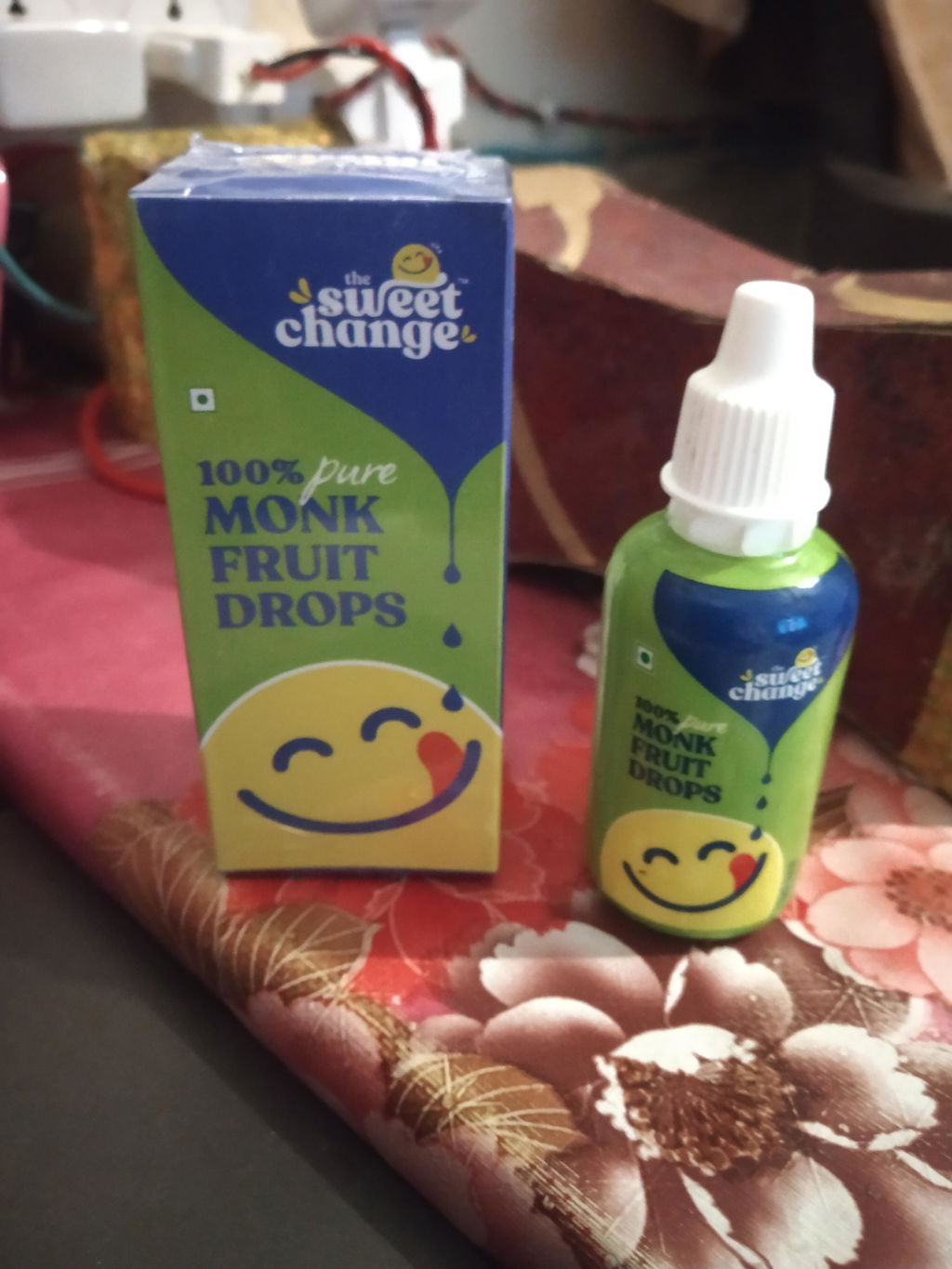
At The Sweet Change: our Monk Fruit Powder is made with monk fruit, guar fibre and allulose (30% / 35% / 35%), with no erythritol, and our Drops contain no erythritol or other sugar alcohols.
We chose that in the light of the 2023 and 2024 studies, which found links, not proof. In our survey of our own buyers, 49% said they chose us for no erythritol.
Plant extracts: stevia and monk fruit
"Natural" is the word on these packs, and the regulators treat them like any other sweetener. The steviol glycosides in stevia have a daily limit of 4 mg per kg of body weight counted as steviol [1].
Stevia's honest downside is taste: some people get a bitter finish, and lab work in 2012 traced that bitterness to two of the tongue's bitter-taste receptors [10]. In our survey of our own buyers, 31% said they chose us for no bitter aftertaste.
Monk fruit takes two sentences here, because it has a page of its own. The US FDA has not questioned the GRAS notices filed for the sweet extract of monk fruit, and no daily limit has been set for it [1].
Our full look at monk fruit safety covers the rest.
Rare sugars: allulose
Allulose is a sugar by chemistry, but the body handles it differently from table sugar; in the US it sits on the list of such sugars that are generally recognised as safe, alongside tagatose and isomaltulose [6]. It is one of the ingredients that can fill the spoon in a powder in place of a sugar alcohol.
Do sweeteners cause cancer?
The regulators whose reviews we read have not found that permitted sweeteners at permitted amounts cause cancer [1] [4]; one of them, aspartame, carries a "possible" hazard label, and that label needs translating.
In July 2023 the International Agency for Research on Cancer (IARC) classed aspartame as possibly carcinogenic to humans, Group 2B, on limited evidence for liver cancer, and on the same day JECFA left the daily limit from the chai section where it was [4].
The US FDA disagreed with IARC's conclusion and said it had found significant shortcomings in the studies IARC relied on [1].
Hazard and risk are two different questions, and the kitchen version is this: hazard asks whether something can cause harm at all, while risk asks how likely harm is at the amounts people actually eat, and a hazard label is the first step towards that second question, not the answer to it [4].

The daily limit is the answer to the second question.
One large study people often quote is French: 102,865 adults followed for a median of 7.8 years, among whom higher consumers of artificial sweeteners had a 13% higher overall cancer risk, with aspartame and ace-K carrying most of it. It was observational, and its authors listed selection bias, residual confounding and reverse causality as its limits [11].
What it means in your cup: a reason to keep intake modest and to count every source; it does not show that the tablet in your chai causes cancer. In short: a possible hazard, a low risk at normal amounts, and the limit as your guide.
How to read a sweetener label in India
Turn the pack over. The back of every sweetener pack sold in India carries the facts you need, if you know where to look.
- Front versus back: the front may say monk fruit or stevia, but the back carries the ingredient list in descending order of weight, so the first name is the one you are mostly buying [5].
- The warning box: table-top sweetener packs in India carry a boxed warning that names the sweetener and, for aspartame, acesulfame potassium and saccharin, who it is not recommended for; packs with polyols carry a laxative-effect line [5].
- Count every source: diet drinks, sugar-free gum, sugar-free sweets and the chai tablets add to the same per-sweetener total, so the cup count above is for all of them together.

In our survey of our own buyers, 9% said they had used sugar-free tablets or sachets before. A good habit for anyone switching: photograph the back of the pack once, so the name of your sweetener is on your phone the next time a forward lands.
Sweetener myths: are sweeteners bad for you?
Four lines you will hear at the dining table, and what the evidence says to each.
- "Natural means safe." The WHO advice in the first section covers stevia as much as it covers sucralose; natural describes where a sweetener comes from, not how safe it is.
- "Gur and honey are the safe sweeteners." They are sugars. On the GI (glycemic index) scale, honey scores 61 and table sugar 65, both medium, while glucose scores 103, high [12]. Two teaspoons of gur in chai is still two teaspoons of sugar; how monk fruit and jaggery compare goes deeper.
- "Sweeteners help you lose weight." The WHO line from the first section is the answer: it advised against using them for weight control. What a sweetener can do is smaller, and still worth having: it keeps your chai sweet while the sugar spoon stays in the dabba.
- "Sugar free means no sugar and no calories." In India "Sugar Free" is also a tablet brand, so the words can mean a brand, a claim on a pack or the sweetener inside, and those are three different things. Read the back, as the label section shows, and you will know which one you are holding.

Is sugar free good for health? Who should be careful
For most adults, swapping sugar for a permitted sweetener and staying inside its limit is a safe way to cut added sugar. It is not a health food, nobody needs one, and some readers should choose with more care.
- People with PKU: aspartame is the one to avoid, as above; the other families are open to you.
- Children, and women who are pregnant or breastfeeding: the Indian warning box names these groups for some sweeteners, so read it before buying and ask your doctor which to use [5].
- Sensitive stomachs: go easy on sugar alcohols; the loose-motions section explains why, and a drops or a powder without them is the simple swap.
- Anyone who reacts to a sweetener: stop it and tell your doctor, the same as with any food that disagrees with you.
- People with diabetes: the WHO advice above leaves you out of its scope.
Which sweeteners are safe to use every day?
Any permitted sweetener, used inside its limit. People search for the best sweetener safe enough for daily use, and the honest answer is the one whose name you know and whose cup count you will never come near. This section is a how-to, not a ranking.
- Pick one and know its name: the family tells you which downside to watch for.
- Stay well inside the cup count: the chai table gives it, and most people use a small fraction of it.
- Avoid aspartame if you have PKU: the one firm rule on this page.
- Go easy on sugar alcohols if your stomach complains: read the back for erythritol, sorbitol, xylitol or maltitol.
- Prefer fewer sweet things to more sweeteners: the WHO's advice points the same way, and that is the change that lasts.
Safe sweeteners, then, are the permitted ones used inside their limits, and that is the everyday answer to "are artificial sweeteners safe"; the rest is taste and habit.
Cheat sheet
- The common sweeteners have daily limits, and normal use sits far below them: 23 to 75 cups of chai a day for a 60 kg adult.
- Aspartame: a "possible" hazard label from IARC, an unchanged daily limit from JECFA; avoid it with PKU.
- Sugar alcohols (erythritol, sorbitol, xylitol, maltitol): the usual cause of loose motions; for erythritol, the 2023 and 2024 heart studies show a link, not proof.
- Not a weight-loss tool, by the WHO's 2023 advice; fewer sweet things is the bigger win.
- Read the back: ingredients run largest first, and for some sweeteners the warning box names who should avoid them.
Questions people ask
Can sweeteners cause cancer?
No regulator whose review we read has found that permitted sweeteners cause cancer at permitted amounts. In 2023 the WHO's cancer agency, IARC, called aspartame a possible hazard on limited evidence, while the FAO/WHO additives committee kept its daily limit. A French cohort study of about 100,000 adults found a modest link, not proof.
Do sweeteners have side effects?
The side effects people notice usually come from sugar alcohols such as erythritol, which can cause loose motions and wind; in a 2007 trial of 64 adults, 50 g of xylitol in a drink brought bloating and watery stools. People with PKU must avoid aspartame. The US FDA notes that some people can react to almost any food substance.
Which sugar free is good for health?
There is no single healthiest sugar free. Any permitted sweetener is acceptable within its daily limit, so choose one, learn its name, stay well under its cup count, and use fewer sweet things overall, which is the direction the WHO's 2023 guideline points.
Which sweeteners are safe?
The sweeteners the US FDA permits are considered safe at permitted amounts: aspartame, acesulfame potassium, sucralose, saccharin, neotame, advantame, steviol glycosides, the sweet extract of monk fruit and allulose. Who should avoid which: aspartame with PKU, sugar alcohols with a sensitive stomach, and the groups named in the Indian warning box.
Are non caloric sweeteners harmful?
Not at permitted amounts, by the US FDA's assessments, whose daily limits sit far above normal use; for aspartame, the FAO/WHO additives committee agreed in 2023. The WHO advises against relying on them to control weight, and long-term questions remain open, so the sensible position is modest use, one sweetener you know, and fewer sweet things overall.
Is sugar free safe?
"Sugar free" can mean a tablet brand, a claim on a pack or the sweetener inside, so turn the pack over first. The sweeteners the US FDA permits are considered safe within their daily limits, and the sweet extract of monk fruit has no limit set; sugar alcohols can loosen the bowels, and aspartame is out for people with PKU.
Sugar free ke nuksan kya hain?
The downsides people actually meet are loose motions and wind from sugar alcohols, which is why FSSAI's label rules put a laxative-effect line on polyol packs; a PKU warning on aspartame packs; and aspartame's "possible" hazard label from IARC, which did not lower its limit. Other sugarfree side effects are not expected at normal use, by the US FDA's assessment.
Our answer to "are artificial sweeteners safe" has not changed from the top of the page: yes, within limits that normal use never approaches, with aspartame off the table for PKU and sugar alcohols kept modest.
The bigger win is drinking fewer sweet things, whatever sweetens them. For the whole family of options, start with our guide to every type of sweetener.
 Monk Fruit Drops (100 servings)
Rs. 497.00
Monk Fruit Drops (200 servings)
Rs. 971.00
Monk Fruit Drops (100 servings)
Rs. 497.00
Monk Fruit Drops (200 servings)
Rs. 971.00
 Monk Fruit Powder No Erythritol (100 servings)
Rs. 675.00
Monk Fruit Powder No Erythritol (300 servings)
Rs. 1,493.00
Monk Fruit Powder No Erythritol (100 servings)
Rs. 675.00
Monk Fruit Powder No Erythritol (300 servings)
Rs. 1,493.00
Related articles


Written by
Kapil Groverr · Chief Business Officer and Co-Founder
IIM Lucknow alumnus · 18 years in marketing
Kapil Groverr is Co-Founder and Chief Business Officer of The Sweet Change, where he leads growth and marketing. He has 18 years in marketing, most recently as Vice President Marketing at Breathe Well-being and before that Head of Digital Marketing at King Koil. An IIM Lucknow alumnus, he writes our sweetener guides and comparisons.
Writes about: Sweetener guides and comparisons
Disclosure: Co-founder of The Sweet Change

Reviewed by
Sheen Hitaishi · Chief Brand Officer and Co-Founder
4 years in content writing · Sri Venkateswara College, University of Delhi
Sheen Hitaishi is Chief Brand Officer and Co-Founder of The Sweet Change, which she started with her sister, Manvi Agnihotri. She runs our social media, customer retention and customer care. Before The Sweet Change she spent four years as a content writer, most recently Senior Content Writer at Univest. She studied at Sri Venkateswara College, University of Delhi.
Disclosure: Co-founder of The Sweet Change

Nutrition reviewed by
Manvi Agnihotri · CEO and Co-Founder
12 years in clinical nutrition, over 11,000 patients · M.Sc Food and Nutrition, silver medallist
Manvi Agnihotri is CEO and Co-Founder of The Sweet Change. She holds an M.Sc in Food and Nutrition, in which she was a silver medallist, and has led brand strategy and patient and doctor education at Breathe Well-being, a diabetes care programme. She reviews our health and nutrition pages before they go live.
Reviews: Nutrition and food science, Blood sugar and diabetes diet
Disclosure: Co-founder of The Sweet Change
Sources
- US Food and Drug Administration. 2025. Aspartame and Other Sweeteners in Food. FDA, content current as of 27 February 2025. https://www.fda.gov/food/food-additives-petitions/aspartame-and-other-sweeteners-food
- Storey D, Lee A, Bornet F, Brouns F. 2007. Gastrointestinal tolerance of erythritol and xylitol ingested in a liquid. European Journal of Clinical Nutrition 61(3):349-354. https://doi.org/10.1038/sj.ejcn.1602532
- World Health Organization. 2023. WHO advises not to use non-sugar sweeteners for weight control in newly released guideline. Departmental update, 15 May 2023. https://www.who.int/news/item/15-05-2023-who-advises-not-to-use-non-sugar-sweeteners-for-weight-control-in-newly-released-guideline
- World Health Organization. 2023. Aspartame hazard and risk assessment results released. Joint news release, 14 July 2023. https://www.who.int/news/item/14-07-2023-aspartame-hazard-and-risk-assessment-results-released
- Food Safety and Standards Authority of India. 2022. Compendium of Food Safety and Standards (Labelling and Display) Regulations, 2020, Version IV, 23 September 2022, Schedule II. https://www.fssai.gov.in/upload/uploadfiles/files/Compendium_Labelling_Display_23_09_2022.pdf
- US Food and Drug Administration. 2023. How Sweet It Is: All About Sweeteners. FDA Consumer Update, content current as of 9 June 2023. https://www.fda.gov/consumers/consumer-updates/how-sweet-it-all-about-sweeteners
- Joint FAO/WHO Expert Committee on Food Additives (JECFA). 2000. Erythritol. In: Safety evaluation of certain food additives and contaminants, WHO Food Additives Series 44 (fifty-third meeting of JECFA, 1999). World Health Organization, Geneva. https://inchem.org/documents/jecfa/jecmono/v44jec03.htm
- Witkowski M, Nemet I, Alamri H, et al. 2023. The artificial sweetener erythritol and cardiovascular event risk. Nature Medicine 29(3):710-718. https://doi.org/10.1038/s41591-023-02223-9
- Witkowski M, Wilcox J, Province V, et al. 2024. Ingestion of the non-nutritive sweetener erythritol, but not glucose, enhances platelet reactivity and thrombosis potential in healthy volunteers. Arteriosclerosis, Thrombosis, and Vascular Biology 44(9):2136-2141. https://doi.org/10.1161/ATVBAHA.124.321019
- Hellfritsch C, Brockhoff A, Stähler F, Meyerhof W, Hofmann T. 2012. Human psychometric and taste receptor responses to steviol glycosides. Journal of Agricultural and Food Chemistry 60(27):6782-6793. https://doi.org/10.1021/jf301297n
- Debras C, Chazelas E, Srour B, et al. 2022. Artificial sweeteners and cancer risk: results from the NutriNet-Santé population-based cohort study. PLoS Medicine 19(3):e1003950. https://doi.org/10.1371/journal.pmed.1003950
- Atkinson FS, Foster-Powell K, Brand-Miller JC. 2008. International tables of glycemic index and glycemic load values: 2008. Diabetes Care 31(12):2281-2283. https://doi.org/10.2337/dc08-1239
The Sweet Change makes the products mentioned on this page. How we write and review