IBS (irritable bowel syndrome): what it is and what helps at home
 Written byKapil GroverrChief Business Officer and Co-Founder, The Sweet Change
 Reviewed byJatin AgnihotriCOO and Co-Founder, The Sweet Change
 Medically reviewed byManvi AgnihotriCEO and Co-Founder, The Sweet Change


IBS, short for irritable bowel syndrome, is a long-lasting gut condition: repeated belly pain that comes with a change in your bowel habits, loose motions, constipation or both, with no visible damage in the gut [1]. It is linked to how the gut and the brain work together [1]. Indian community studies find it in 0.4% to 4.2% of adults, and changes to food, fibre, sleep and stress may ease it [2] [1].
Key takeaways
- A sensitive gut-brain line, not damage: IBS is a disorder of how the gut and brain work together, not a disease that harms the gut [1].
- Common in India, in men too: community studies found it in 0.4% to 4.2% of adults, a Haryana village study in 4%, and men are affected about as often as women [2] [3].
- FODMAPs can set it off: onion, garlic, beans, wheat, milk and "-ol" sweeteners are on the list of FODMAP foods that can trigger symptoms [1] [2].
- The label tells you: in India, a food with 10% or more polyols must carry the line "Polyols may have laxative effect" [4].
- Warning signs need a doctor: blood in the stool, weight loss you did not try for, symptoms at night or a start after 45 call for a check [2].
Discuss with your doctor or dietitian before changing your diet, especially if you take diabetes medicines.
On this page
- What is IBS? The meaning in plain words
- How common is IBS in India?
- The three types of IBS
- What it feels like day to day
- What sets it off: infections, food and stress
- How doctors diagnose it, and when to see one
- FODMAPs: the foods that set it off, in an Indian kitchen
- Fibre: add it slowly
- Milk, chai and lactose
- Sweeteners: why the "-ol" ones matter
- How to spot sugar alcohols on an Indian label
- Stress, sleep and movement
- Cooking at home for a sensitive gut
- Where to go next
- The short version for your kitchen
- Sources
This guide is general information. If your gut symptoms are new, changing or come with any warning sign below, see a doctor, and talk to a dietitian before you start a strict diet.
What is IBS? The meaning in plain words
You have had the ultrasound, maybe a blood test or two, and every report came back normal. The pain and the trips to the bathroom did not read the report.
Search "IBS meaning" and you get a wall of Latin. The IBS full form is irritable bowel syndrome, and the IBS definition doctors work from is a pattern, not a scan result: repeated pain in the abdomen with a change in bowel habit, diarrhoea, constipation or both, and no visible sign of damage or disease in the digestive tract [1].
Doctors used to file it under functional gastrointestinal disorders and now call it a disorder of gut-brain interaction. The gut becomes more sensitive and the muscles of the bowel contract differently, so a normal amount of gas or stool can hurt, and food can move too fast or too slowly [1].
Older names you may still hear from an elder in the family: spastic colon, nervous colon, mucous colitis [1]. Nothing shows on the scan, so a lot of people are told "it's just stress"; it is a real and common condition, with a name, a way of diagnosing it and a list of things that help.
Not IBD: no damage to the gut
The condition can hurt a great deal, but it does not damage the digestive tract or lead to other diseases [1]. Inflammatory bowel disease is a different problem, and when a doctor suspects it, a colonoscopy is one of the tests that tells the two apart [1].
In short: a pattern of symptoms from a sensitive gut-brain line, with no damage to find.
How common is IBS in India?
If you feel alone with this, you are not. In our survey of our own buyers, 19% said someone at home keeps an eye on digestion [5].
Community studies across India found it in 0.4% to 4.2% of adults; an early house-to-house survey in urban Mumbai put it at 7.2% [2]. A door-to-door study of 4,767 adults in Ballabgarh block, Haryana, found it in 4%, a little more often in women (4.8%) than men (3.2%), and more often with age [3].
Taken together, the 2023 Indian consensus concluded that the condition is about as common in men as in women here, and that in clinics more than two-thirds of patients are men, possibly because men seek care more often [2].
That is a real difference from the US, where about 12% of people have it and women are up to two times more likely to have it than men [1].
This is not a women's condition, and it is not rare.
The three types of IBS
Your doctor will ask what your stools look like on the bad days. The answer puts you into one of three types, by the stool pattern on days when you have at least one abnormal bowel movement [1]:
- IBS-C (constipation): more than a quarter of stools hard or lumpy, fewer than a quarter loose or watery.
- IBS-D (diarrhoea): more than a quarter loose or watery, fewer than a quarter hard or lumpy.
- IBS-M (mixed): more than a quarter hard or lumpy and more than a quarter loose or watery.
Some medicines work only for one type or make another worse, so your doctor may need to know your type; this guide does not cover medicines [1].
In India the neat split often fails. A large share of patients cannot be classified by the Rome stool rules, so doctors here are advised to also ask about straining, urgency, a feeling of not having finished and your own description of your bowel pattern [2].
So keep a plain note for two weeks before the appointment: the date, the stool in your own words, the pain, what you ate.
What it feels like day to day
It is rarely one symptom. Abdominal pain tied to going to the toilet, better or worse afterwards, sits at the centre; around it come bloating, a feeling that you have not finished, sometimes whitish mucus in the stool, and for many women more symptoms around their periods [1].
It is a chronic condition, meaning it lasts a long time, often years, but the symptoms come and go [1]. In India it often arrives with company: indigestion (dyspepsia) and the bowel condition overlap in a large share of patients, so the acidity you keep getting and the bowel trouble may be two faces of one thing [2].
What sets it off: infections, food and stress
The question everyone asks after the diagnosis is "what did I do?" Nothing, in the sense of one cause.
No single cause has been found; a mix is more likely: a gut-brain line that over-reacts, a gut infection in the past, bacterial overgrowth in the small intestine, food intolerances, stressful or difficult early life events, anxiety or depression, and genes that make some people more prone [1].
Two of those matter a lot in India. Gut infections are common here, and the bowel trouble that can follow one (post-infection IBS) is well recognised; and FODMAPs, a family of carbohydrates we come to below, may contribute to symptoms [2].
An urban pattern has also been linked with more of the condition: junk and fatty food, lots of tea, coffee and fizzy drinks, smoking or chewing tobacco, little physical activity and psychological stress [2].
Linked is the word: these are associations, not proof that your evening chai did it, so watch them over two weeks of notes before you change anything. Guessing usually blames the wrong dal.
How doctors diagnose it, and when to see one
There is no single blood test for it, which is why the normal report and the real pain can both be true.
Diagnosis rests on the pattern. A doctor may diagnose it when you have pain in the abdomen with two or more of these: the pain is tied to bowel movements, your bowel movements have changed in how often they come, or your stools have changed in how they look [1].
The usual time rule is symptoms at least once a week over the last 3 months, with a start at least 6 months ago [1]. In India, doctors may prefer the older Rome III version of the Rome criteria over Rome IV because it picks up more patients [2].
Tests are there to rule other things out, not to prove it: blood and stool tests, and sometimes a breath test, an endoscopy or a colonoscopy if the picture points elsewhere [1]. Because gut infections and parasites are common here, a few baseline tests are suggested even when nothing alarming is present [2].
Warning signs that need a doctor soon
These are the signs that call for tests to rule out something else, rather than wait and see [2] [1]:
- symptoms that start after the age of 45
- anaemia (a low haemoglobin on a blood test)
- blood in the stool, or black, tarry stools
- weight loss you did not try for
- symptoms that wake you at night
- fever
- a lump in the abdomen
- a family history of colorectal cancer
None of these means the worst. They mean "get it looked at this week, not this year".
FODMAPs: the foods that set it off, in an Indian kitchen
The tadka goes in, onion and garlic hit the hot oil, and the kitchen smells like home. For many people with a sensitive gut, that smell is also the start of a bad evening.
FODMAPs are a family of carbohydrates that are hard to digest, and foods high in them can set off symptoms in a sensitive gut [1] [2]. Read the US list through an Indian kitchen and it looks like this [1]:
- Onion and garlic: the everyday tadka, and the base of most gravies.
- Beans and lentils: rajma, chana and many dals.
- Cauliflower, cabbage and mushrooms: gobi, patta gobi and the mushroom masala.
- Wheat and rye: atta, maida, bread, biscuits and other wheat products.
- Milk and milk products: milk, soft cheese, yogurt (curd), custard and ice cream.
- Some fruit: apples, mango, watermelon, pears and plums, and their juices.
- Honey, and foods sweetened with high-fructose corn syrup.
- Sweets and gum with "-ol" sweeteners: sorbitol, mannitol, xylitol and maltitol.

Across 13 randomised trials with 944 patients, a low FODMAP diet ranked first for overall symptoms, pain and bloating, but most of those trials ran in hospital clinics and did not test adding foods back [6].
India has a trial of its own. In it, 101 people with IBS-D were put either on a strict low FODMAP diet for 4 weeks, then a step-by-step return of foods, or on traditional diet advice [7]. On the diet, 63% improved against 41% on usual advice at 4 weeks, and 53% against 31% at 16 weeks [7].
The downside sits in the same paper: in the strict 4 weeks, people ate less energy, carbohydrate, fat and fibre, which improved by 16 weeks as foods came back [7]. And the diet helps a proportion of people, not everyone; Indian evidence is still thin, and regional diets differ so much that more studies are needed [2].
So run it as a short test of a few weeks, after which foods come back one at a time to find your own triggers, ideally with a dietitian [1]. Do not run it for months on your own.
Where those foods hide in everyday dishes, from the US list above:
| Everyday dish | FODMAP foods inside it |
|---|---|
| Dal tadka | Lentils, onion, garlic |
| Rajma or chole with rice | Beans, onion, garlic |
| Roti, paratha, bread, biscuits | Wheat (atta, maida) |
| Chai, kheer, mango shake | Milk; mango in the shake |
| Aloo gobi, patta gobi sabzi | Cauliflower, cabbage, onion |
| Sugar-free mithai or gum | "-ol" sweeteners such as sorbitol or maltitol |
Fibre: add it slowly
"Eat more fibre" is the advice everyone with constipation gets, and for this condition it is half right.
Fibre can ease the constipation because it makes stool softer and easier to pass, and soluble fibre (beans, fruit, oats) seems more helpful than insoluble fibre (whole grains, vegetables) [1]. The catch is speed: too much at once makes gas, which itself sets off symptoms, so adding about 2 to 3 g a day lets the gut adjust [1].
For scale, in the US the dietary guidelines put adults at 22 to 34 g a day [1].
The honest tension: beans are a soluble-fibre food and also a FODMAP food, so the same katori of rajma can help a constipated gut and upset a sensitive one. That is exactly where a dietitian earns their fee.
One more food question doctors sometimes raise: some people with the condition feel worse after gluten, the protein in wheat, barley and rye, even without coeliac disease, and a doctor may suggest a trial without it [1].
Milk, chai and lactose
Three cups of chai a day is normal in most Indian homes, and each one carries milk.
Milk sits on that FODMAP list because of lactose, its natural sugar [1] [2]. In India there is a regional twist: lactose malabsorption is more common in southern than in northern Indian populations [2].

What it means for your cup: some people try a fortnight with less milk, or a lactose-free milk, and note what changes. Curd is still a milk product on that list, so do not assume dahi is the safe swap [1].
Chai brewed strong with half the usual milk keeps the 4 pm ritual while you find out whether milk is one of your triggers.
Sweeteners: why the "-ol" ones matter
"Sugar-free" on a mithai box or a gum pack sounds like the safe choice. For a sensitive gut it can be the opposite.
The sweeteners ending in "-ol", sorbitol, mannitol, xylitol and maltitol, are sugar alcohols (polyols), and they sit on the FODMAP list beside onion and milk [1]. In a small randomised trial, a 10 g dose of sorbitol or mannitol raised gut symptoms in 20 people with IBS but not in 21 healthy people, whatever the amount absorbed [8].
India's food regulator has written this onto the pack. Under FSSAI's labelling rules, a food with 10% or more polyols must carry, in a rectangular box, the line "Polyols may have laxative effect"; a food with 10% or more sorbitol carries "May have laxative effect, cause bloating and diarrhea in children; and reduce calcium absorption in post-menopausal women" [4].
Monk fruit (Siraitia grosvenorii, luo han guo) is a different kind of sweetener altogether. Its extract is a high-intensity sweetener, not a sugar alcohol: the sweetness comes from mogrosides, and it is 100 to 250 times sweeter than sugar, so a pinch does the work of a spoon [9].
The US FDA has reviewed seven GRAS notices for monk fruit extract and juice concentrate and raised no questions on any of them [10]. Its limit: we found no trial of monk fruit in people with IBS when we searched, so what you are choosing on is its ingredient profile, not a study in people with the condition.
For the long version, read what the research says on monk fruit safety and what monk fruit is.
Allulose, a rare sugar, has a tolerance study of its own: in healthy young adults, single doses up to 0.4 g per kg of body weight caused no severe gut symptoms, and 0.5 g per kg caused severe diarrhoea [11]. The study we read was not in people with the condition; our allulose guide has the detail.
Our pick, as our view: if you sweeten chai or mithai and want to stay clear of the "-ol" group, pick a monk fruit sweetener made without sugar alcohols, and let the back of the pack decide, not the front.
How to spot sugar alcohols on an Indian label
Turn the pack over. The front is marketing; the back is law.
Ingredients are listed in descending order of weight or volume at the time of manufacture, so the first name is the one there is most of [4]. Then look for three things: names ending in "-itol", such as sorbitol, maltitol, xylitol, mannitol and erythritol, the word "polyol", and the rectangular warning box you read about above [9] [4].
Sugar-free sweets and chewing gum are good places to check: sorbitol turns up in sugar-free gum and in some fruits, and candy and gum are among the products that carry the "-ol" sweeteners [8] [1].
A "monk fruit" or "stevia" powder that measures spoon for spoon like sugar needs something to fill that spoon, because a pinch of extract cannot. That something may be a sugar alcohol, and the ingredient list will name it; our guide to sweetener ingredients walks through every "-itol" by name.
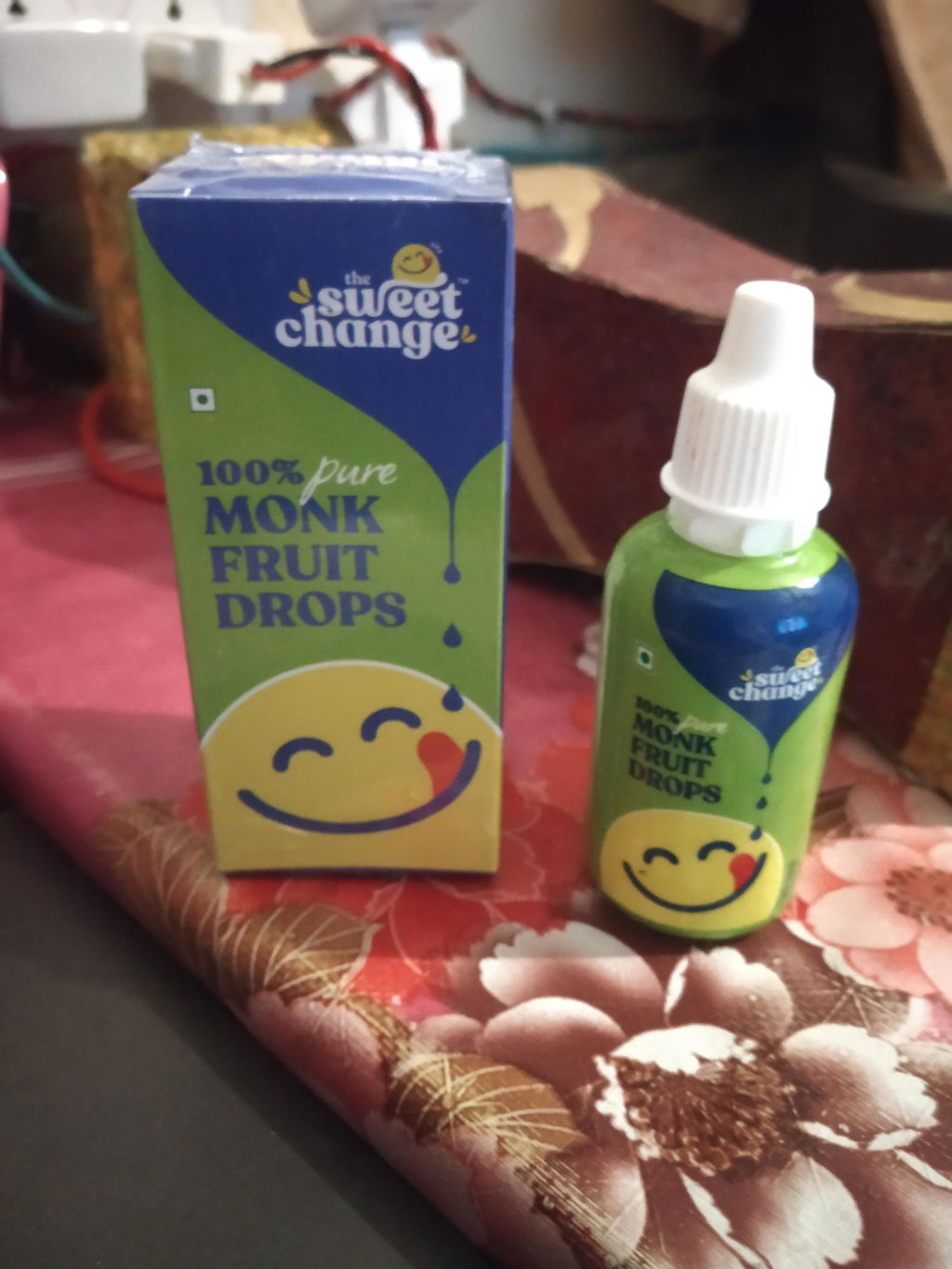
At The Sweet Change: our monk fruit sweetener contains no erythritol or other sugar alcohols, and we sell it as drops and powder, with sachets coming. Monk Fruit Drops have three ingredients: monk fruit extract, water and vitamin C. Monk Fruit Sweetener Powder is made with monk fruit, guar fibre and allulose (30% / 35% / 35%), with no erythritol.
Stress, sleep and movement
The gut-brain line runs both ways, which is why a bad week at work can show up in the bathroom.
More physical activity, less stress where you can manage it, and enough sleep may help the symptoms [1]. In India, counselling and lifestyle change are counted as important parts of care, and several trials found exercise, including yoga, useful [2].
Talking therapies are options too: cognitive behavioural therapy, gut-directed hypnotherapy and relaxation training are all used, and a doctor can point you to them [1]. Probiotics may help, but the studies are still under way, so ask your doctor first [1] [2].
A 20-minute walk after dinner and a fixed bedtime are not extras here. They are part of the plan.
Cooking at home for a sensitive gut
The hardest part is not the science. It is the Sunday rajma, the wedding buffet and the box of mithai that arrives at Diwali.
- Tadka without onion and garlic for a test fortnight: both are on the FODMAP list, and two weeks is long enough to notice a change.
- Smaller portions of rajma, chole and dal, not zero: a half katori is a fairer test than a full ban.
- One change at a time, written down: change the tadka this fortnight and the milk the next; change both and you will never know which one it was.
- Check the sweet dishes: the sugar-free mithai and the gum, for the "-ol" names above.
- Festival food is the honest hard part: take the smaller plate, skip the second helping of the dish you suspect, and do not let one bad day undo the notes.
Dal tastes different without the onion for a week or two. Your gut's answer is worth a fortnight of dull dal.
Where to go next
This page is the hub. Each line below is one of the questions it leads into, in the order most people meet them.
- The constipation type and the Indian stool rules: why so many patients here fall outside the three types.
- What sets it off: infections, FODMAPs, stress and the urban pattern, in detail.
- The tests doctors may order: what each one rules out.
- The low FODMAP eating plan: the test weeks and the adding-back, dish by dish.
- Yoga and the gut: what the Indian trials found.
- Monk fruit, allulose and the artificial sweeteners in a sensitive gut: what has been studied and what has not.
- A diet chart for the gut: a week of meals built on the list above.
For the sweetener side of the question, our guide to sweeteners covers every kind, sugar alcohols included.
Monk fruit sweetener, drops and powder, with sachets coming. Contains no erythritol or other sugar alcohols. See the monk fruit sweetener
The short version for your kitchen
Cheat sheet
- IBS is a pattern, not damage: belly pain with a changed bowel habit and normal tests; common in India, in men as much as women.
- Find your triggers before you ban anything: two weeks of notes on food, sleep and stress, then one change at a time.
- Know the FODMAP list in your own kitchen: onion and garlic tadka, rajma and dal, atta, milk, mango and honey, and "-ol" sweeteners.
- Fibre by the spoon: a few grams more a day, soluble first, never a plateful at once.
- Read the back of the pack: names ending in "-itol" and the box "Polyols may have laxative effect"; and see a doctor for any warning sign.
IBS is a real condition with a long Indian story, and most of what helps starts in your own kitchen and your own notes.
Questions people ask
IBS kya hota hai?
Seedhi baat: IBS, irritable bowel syndrome, is a long-term gut condition where belly pain comes with a change in bowel habit, loose motions, constipation or both, and no damage shows on tests. The US NIDDK calls it a disorder of gut-brain interaction. India's 2023 consensus guideline reports community studies finding it in up to about four in a hundred adults.
What can trigger IBS?
No single cause has been found. The US NIDDK lists a mix: an over-sensitive gut-brain line, a past gut infection, bacterial overgrowth in the small intestine, food intolerances, stressful early life events, anxiety or depression, and genes. India's 2023 consensus guideline adds post-infection IBS, FODMAP foods, and an urban pattern of junk food, tea, coffee, smoking, inactivity and stress.
What fruits can be eaten with IBS?
Start with the list to test, not a list of safe fruits. The US NIDDK names apples, apricots, blackberries, cherries, mango, nectarines, pears, plums and watermelon as FODMAP fruits, along with their juices and large amounts of dried fruit. Which fruits suit you is found by adding them back one at a time, ideally with a dietitian.
What milk is best for IBS?
Milk is on the US NIDDK's FODMAP list because of its sugar, lactose, and India's 2023 IBS consensus notes that lactose malabsorption is more common in southern than northern India. Curd and ice cream sit on the same list. Some people test less milk in their chai, or a lactose-free milk, for a fortnight and note what changes.
What sweetener is OK for IBS?
Sugar alcohols, the "-ol" sweeteners, sit on the FODMAP list, and FSSAI's labelling rules put the box "Polyols may have laxative effect" on foods high in them. Monk fruit extract is not a sugar alcohol, so our pick is a monk fruit sweetener made without sugar alcohols. We found no trial of monk fruit in people with IBS.
What helps with bloating and IBS?
Two steps have good support. A low FODMAP eating plan, tried for a few weeks with a dietitian and then relaxed food by food, ranked first for bloating in a 2022 review of randomised trials; and fibre added slowly, a few grams a day, so the gut does not fill with gas, as the US NIDDK advises.
What is best for IBS?
There is no single best treatment. The US NIDDK lists changes to what you eat, more fibre, a trial without gluten or a low FODMAP eating plan, along with more activity, less stress, enough sleep and talking therapies; India's 2023 consensus adds counselling and exercise such as yoga. Medicines exist for some types, and that part is your doctor's.
 Monk Fruit Drops (100 servings)
Rs. 497.00
Monk Fruit Drops (300 servings)
Rs. 1,197.00
 Monk Fruit Powder No Erythritol (100 servings)
Rs. 675.00
Monk Fruit Powder No Erythritol (300 servings)
Rs. 1,493.00
Related articles


Written by
Kapil Groverr · Chief Business Officer and Co-Founder
IIM Lucknow alumnus · 18 years in marketing
Kapil Groverr is Co-Founder and Chief Business Officer of The Sweet Change, where he leads growth and marketing. He has 18 years in marketing, most recently as Vice President Marketing at Breathe Well-being and before that Head of Digital Marketing at King Koil. An IIM Lucknow alumnus, he writes our sweetener guides and comparisons.
Writes about: Sweetener guides and comparisons
Disclosure: Co-founder of The Sweet Change

Reviewed by
Jatin Agnihotri · COO and Co-Founder
MBA, Indian School of Business · 12 years in technology and security
Jatin Agnihotri is COO and Co-Founder of The Sweet Change, where he runs operations, from manufacturers and vendors to shipping and logistics, and creates content for our Instagram. He spent 12 years in technology at Honda Cars India, Extramarks Education, where he was Vice President IT, and Jio Platforms. He holds an MBA from ISB.
Disclosure: Co-founder of The Sweet Change

Medically reviewed by
Manvi Agnihotri · CEO and Co-Founder
12 years in clinical nutrition, over 11,000 patients · M.Sc Food and Nutrition, silver medallist
Manvi Agnihotri is CEO and Co-Founder of The Sweet Change. She holds an M.Sc in Food and Nutrition, in which she was a silver medallist, and has led brand strategy and patient and doctor education at Breathe Well-being, a diabetes care programme. She reviews our health and nutrition pages before they go live.
Reviews: Nutrition and food science, Blood sugar and diabetes diet
Disclosure: Co-founder of The Sweet Change
Sources
- National Institute of Diabetes and Digestive and Kidney Diseases (NIDDK), US National Institutes of Health (2017). Irritable Bowel Syndrome (IBS): Definition & Facts; Symptoms & Causes; Diagnosis; Treatment; Eating, Diet, & Nutrition. Last reviewed November 2017. https://www.niddk.nih.gov/health-information/digestive-diseases/irritable-bowel-syndrome/definition-facts
- Ghoshal UC, Sachdeva S, Pratap N, et al. (2023). Indian consensus statements on irritable bowel syndrome in adults: a guideline by the Indian Neurogastroenterology and Motility Association and jointly supported by the Indian Society of Gastroenterology. Indian Journal of Gastroenterology, 42(2), 249-273. DOI https://doi.org/10.1007/s12664-022-01333-5 and full text https://pmc.ncbi.nlm.nih.gov/articles/PMC10036984/
- Makharia GK, Verma AK, Amarchand R, et al. (2011). Prevalence of irritable bowel syndrome: a community based study from northern India. Journal of Neurogastroenterology and Motility, 17(1), 82-87. DOI https://doi.org/10.5056/jnm.2011.17.1.82
- Food Safety and Standards Authority of India (2020). Food Safety and Standards (Labelling and Display) Regulations, 2020, compendium Version IV (23 September 2022): regulation 5(2)(b) and Schedule II, 1 Mandatory declarations. FSSAI, New Delhi. https://www.fssai.gov.in/upload/uploadfiles/files/Compendium_Labelling_Display_23_09_2022.pdf
- The Sweet Change (2026). Post-purchase survey of our own buyers. Internal data; percentages are whole-number shares of the buyers who answered each question. https://www.thesweetchange.com/
- Black CJ, Staudacher HM, Ford AC (2022). Efficacy of a low FODMAP diet in irritable bowel syndrome: systematic review and network meta-analysis. Gut, 71(6), 1117-1126. DOI https://doi.org/10.1136/gutjnl-2021-325214
- Goyal O, Batta S, Nohria S, et al. (2021). Low fermentable oligosaccharide, disaccharide, monosaccharide, and polyol diet in patients with diarrhea-predominant irritable bowel syndrome: a prospective, randomized trial. Journal of Gastroenterology and Hepatology, 36(8), 2107-2115. DOI https://doi.org/10.1111/jgh.15410
- Yao CK, Tan HL, van Langenberg DR, et al. (2014). Dietary sorbitol and mannitol: food content and distinct absorption patterns between healthy individuals and patients with irritable bowel syndrome. Journal of Human Nutrition and Dietetics, 27(Suppl 2), 263-275. DOI https://doi.org/10.1111/jhn.12144
- US Food and Drug Administration (2025). Aspartame and Other Sweeteners in Food. FDA, content current as of 27 February 2025. https://www.fda.gov/food/food-additives-petitions/aspartame-and-other-sweeteners-food
- US Food and Drug Administration (2010 to 2018). GRAS Notice Inventory: the seven notices for Siraitia grosvenorii (monk fruit) extract and juice concentrate, each closed with "FDA has no questions". https://www.hfpappexternal.fda.gov/scripts/fdcc/index.cfm?set=GRASNotices&sort=GRN_No&order=DESC&startrow=1&type=basic&search=Siraitia
- Han Y, Choi BR, Kim SY, et al. (2018). Gastrointestinal tolerance of D-allulose in healthy and young adults. Nutrients, 10(12), 2010. DOI https://doi.org/10.3390/nu10122010 and full text https://pmc.ncbi.nlm.nih.gov/articles/PMC6315886/
The Sweet Change makes the products mentioned on this page. How we write and review