Foods for bloating: what may help, what to limit, and Indian kitchen fixes
 Written byKapil GroverrChief Business Officer and Co-Founder, The Sweet Change
 Reviewed bySheen HitaishiChief Brand Officer and Co-Founder, The Sweet Change
 Medically reviewed byManvi AgnihotriCEO and Co-Founder, The Sweet Change


The foods for bloating that work best are the ones your gut digests fully, because the gas behind bloating comes from swallowed air and from gut bacteria breaking down carbohydrates you did not digest [1]. The usual bloating foods are pulses, cauliflower and other cabbage-family vegetables, apples, milk for some people, whole wheat, sweet fizzy drinks and sugar-free sweets with "-ol" sweeteners [2]. Smaller meals, eating slowly and a food diary help you find yours [2].
Key takeaways
- Two sources of gas: the air you swallow, and bacteria fermenting carbohydrates your stomach and small intestine did not fully digest [1].
- Bloated is not always bigger: only about half of people who feel bloated also have a visibly swollen belly [1].
- Dairy is not all or nothing: most people with lactose intolerance can have some lactose without symptoms [3].
- Soak, pour off, cook: in lab tests, soaking and cooking lowered the gas-forming sugars in chickpeas, lentils and beans [4] [5].
- Read the back of sugar-free sweets: names ending in "-ol", such as sorbitol and maltitol, may add gas [2].
Discuss with your doctor or dietitian before changing your diet, especially if you take diabetes medicines.
On this page
- Foods for bloating: the short version
- Why some foods bloat you
- Foods that cause bloating, and their Indian versions
- Food that reduces bloating: what may help, and how sure we are
- Indian kitchen fixes that reduce gas
- Sugar-free sweets and the "-ol" label
- Where The Sweet Change fits
- Bloating diet: a sample Indian day of eating
- When bloating needs a doctor
- The kitchen version
- Sources
This is general information. See a doctor if bloating is new, severe or comes with pain, weight loss, blood in stool or a change in bowel habits.
Foods for bloating: the short version
Sunday lunch was rajma-chawal, a second helping and a glass of chilled cola. By 4 pm the waistband is tight and the sofa looks better than the evening walk.
So which foods for bloating actually help? Fewer than the internet promises, so don't expect one food to switch bloating off. What changes things is which foods ferment in your gut and how much of them lands at one sitting.
If you are reading this for someone at home, you are not alone. In our survey of our own buyers, 19% said someone at home keeps an eye on digestion [6].
This page covers the everyday, after-meal kind of bloating and the food side of it.
Why some foods bloat you
It starts with what your gut cannot finish digesting.
Gas gets into your gut two ways: the air you swallow while you eat and drink, and the gas that bacteria in your large intestine make when they break down carbohydrates your stomach and small intestine did not fully digest [1].
Sugars, starches and fibre can all reach the large intestine like this, and the more of them you eat, the more gas symptoms you may have [1].
Doctors have a name for the hardest-to-digest group. FODMAPs, short for fermentable oligosaccharides, disaccharides, monosaccharides and polyols, are carbohydrates that are hard to digest [7] [8].
Bloating is the feeling of fullness or swelling in your belly; when the belly gets bigger, doctors call it distention [1]. Passing gas is normal too: on average people pass it 8 to 14 times a day, and up to 25 times is still considered normal [1].
So the goal in your kitchen is less gas at one go, not zero gas.
Foods that cause bloating, and their Indian versions
The foods that cause bloating most often carry carbohydrates your gut ferments [2]. The list comes from US health guidance; the desi twin on your plate is our addition.
- Pulses: rajma, chana, lobia, whole moong and the dal in your katori; beans, peas and lentils are a named group [2].
- Cabbage-family vegetables: gobhi, patta gobhi and broccoli belong to the cruciferous group [2].
- Onion and garlic: both sit on the FODMAP list doctors use for IBS, along with mushrooms, mango and watermelon [7].
- Some fruits and juices: apples, pears, peaches and fruit juices [2].
- Milk and milk sweets: milk, ice cream and curd make the dairy line of the list [2].
- Whole wheat: whole grains such as whole wheat are on the list, so atta roti and brown bread count [2].
- Cold drinks and packaged juices: drinks with high-fructose corn syrup, such as soft drinks and fruit juices, so check the label of the bottle you buy [2]. The fizz adds swallowed air on top [1].
- Fried, rich food: high-fat foods such as samosa and pakora can increase bloating [2].
- Sugar-free mithai, gum and candy: these have a section of their own below, because the label tells you a lot.

Read that list as suspects, not a ban. Some people have more gas symptoms with these foods, not everyone, and a doctor may ask you to keep a diary of what you eat and drink and your symptoms to find which ones are yours [2].
In practice, pick your two strongest suspects and write down what you ate and how you felt for a couple of weeks. For gas that feels like more than an after-meal thing, see
| Common trigger | Why it can bloat | Try on a bad day |
|---|---|---|
| Rajma, chana, whole moong | Fermentable carbohydrates | A smaller katori, soaked and pressure-cooked |
| Gobhi, patta gobhi | Cruciferous vegetables ferment | A vegetable not on the list, such as lauki or tori |
| A glass of milk | Lactose, if you are lactose intolerant | Less milk, with a meal, or a katori of curd |
| Cola, packaged juice | Fizz adds air; high-fructose corn syrup | Water, or nimbu paani without the soda |
| Sugar-free mithai, gum | "-ol" sweeteners | Check the label first |
Food that reduces bloating: what may help, and how sure we are
The health guidance we lean on here names foods to limit and habits to change; it does not give a list of anti-bloating foods [2]. So the food that reduces bloating for you is usually a swap: a form your gut handles better, or a smaller amount.
That is how we have sorted the foods for bloating below, each with an honest label.
- Curd in place of a glass of milk (guidance, if lactose is your trigger): curd is lower in lactose than milk, and many people with lactose intolerance manage about 12 g of lactose, the amount in about a cup of milk, with no or mild symptoms [3]. Curd is still dairy, so test it if dairy itself sets you off.
- Milk in small amounts, with meals (guidance for lactose intolerance): you may tolerate milk better if you take a little at a time with a meal and add it back to your diet slowly [3].
- Fibre, added slowly (guidance written for IBS): too much fibre at once can cause gas, and adding it by 2 to 3 g a day may help prevent gas and bloating [7]. In everyday terms, add one fibre food at a time rather than a new salad, a bowl of oats and a fruit plate in the same week.
- Soaked, pressure-cooked dal (lab evidence): soaking and cooking lower the gas-forming sugars in pulses; the numbers are in the kitchen section below.
- Saunf, ajwain, jeera, ginger and hing (tradition): you probably keep one of these for after a heavy meal. We make no claim for them, and a spoon of saunf will not undo a second helping of rajma. If one sits well with you, keep it.
Best food for bloating and gas, if you want one answer
The best food for bloating and gas is a plain, cooked, moderate meal that you eat slowly. That is our view, built from the lists above. Rice, a well-cooked split dal, a cooked vegetable that is not on the trigger list and a small katori of curd fit that brief.
Indian kitchen fixes that reduce gas
Rajma night does not have to go. Some of the most useful foods for bloating are the same pulses, cooked the old way, because a few kitchen habits change what reaches your gut.
- Soak overnight, then pour the water away: in common beans, the species rajma belongs to, soaking and then cooking without the soaking water cut raffinose and stachyose, two of the gas-forming sugars, by about a quarter and verbascose by about two-fifths [5].
- Pressure-cook until soft: soaking alone lowered these sugars by 40% in chickpeas (chana) and by 10% in lentils, and cooking took them lower still [4].
- Serve a smaller katori: less of the same dal means less for gut bacteria to ferment at one go, so the portion matters as much as the recipe.
- Keep the hing in the tadka: it is tradition, and we make no claim for it beyond flavour.
- On a bad day, switch the dal: try a smaller katori of a split dal, such as dhuli moong, instead of whole rajma or chana, and note in your diary how it goes.
Those soaking and cooking figures come from lab measurements of the beans, not from tests of gas in people. They do suggest your nani's overnight soak had a point.
Sugar-free sweets and the "-ol" label
You switched to sugar-free mithai and sugar-free gum to cut sugar, and the stomach rumbles anyway. The label usually explains why.
Candy, gum and other products with sweeteners whose names end in "-ol", such as sorbitol, mannitol, xylitol, erythritol and maltitol, may lead to extra gas [2]. These are sugar alcohols, also called polyols.
Indian labelling rules put a warning on the pack. A food with 10% or more polyols must carry the line "Polyols may have laxative effect" in a rectangular box, and one with 10% or more sorbitol must say "May have laxative effect, cause bloating and diarrhea in children; and reduce calcium absorption in post-menopausal women" [9].
So turn the pack over before it goes in the trolley. Look for names ending in "-itol" and for that box; our guide to sweetener ingredients explains each name you will meet.
If you sweeten chai every day, our pick is a monk fruit sweetener made without sugar alcohols.
Sweetener made from monk fruit is 100 to 250 times sweeter than sugar, depending on how much mogroside it holds [10]. That is why a powder that measures spoon for spoon like sugar needs something to fill the spoon, so check that the filler is not an "-ol", and read what the research says about monk fruit safety before you switch.
Where The Sweet Change fits
At The Sweet Change: our monk fruit sweetener comes as drops and powder, with sachets coming. The Powder is made with monk fruit, guar fibre and allulose (30% / 35% / 35%), with no erythritol. Both contain no erythritol or other sugar alcohols.
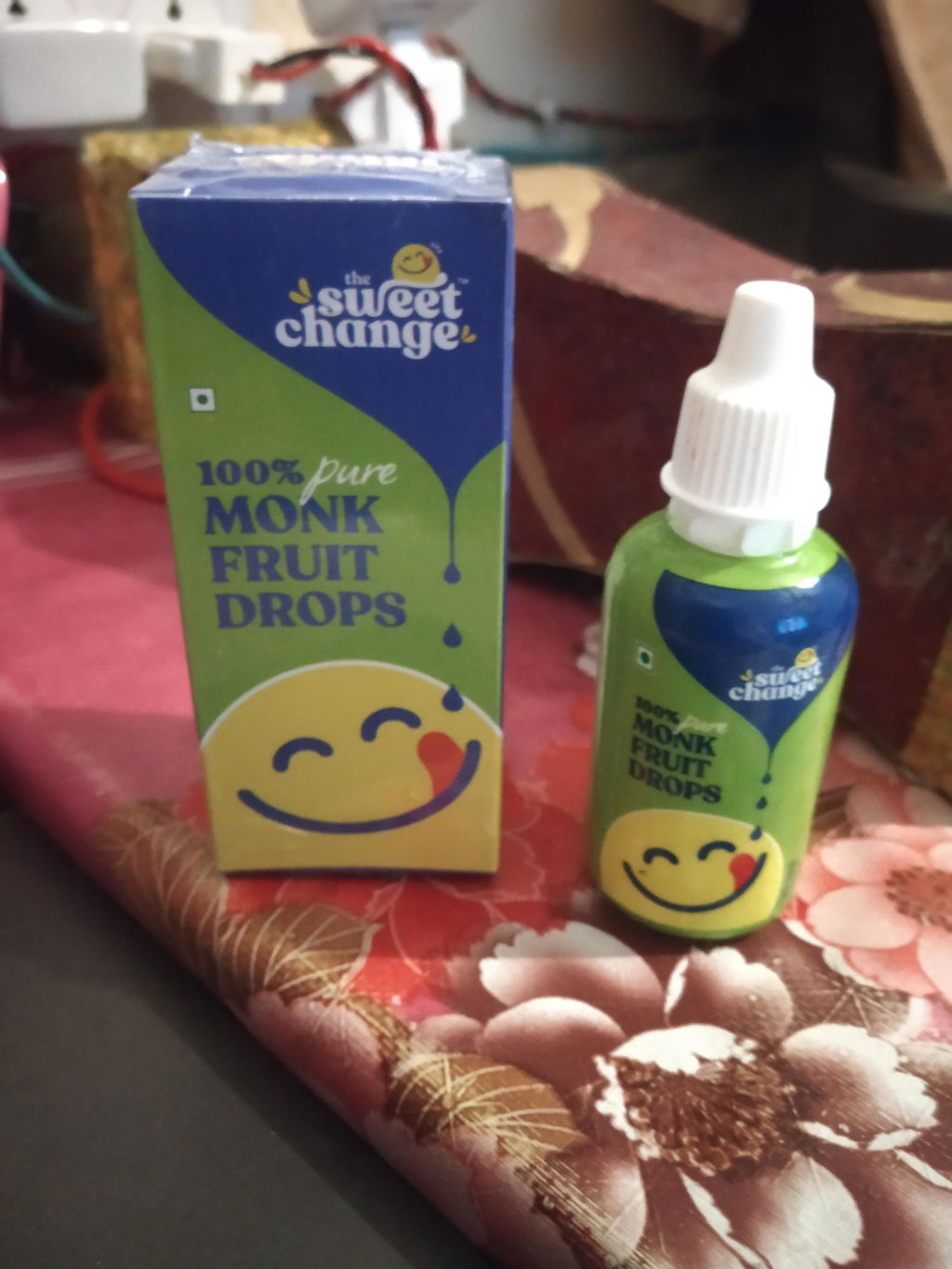
The Drops are monk fruit extract, water and vitamin C, and two drops replace a teaspoon of sugar. Unlike the Powder, the Drops contain no guar fibre.
Bloating diet: a sample Indian day of eating
A bloating diet does not need special foods. It needs smaller plates and slower meals.
The habits first, because they cost nothing. Limit chewing gum, hard candy, fizzy drinks and drinking through a straw; avoid talking while you eat; eat slowly and sitting down; and choose smaller, more frequent meals over two big ones [2].
This example day builds on those habits and the lists above. It is a starting point to adjust with your diary, not a prescription.

- Breakfast: vegetable poha or two idlis with coconut chutney, and your usual chai.
- Mid-morning: a fruit you get on with; apples and pears are on the gas list, so test them on a good day.
- Lunch: rice, a katori of soaked, pressure-cooked dhuli moong dal, cooked lauki sabzi and a small katori of curd.
- Evening: chai with a handful of roasted makhana instead of samosa or pakora.
- Dinner: two rotis, or rice if wheat seems to bother you, with paneer bhurji and a cooked vegetable such as tori or bhindi, eaten at the table rather than on the sofa.
When bloating needs a doctor
Some gas symptoms during or after a meal are normal [1]. Talk to a doctor if your symptoms bother you, change suddenly, or come with belly pain, constipation, diarrhoea or weight loss [1].
Extra gas and bloating can also come from a health condition, such as irritable bowel syndrome (IBS), lactose intolerance, coeliac disease or constipation [1]. If IBS is a possibility, our guide to IBS and what helps at home walks through it.
For IBS, there is trial evidence for cutting FODMAPs. A review of 13 trials with 944 patients found a diet low in FODMAPs ranked first for bloating or distension among the approaches compared, though most trials were in specialist clinics and did not test adding foods back [8].
It is done for a few weeks with a doctor or dietitian, and foods go back in slowly afterwards [7]. That evidence is for IBS; it is not a plan for everyday bloating.
The kitchen version
Foods for bloating are less about a special katori and more about the plate you already eat: smaller portions of pulses, soaked and well cooked, curd in place of a big glass of milk if lactose bothers you, fewer cold drinks, and a look at the back of any sugar-free pack.
There is no single best food for bloating that suits everyone. Keep the diary for a couple of weeks and you end up with your own list, which matters more than any list online.
Cheat sheet
- Two causes: swallowed air and fermented carbohydrates; some gas is normal.
- Usual suspects: pulses, gobhi and cabbage, apples and pears, milk, whole wheat, cold drinks, "-ol" sweeteners.
- Kitchen fixes: soak, pour off the water, pressure-cook, serve a smaller katori.
- Habits: eat slowly, sitting down; smaller meals; skip the straw and the gum.
- Label check: names ending in "-itol" and the "Polyols may have laxative effect" box.
Questions people ask
Can bread make you bloated?
It can for some people. The US government's digestive health institute, NIDDK, lists whole grains such as whole wheat among foods that may lead to extra gas, and its lactose guidance notes that bread and baked goods can contain milk, which matters if you are lactose intolerant. A food diary shows whether bread is your trigger.
Does eating apples help with bloating?
Usually not, if apples are a trigger for you. NIDDK, the US digestive health institute, lists apples, pears, peaches and fruit juices among the foods that may lead to excess gas, because they carry carbohydrates the gut does not fully digest. Not everyone reacts, so try a small apple on a good day and note how you feel.
How to reduce bloating with food?
Start with a food and symptom diary, as NIDDK suggests, to find your own triggers. Then cut the portion of the worst one rather than the whole food, take curd or small amounts of milk with meals if dairy bothers you, and soak and pressure-cook pulses, since lab studies of beans and chickpeas found this lowers their gas-forming sugars.
Does eating make bloating worse?
Some gas and bloating during or after a meal is normal, according to NIDDK. Big meals and eating fast can make it worse, so its advice is smaller, more frequent meals, eating slowly and sitting down, and less chewing gum, fizzy drinks and straws, which add swallowed air. See a doctor if bloating comes with pain or weight loss.
 Monk Fruit Drops (100 servings)
Rs. 497.00
Monk Fruit Drops (300 servings)
Rs. 1,197.00
 Monk Fruit Powder No Erythritol (100 servings)
Rs. 675.00
Monk Fruit Powder No Erythritol (300 servings)
Rs. 1,493.00
Related articles


Written by
Kapil Groverr · Chief Business Officer and Co-Founder
IIM Lucknow alumnus · 18 years in marketing
Kapil Groverr is Co-Founder and Chief Business Officer of The Sweet Change, where he leads growth and marketing. He has 18 years in marketing, most recently as Vice President Marketing at Breathe Well-being and before that Head of Digital Marketing at King Koil. An IIM Lucknow alumnus, he writes our sweetener guides and comparisons.
Writes about: Sweetener guides and comparisons
Disclosure: Co-founder of The Sweet Change

Reviewed by
Sheen Hitaishi · Chief Brand Officer and Co-Founder
4 years in content writing · Sri Venkateswara College, University of Delhi
Sheen Hitaishi is Chief Brand Officer and Co-Founder of The Sweet Change, which she started with her sister, Manvi Agnihotri. She runs our social media, customer retention and customer care. Before The Sweet Change she spent four years as a content writer, most recently Senior Content Writer at Univest. She studied at Sri Venkateswara College, University of Delhi.
Disclosure: Co-founder of The Sweet Change

Medically reviewed by
Manvi Agnihotri · CEO and Co-Founder
12 years in clinical nutrition, over 11,000 patients · M.Sc Food and Nutrition, silver medallist
Manvi Agnihotri is CEO and Co-Founder of The Sweet Change. She holds an M.Sc in Food and Nutrition, in which she was a silver medallist, and has led brand strategy and patient and doctor education at Breathe Well-being, a diabetes care programme. She reviews our health and nutrition pages before they go live.
Reviews: Nutrition and food science, Blood sugar and diabetes diet
Disclosure: Co-founder of The Sweet Change
Sources
- National Institute of Diabetes and Digestive and Kidney Diseases (NIDDK), US National Institutes of Health (2021). Symptoms & Causes of Gas in the Digestive Tract. Last reviewed June 2021. https://www.niddk.nih.gov/health-information/digestive-diseases/gas-digestive-tract/symptoms-causes
- National Institute of Diabetes and Digestive and Kidney Diseases (NIDDK), US National Institutes of Health (2021). Eating, Diet, & Nutrition for Gas in the Digestive Tract. Last reviewed June 2021. https://www.niddk.nih.gov/health-information/digestive-diseases/gas-digestive-tract/eating-diet-nutrition
- National Institute of Diabetes and Digestive and Kidney Diseases (NIDDK), US National Institutes of Health (2018). Eating, Diet, & Nutrition for Lactose Intolerance. Last reviewed February 2018. https://www.niddk.nih.gov/health-information/digestive-diseases/lactose-intolerance/eating-diet-nutrition
- Njoumi S, Amiot MJ, Rochette I, Bellagha S, Mouquet-Rivier C (2019). Soaking and cooking modify the alpha-galacto-oligosaccharide and dietary fibre content in five Mediterranean legumes. International Journal of Food Sciences and Nutrition, 70(5), 551-561. DOI https://doi.org/10.1080/09637486.2018.1544229
- Queiroz KS, de Oliveira AC, Helbig E, Reis SM, Carraro F (2002). Soaking the common bean in a domestic preparation reduced the contents of raffinose-type oligosaccharides but did not interfere with nutritive value. Journal of Nutritional Science and Vitaminology, 48(4), 283-289. DOI https://doi.org/10.3177/jnsv.48.283
- The Sweet Change (2026). Post-purchase survey of our own buyers. Internal data; percentages are whole-number shares of the buyers who answered each question. https://www.thesweetchange.com/
- National Institute of Diabetes and Digestive and Kidney Diseases (NIDDK), US National Institutes of Health (2017). Eating, Diet, & Nutrition for Irritable Bowel Syndrome. Last reviewed November 2017. https://www.niddk.nih.gov/health-information/digestive-diseases/irritable-bowel-syndrome/eating-diet-nutrition
- Black CJ, Staudacher HM, Ford AC (2022). Efficacy of a low FODMAP diet in irritable bowel syndrome: systematic review and network meta-analysis. Gut, 71(6), 1117-1126. DOI https://doi.org/10.1136/gutjnl-2021-325214
- Food Safety and Standards Authority of India (2020). Food Safety and Standards (Labelling and Display) Regulations, 2020, compendium Version IV (23 September 2022): Schedule II, 1 Mandatory declarations. FSSAI, New Delhi. https://www.fssai.gov.in/upload/uploadfiles/files/Compendium_Labelling_Display_23_09_2022.pdf
- US Food and Drug Administration (2025). Aspartame and Other Sweeteners in Food. FDA, content current as of 27 February 2025. https://www.fda.gov/food/food-additives-petitions/aspartame-and-other-sweeteners-food
The Sweet Change makes the products mentioned on this page. How we write and review