Cholesterol Meaning: What It Is and What It Does to Your Heart
 Written byJatin AgnihotriCOO and Co-Founder, The Sweet Change
 Reviewed byKapil GroverrChief Business Officer and Co-Founder, The Sweet Change
 Medically reviewed byManvi AgnihotriCEO and Co-Founder, The Sweet Change


In plain words, the cholesterol meaning is a waxy, fat-like substance your body needs, in the right amounts, to build cells and make hormones, vitamin D and bile acids [1] [2]. It travels in your blood in two main forms: LDL, often called bad because too much builds plaque in arteries, and HDL, often called good because it carries cholesterol to the liver [1]. High cholesterol usually causes no symptoms, so most people find out from a blood test [3].
Key takeaways
- Your body needs cholesterol; the trouble starts when too much LDL builds plaque [1].
- It rarely shows symptoms, so a routine blood test is how most people learn about it [3].
- In a national Indian study, 87 in 100 adults tested had at least one blood-fat reading outside its cut-offs, mostly low HDL [4].
- India's heart guideline asks you to strongly limit refined carbs, sugary drinks and processed food [5].
- Tea in moderation, 3 to 5 cups a day, is acceptable in that guideline [5].
Discuss with your doctor or dietitian before changing your diet, especially if you take diabetes medicines.
On this page
- Cholesterol meaning: what is cholesterol?
- Types of cholesterol: LDL, HDL and the rest
- How cholesterol affects your heart
- How common is high cholesterol in India?
- What raises cholesterol?
- Food and habits that help your cholesterol
- Chai se cholesterol badhta hai kya?
- When to get your cholesterol checked
- Cheat sheet
- Sources
This guide explains what cholesterol is; it does not read your report. For your numbers and any treatment, talk to your doctor.
The word turns up on a report, or in a call from home: "Papa's cholesterol is high." Nobody stops to explain what it actually is, and the internet answers with plaque and lipoproteins. In our survey of our own buyers, 35% said someone at home keeps an eye on blood pressure or cholesterol [6].
So this guide starts with the plain meaning and builds up, one step at a time, to your heart and the cup of chai in your hand.
Cholesterol meaning: what is cholesterol?
Cholesterol is a waxy, fat-like substance that your body needs for good health, in the right amounts [1]. That is the whole idea in one line: it is building material your body uses every day, and the trouble is only ever about how much of it is in your blood.
Your cells use cholesterol in their outer walls. Your body also uses it as the starting block for steroid hormones, vitamin D and bile acids [2].
Here's the catch. Cholesterol is a fat, and fat does not mix with water, so it cannot float loose in your blood. It is packed with protein into tiny carriers called lipoproteins, and those carriers move it around your body [2] [1].
So when a report says "cholesterol", it is really telling you about those carriers and what they hold.
Cholesterol in Hindi meaning
In Hindi it is the same word: cholesterol, written कोलेस्ट्रॉल. If you typed "cholesterol hindi meaning" into a search bar, that is the answer, and nothing new to learn.
If you searched "cholesterol kya hai" or "cholesterol yani kya", the meaning is the same one: a fat-like substance your body needs in the right amount.
What matters more than the word is the type, because a report never gives you just one number for it.
Types of cholesterol: LDL, HDL and the rest
Once the basic cholesterol meaning is clear, the report starts to make sense. There are two main types of cholesterol carrier people talk about, LDL and HDL, and a report adds a few more names around them. Each one tells your doctor something different.
LDL, the one called "bad"
LDL stands for low-density lipoprotein. It is often called bad cholesterol because high levels can build up as plaque in the walls of your blood vessels [1].
HDL, the one called "good"
HDL, high-density lipoprotein, is often called good cholesterol. It carries cholesterol from the rest of the body back to the liver, which clears it out [1] [5].
Triglycerides and VLDL
Triglycerides sit on the same report, though they are a different kind of blood fat. Their level tracks the triglyceride-rich carriers in your blood, and VLDL, very low-density lipoprotein, is one of them [5].
Non-HDL, the whole group
Some reports also show a non-HDL figure. It counts every carrier that can help form plaque, VLDL and LDL among them, as one figure [5].
The types side by side
| Name | What it does | Often called |
|---|---|---|
| LDL | Can build plaque in artery walls when high [1] | "Bad" |
| HDL | Carries cholesterol back to the liver [1] | "Good" |
| VLDL | Carries triglycerides [5] | No nickname |
| Non-HDL | Counts all the plaque-forming carriers together [5] | No nickname |
The names are the hard part. Once you know them, a report reads far more easily.
How cholesterol affects your heart
When LDL builds plaque inside your arteries, that plaque can reduce the flow of blood, and over time the build-up can lead to a heart attack, a stroke or other problems [1].
HDL works the other way round. Higher levels of it, the carrier that takes cholesterol back to the liver, may lower your risk of health problems [1].
The part that surprises most families is how quiet this is. High LDL usually causes no symptoms, and most people learn about it only when a routine blood test is done [3].
Cholesterol is one piece of a larger picture. An unhealthy diet, including too much salt, sugar and fat, along with tobacco use and obesity, is among the risks for heart and blood vessel disease, and most of that disease can be prevented by working on those risks [7].
So the useful way to think about it is calm and practical. You cannot feel your cholesterol, so you check it, and what you eat and do every day is the part you can change.
How common is high cholesterol in India?
Very common, by one national measure. In the ICMR-INDIAB study, run by the Indian Council of Medical Research, fasting blood fats were tested in every fifth adult taking part, 23,665 people aged 20 and over from all states and union territories [4].
By the study's cut-offs, 87.3% had at least one blood-fat reading out of range, and low HDL was the most common, at 66.8%. Even among people without diabetes, high blood pressure or obesity, 40% had one. The study also linked these readings with a sedentary lifestyle, obesity, high blood pressure and diabetes [4].
Here is the honest reading. The study used the Lipid Association of India's strict cut-offs and counted any one reading outside them, so this is not "87% of Indians have high cholesterol". It is that most adults tested had at least one blood-fat number worth a conversation with a doctor [4].
The Cardiological Society of India's 2024 guideline adds two points. Regional and multisite studies in India report total cholesterol, LDL and triglycerides rising at population level while they fall in developed countries, and raised triglycerides are an important and distinctive feature of the Indian pattern [5].
For a family, the takeaway is simple. Being slim or free of diabetes does not mean nobody at home needs a check.
What raises cholesterol?
An unhealthy lifestyle is the most common cause of high LDL or low HDL [8]. In plain terms, that covers a few everyday habits.
- Saturated fat: eating a lot of it, as in fatty cuts of red meat and dairy products, raises LDL [8].
- Sitting more than moving: too little physical activity is linked with unhealthy cholesterol levels [8].
- Smoking and alcohol: smoking lowers HDL, and drinking too much alcohol can raise total cholesterol [8].
It is not always about habits. Genes passed down in families can cause familial hypercholesterolaemia, where the body finds it harder to clear LDL, and conditions such as diabetes, hypothyroidism, chronic kidney disease, obesity and PCOS can also push the numbers the wrong way [8].
If someone in your house has diabetes, our guide to eating well with diabetes covers the everyday plate: what to eat with diabetes. If PCOS is part of the picture, start with what PCOD is.
Food and habits that help your cholesterol
The good news sits in your own kitchen. The Cardiological Society of India's guideline gives clear food and movement advice [5], and most of it is ordinary Indian food done a little differently.
- Sugar and refined carbs: strongly limit refined carbohydrates, sugary drinks and processed foods, and replace them with healthy grains and fibre [5].
- Cooking oil: prefer oils high in mono-unsaturated and poly-unsaturated fats, avoid palm oil and trans fats, and keep deep frying in refined oil to a minimum [5].
- A small handful of nuts: one serving a day, about 1 ounce [5].
- The plate: 3 to 5 servings of vegetables and legumes, 2 to 3 of fruit and 2 to 3 of whole grains a day, where one medium multigrain chapati is one serving [5].
- Whole grains and millets: combine cereals, pulses and millets, and choose fibre-rich foods over refined grains [9].
- Moving your body: moderate activity every day, or at least 5 days a week, to reach 150 minutes a week [5].
In kitchen terms, that is a bran-mixed or multigrain atta for the chapati, a katori of dal or chana, a sabzi cooked in a little oil instead of a fried snack, and a piece of fruit in place of the biscuit. Nothing on that list needs a second kitchen.
Eggs are a common worry at home. The same guideline says cholesterol in food, as in eggs, has a neutral link with heart disease and blood lipid levels, while cholesterol in your blood is a major risk factor; it asks people who already have heart disease to restrict egg yolk [5].
Chai se cholesterol badhta hai kya?
Tea on its own is not the problem. The Cardiological Society of India's guideline accepts moderate tea, 3 to 5 cups a day [5]. The sugar in each cup is the part to watch.
That matters in an Indian home, where chai is where the sweet goes. In our survey of our own buyers, 64% said their sweetener goes into chai [6].
What sugar does to blood fats
The evidence here is real but small. One review of trials found that eating more sugar raised triglycerides, total cholesterol and LDL by small amounts [10].
A second review looked at fructose on its own. Fructose made no difference to blood fats when it replaced other carbohydrates, and it raised triglycerides when it was added on top of a normal diet as extra calories [11].
So sugar can nudge blood fats up a little, even when your weight does not change [10]. It is one habit among many, and one of the easiest to count.
Count the spoons
ICMR-NIN advises adults to keep sugar under 5% of the day's energy [9]. The WHO advises keeping free sugars under 10% of energy, about 12 level teaspoons a day for an adult of healthy weight eating about 2,000 calories, and says 5% or less may bring more benefit [12].
Now count your own day. Four cups of chai with two teaspoons each is eight teaspoons before a single biscuit or mithai, and the 5% line is about half of those 12 teaspoons.
If you use a sweetener
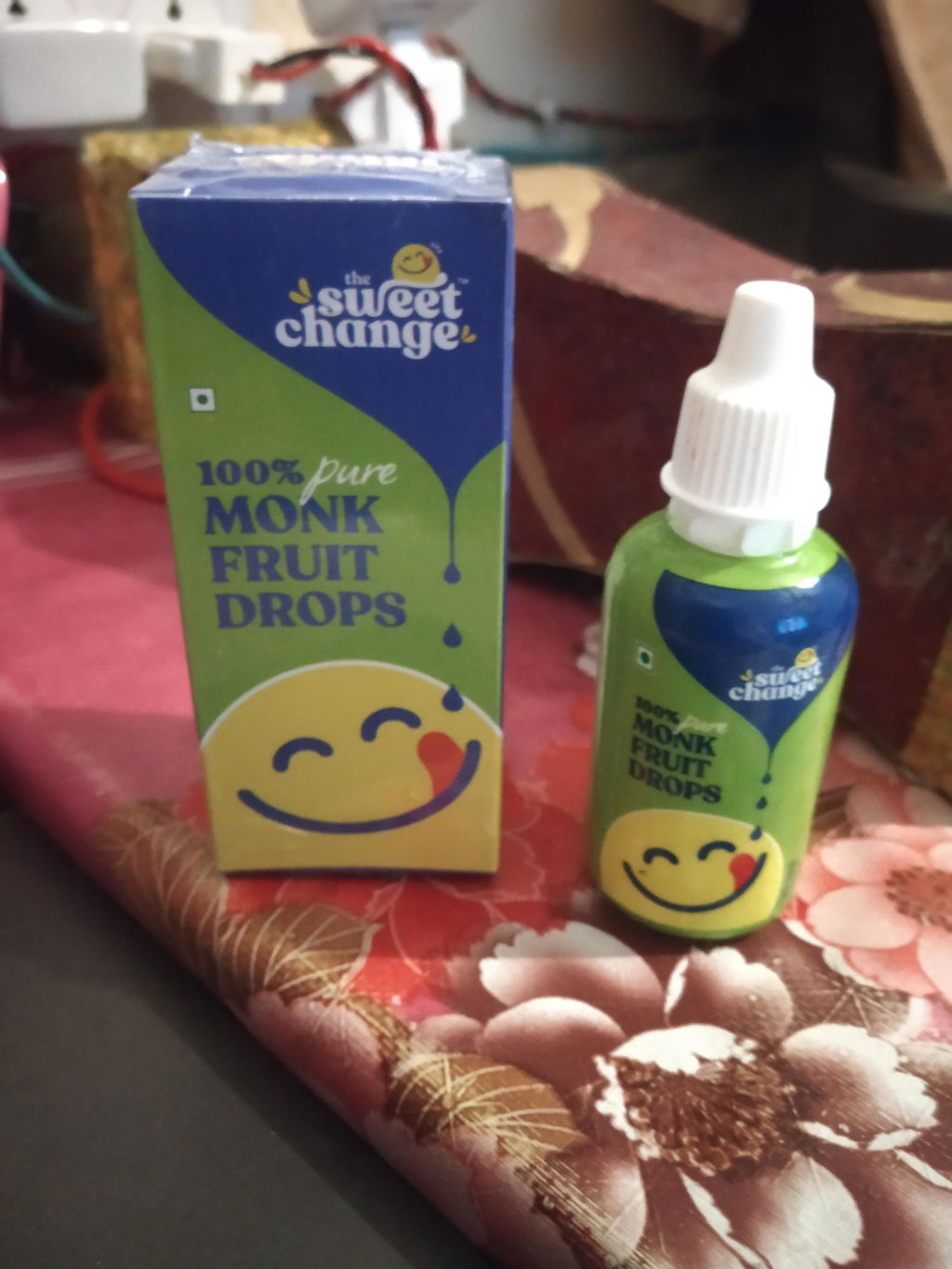
Some people would rather cut the spoon than the sweet taste, and a sweetener is one way to do that. Our pick for chai is a monk fruit sweetener made without sugar alcohols.
Monk fruit extract is reported to be 100 to 250 times sweeter than sugar, depending on its mogroside content, so a very small amount sweetens a cup. The US FDA has not questioned the GRAS notices for monk fruit extract as a general-purpose and tabletop sweetener [13]. Our monk fruit guide explains where it comes from.
Read the back of the pack, though. Erythritol is used as a bulk sweetener alongside high-intensity sweeteners, and higher blood erythritol has been linked with heart attack, stroke or death over three years in people who were already under heart evaluation [14].
That is a link, not proof. The US FDA reviewed that 2023 paper and said its observational studies did not establish a causal link [13]. Even so, if something goes into your chai every day, it is fair to want to know what is in it.
At The Sweet Change: our sweetener comes as drops and powder, with sachets coming. The powder is made with monk fruit, guar fibre and allulose, with no erythritol, and we chose that mix in light of the 2023 study, which found a link, not proof.
For a wider look at safety, see our guide on whether artificial sweeteners are safe.
Start with the cup you drink most often, which for most people is the morning chai.
When to get your cholesterol checked
Cholesterol is measured with a blood test called a lipid profile, or lipid panel, which measures LDL, HDL and triglycerides [15].
Fasting is the question most people have. The Indian guideline recommends non-fasting samples for estimating risk [5]. In the US, your provider may ask you to fast for 8 to 12 hours first [15].
Both are in use, so follow the instruction your lab or doctor gives you.
What the numbers on that report mean is for your doctor to read with you, alongside your age, family history and other health conditions. This guide stays with what cholesterol is and the food and habits around it.
If your doctor has prescribed medicine for cholesterol, that is a decision between the two of you; this guide covers food and habits.
Cheat sheet
The cholesterol meaning, and what to do with it, on one screen:
- It is a needed fat: your body builds cells and hormones with it; the amount in your blood is what matters.
- LDL and HDL: LDL can build plaque; HDL carries cholesterol back to the liver.
- No symptoms: a blood test is how most people find out, so get checked.
- The Indian guideline's plate: less sugar, refined carbs and fried food; more whole grains, vegetables, fruit and a few nuts.
- Chai: keep the cups, count the spoons.
Questions people ask
Cholesterol kya hota hai in hindi?
The cholesterol meaning in Hindi uses the same word, cholesterol. It is a waxy, fat-like substance your body needs to build cells and make hormones and vitamin D. The US National Heart, Lung, and Blood Institute describes it as needed for good health, but in the right amounts, and too much of the LDL kind can build plaque in arteries.
Cholesterol badhne par kya hota hai?
When LDL stays high, it can build plaque in the walls of your arteries, and over years that can lead to a heart attack or stroke, says the US National Heart, Lung, and Blood Institute. High cholesterol usually causes no symptoms, so most people learn about it only from a routine blood test.
Cholesterol ghatane ke liye kya karen?
The Cardiological Society of India's 2024 guideline gives clear food and movement advice. It asks you to strongly limit refined carbohydrates, sugary drinks and processed food, avoid trans fats and palm oil, and eat whole grains, vegetables, fruit and some nuts while staying active most days. Your doctor decides whether you need more.
Cholesterol janch kya hota hai?
Cholesterol is checked with a blood test called a lipid profile, which measures blood fats such as LDL, HDL and triglycerides. The Cardiological Society of India accepts a sample taken without fasting, while the US National Heart, Lung, and Blood Institute notes your provider may ask you to fast first. Follow your lab's instructions.
Chai cholesterol badhta hai kya?
Tea itself is not the worry. The Cardiological Society of India's guideline accepts moderate tea, a few cups a day. The sugar stirred into each cup is what adds up, and the World Health Organization advises keeping free sugars low, so counting your daily cups and spoons is the simplest place to start.
Is the cholesterol in food the same as in blood?
Not quite. The Cardiological Society of India's 2024 guideline says cholesterol in food, such as in eggs, has a neutral link with heart disease and blood lipid levels, while cholesterol in your blood is a major risk factor. It still asks people who already have heart disease to limit egg yolk.
 Monk Fruit Drops (100 servings)
Rs. 497.00
Monk Fruit Drops (300 servings)
Rs. 1,197.00
 Monk Fruit Powder No Erythritol (100 servings)
Rs. 675.00
Monk Fruit Powder No Erythritol (300 servings)
Rs. 1,493.00
Related articles


Written by
Jatin Agnihotri · COO and Co-Founder
MBA, Indian School of Business · 12 years in technology and security
Jatin Agnihotri is COO and Co-Founder of The Sweet Change, where he runs operations, from manufacturers and vendors to shipping and logistics, and creates content for our Instagram. He spent 12 years in technology at Honda Cars India, Extramarks Education, where he was Vice President IT, and Jio Platforms. He holds an MBA from ISB.
Disclosure: Co-founder of The Sweet Change

Reviewed by
Kapil Groverr · Chief Business Officer and Co-Founder
IIM Lucknow alumnus · 18 years in marketing
Kapil Groverr is Co-Founder and Chief Business Officer of The Sweet Change, where he leads growth and marketing. He has 18 years in marketing, most recently as Vice President Marketing at Breathe Well-being and before that Head of Digital Marketing at King Koil. An IIM Lucknow alumnus, he writes our sweetener guides and comparisons.
Writes about: Sweetener guides and comparisons
Disclosure: Co-founder of The Sweet Change

Medically reviewed by
Manvi Agnihotri · CEO and Co-Founder
12 years in clinical nutrition, over 11,000 patients · M.Sc Food and Nutrition, silver medallist
Manvi Agnihotri is CEO and Co-Founder of The Sweet Change. She holds an M.Sc in Food and Nutrition, in which she was a silver medallist, and has led brand strategy and patient and doctor education at Breathe Well-being, a diabetes care programme. She reviews our health and nutrition pages before they go live.
Reviews: Nutrition and food science, Blood sugar and diabetes diet
Disclosure: Co-founder of The Sweet Change
Sources
- US National Heart, Lung, and Blood Institute (2024). What Is Blood Cholesterol? NHLBI, National Institutes of Health, last updated 17 April 2024. https://www.nhlbi.nih.gov/health/blood-cholesterol
- Craig M, Yarrarapu SNS, Dimri M (2023). Biochemistry, Cholesterol. StatPearls. StatPearls Publishing, Treasure Island (FL). NCBI Bookshelf NBK513326, PMID 30020698. https://www.ncbi.nlm.nih.gov/books/NBK513326/
- US National Heart, Lung, and Blood Institute (2024). Blood Cholesterol: Symptoms. NHLBI, National Institutes of Health, last updated 18 April 2024. https://www.nhlbi.nih.gov/health/blood-cholesterol/symptoms
- Deepa M, Pradeepa R, Anjana RM, et al. (2026). Prevalence of dyslipidemia in India: The ICMR-INDIAB National Study (ICMR-INDIAB-25). Journal of Clinical Lipidology. DOI https://doi.org/10.1016/j.jacl.2026.07.011 (PMID 42547322)
- Sawhney JPS, Ramakrishnan S, et al. (2024). CSI clinical practice guidelines for dyslipidemia management: Executive summary. Indian Heart Journal, 76(Suppl 1), S6-S19. Cardiological Society of India. DOI https://doi.org/10.1016/j.ihj.2023.11.271 and full text https://pmc.ncbi.nlm.nih.gov/articles/PMC11019331/
- The Sweet Change (2026). Post-purchase survey of our own buyers. Internal data; percentages are whole-number shares of the buyers who answered each question. https://www.thesweetchange.com/
- World Health Organization (2026). Cardiovascular diseases (CVDs), fact sheet. WHO, Geneva, accessed 10 October 2026. https://www.who.int/news-room/fact-sheets/detail/cardiovascular-diseases-(cvds)
- US National Heart, Lung, and Blood Institute (2024). Blood Cholesterol: Causes and Risk Factors. NHLBI, National Institutes of Health, last updated 19 April 2024. https://www.nhlbi.nih.gov/health/blood-cholesterol/causes
- ICMR-National Institute of Nutrition (2024). Dietary Guidelines for Indians, English booklet. ICMR-NIN, Hyderabad. https://www.nin.res.in/downloads/DGI_Booklet_English_CMYK.pdf
- Te Morenga LA, Howatson AJ, Jones RM, Mann J (2014). Dietary sugars and cardiometabolic risk: systematic review and meta-analyses of randomized controlled trials of the effects on blood pressure and lipids. American Journal of Clinical Nutrition, 100(1), 65-79. DOI https://doi.org/10.3945/ajcn.113.081521
- Chiavaroli L, de Souza RJ, Ha V, et al. (2015). Effect of fructose on established lipid targets: a systematic review and meta-analysis of controlled feeding trials. Journal of the American Heart Association, 4(9), e001700. DOI https://doi.org/10.1161/JAHA.114.001700
- World Health Organization (2026). Healthy diet, fact sheet. WHO, Geneva. https://www.who.int/news-room/fact-sheets/detail/healthy-diet
- US Food and Drug Administration (2025). Aspartame and Other Sweeteners in Food. FDA, content current as of 27 February 2025. https://www.fda.gov/food/food-additives-petitions/aspartame-and-other-sweeteners-food
- Witkowski M, Nemet I, Alamri H, et al. (2023). The artificial sweetener erythritol and cardiovascular event risk. Nature Medicine, 29(3), 710-718. DOI https://doi.org/10.1038/s41591-023-02223-9
- US National Heart, Lung, and Blood Institute (2024). Blood Cholesterol: Diagnosis. NHLBI, National Institutes of Health, last updated 18 April 2024. https://www.nhlbi.nih.gov/health/blood-cholesterol/diagnosis
The Sweet Change makes the products mentioned on this page. How we write and review